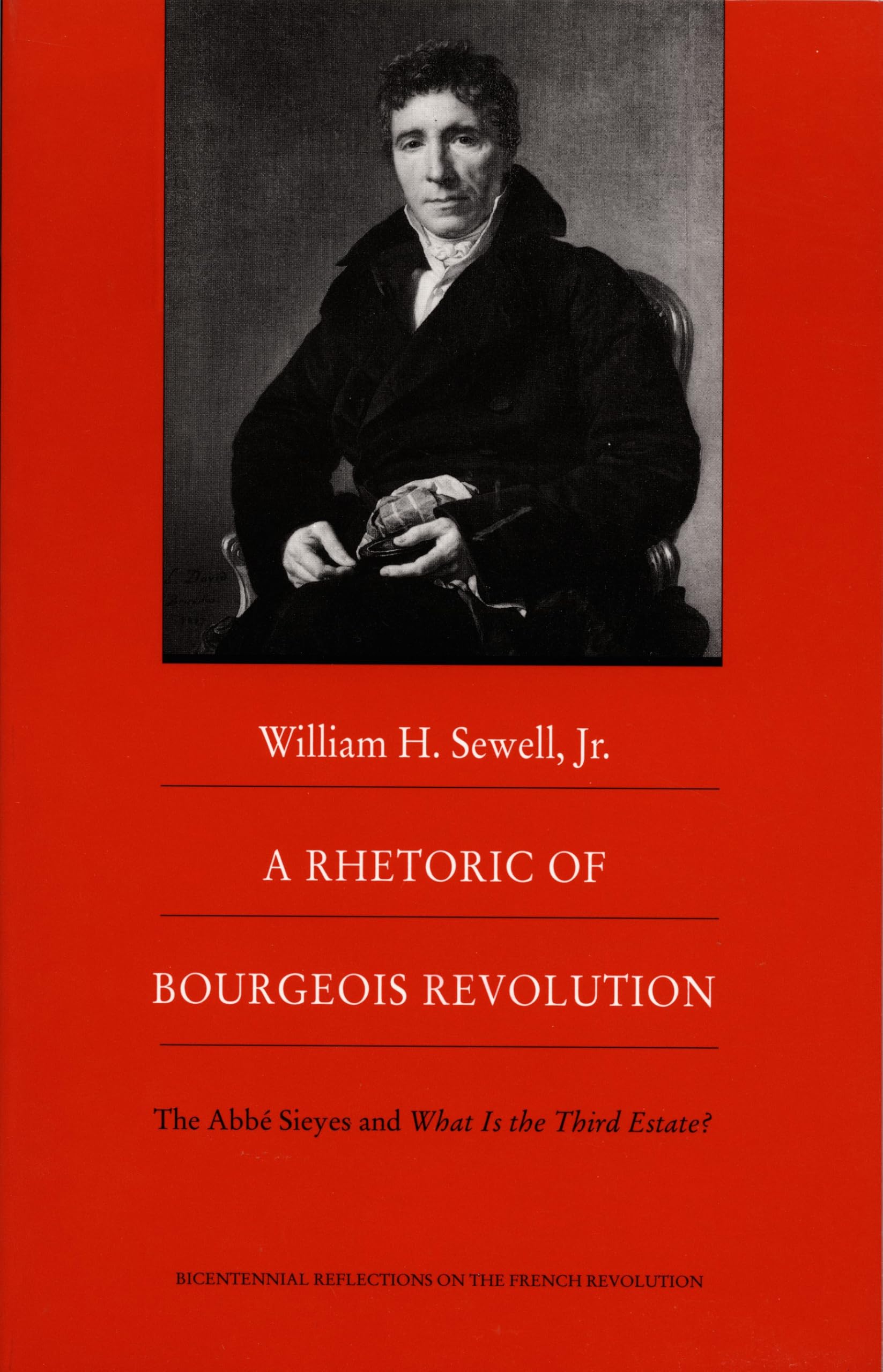
A Rhetoric of Bourgeois Revolution: The Abbe Sieyes and What is the Third Estate? (Bicentennial Reflections on the French Revolution)
$31.95
by William H Sewell Jr



What Is the Third Estate? was the most influential pamphlet of 1789. It did much to set the French Revolution on a radically democratic course. It also launched its author, the Abbé Sieyes, on a remarkable political career that spanned the entire revolutionary decade. Sieyes both opened the revolution by authoring the National Assembly’s declaration of sovereignty in June of 1789 and closed it in 1799 by engineering Napoleon Bonaparte’s coup d’état. This book studies the powerful rhetoric of the great pamphlet and the brilliant but enigmatic thought of its author. William H. Sewell’s insightful analysis reveals the fundamental role played by the new discourse of political economy in Sieyes’s thought and uncovers the strategies by which this gifted rhetorician gained the assent of his intended readers—educated and prosperous bourgeois who felt excluded by the nobility in the hierarchical social order of the old regime. He also probes the contradictions and incoherencies of the pamphlet’s highly polished text to reveal fissures that reach to the core of Sieyes’s thought—and to the core of the revolutionary project itself. Combining techniques of intellectual history and literary analysis with a deep understanding of French social and political history, Sewell not only fashions an illuminating portrait of a crucial political document, but outlines a fresh perspective on the history of revolutionary political culture. "In this remarkable analysis, William Sewell restores to Sieyes’s great text a complexity that has too often been denied it. Drawing on contemporary political theory and political economy as well as historical and biographical material, Sewell masterfully demonstrates that what matters about Sieyes’s text is not only its acknowledged influence on the events of the French Revolution, but also the ways in which contemporaries misunderstood or rejected its deeper, prophetic vision."—Sarah Maza, Northwestern University "In this remarkable analysis, William Sewell restores to Sieyes's great text a complexity that has too often been denied it. Drawing on contemporary political theory and political economy as well as historical and biographical material, Sewell masterfully demonstrates that what matters about Sieyes's text is not only its acknowledged influence on the events of the French Revolution, but also the ways in which contemporaries misunderstood or rejected its deeper, prophetic vision."--Sarah Maza, Northwestern University William H. Sewell, Jr. is Professor of Political Science and History at the University of Chicago. He is also the author of Work and Revolution in France: The Language of Labor from the Old Regime to 1848 , winner of the Herbert Baxter Adams Prize, and Structure and Mobility: The Men and Women of Marseille, 1820–1870 . A Rhetoric of Bourgeois Revolution The Abbé Sieyes and What Is the Third Estate? By William H. Sewell Jr. Duke University Press Copyright © 1994 Duke University Press All rights reserved. ISBN: 978-0-8223-1538-4 Contents Editors' Introduction, Preface, 1 Introduction, 2 What is the Third Estate?, 3 Political Economy, Social Contract, and Representation: The Foundations of Sieyes's Political Thought, 4 What is Privilege? A Rhetoric of Amnesia, 5 What is the Citizen? The Denial of Political Equality, 6 An Uncontrollable Revolution, Epilogue: The Paradoxical History of Sieyes's Rhetorical Devices, Bibliography, Index, CHAPTER 1 INTRODUCTION * * * What is the third estate? Is an extraordinary text. It was, by all accounts, the most influential pamphlet of the thousands published in the months leading up to the French Revolution. Appearing in January 1789, What Is the Third Estate? was longer than most at 127 pages, and it contained some difficult philosophical arguments as well. But its scintillating style, its exceptionally clear posing of the issues, and its radical conclusions won it immediate acclaim. It probably did more than any other work to chart out the radically democratic path that the revolution was to follow in its first year. Its blistering antiaristocratic rhetoric did much to turn the commoners—known in France as the Third Estate—against the nobility. Moreover, it set forth a radical theory of national sovereignty and elaborated a revolutionary political strategy that was followed by the National Assembly when it seized sovereignty from the king in the summer of 1789. The author of What Is the Third Estate? was an obscure ecclesiastic named Emmanuel-Joseph Sieyes, a canon of the cathedral of Chartres. The pamphlet launched him on a remarkable political career; it is commonly said that he not only opened the French Revolution by publishing What Is the Third Estate? and authoring the National Assembly's declaration of sovereignty in June 1789 but closed it by helping to engineer Napoleon Bonaparte's coup d'etat a decade later in 1799. The pamphlet's combination of philosophical depth, rhetorical