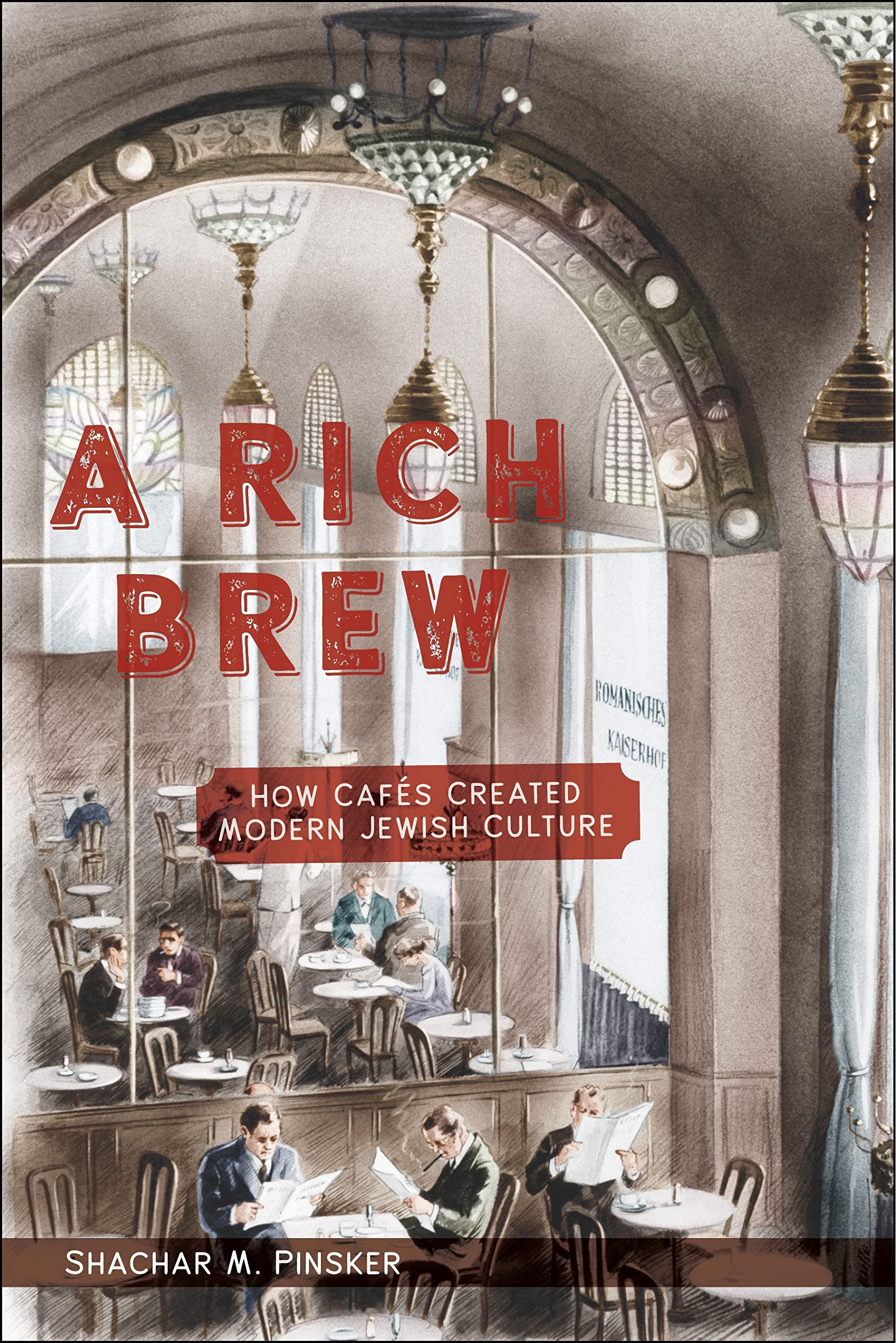



Finalist, 2018 National Jewish Book Award for Modern Jewish Thought and Experience, presented by the Jewish Book Council Winner, 2019 Jordan Schnitzer Book Award, in the Jewish Literature and Linguistics Category, given by the Association for Jewish Studies A fascinating glimpse into the world of the coffeehouse and its role in shaping modern Jewish culture Unlike the synagogue, the house of study, the community center, or the Jewish deli, the café is rarely considered a Jewish space. Yet, coffeehouses profoundly influenced the creation of modern Jewish culture from the mid-nineteenth to mid-twentieth centuries. With roots stemming from the Ottoman Empire, the coffeehouse and its drinks gained increasing popularity in Europe. The “otherness,” and the mix of the national and transnational characteristics of the coffeehouse perhaps explains why many of these cafés were owned by Jews, why Jews became their most devoted habitués, and how cafés acquired associations with Jewishness. Examining the convergence of cafés, their urban milieu, and Jewish creativity, Shachar M. Pinsker argues that cafés anchored a silk road of modern Jewish culture. He uncovers a network of interconnected cafés that were central to the modern Jewish experience in a time of migration and urbanization, from Odessa, Warsaw, Vienna, and Berlin to New York City and Tel Aviv. A Rich Brew explores the Jewish culture created in these social spaces, drawing on a vivid collection of newspaper articles, memoirs, archival documents, photographs, caricatures, and artwork, as well as stories, novels, and poems in many languages set in cafés. Pinsker shows how Jewish modernity was born in the café, nourished, and sent out into the world by way of print, politics, literature, art, and theater. What was experienced and created in the space of the coffeehouse touched thousands who read, saw, and imbibed a modern culture that redefined what it meant to be a Jew in the world. "[H]ugely entertaining and intimidatingly well researched, with scarcely a café in which a Jewish writer raised a cup of coffee from Warsaw to New York left undocumented." -- Adam Gopnik ― The New Yorker "Shachar Pinsker masterfully documents the impact of café life on Jewish culture throughout the civilized world. . . . A Rich Brew is aptly named. Engagingly illustrated with many contemporary photos and cartoons, it offers a deep dive into the café world of six cities that gave birth to modern Jewish thought and culture." ― Moment Magazine "A Rich Brew evokes the sense of lingering in a timeless café, savoring the flavor and scent of good coffee and the conversation that goes along with it." ― The Jewish Week "Pinsker . . . believes that cafés in six cities created modern Jewish culture. Its the kind of claim that sounds as if it might be a game-changer, and there are enough grounds and gossip in A Rich Brew to keep this customer engrossed from cup to cup." ― The Wall Street Journal "Pinsker makes clear the vital role literary cafes played in 19th- and 20th-century Western Jewish culture in this smart volume." ― Publishers Weekly "Pinsker takes the reader on a journey across the important centers of modern Jewish culture: Odessa, Warsaw, Vienna, Berlin, New York and Tel Aviv, using a host of different sources and making for a captivating read." ― The Forward "This meticulously researched book pays tribute to an electrifying network of cafes that once incubated modern Jewish culture." -- Hadassah "Weaving stories of writers, artists, activists, and revolutionaries in the cafes of Odessa, Warsaw, Vienna, Berlin, New York City, and Tel Aviv, Pinsker takes us on a journey from Moses Mendelssohn’s philosophical writings in Berlin’s Gelehrtes Kaffehause in 1755 to the funeral of the last Yiddish-speaking café owner in 1979 Tel Aviv, 'attended by a crowd of thousands.'" -- Marginalia Review of Books "A captivating tale of Jewish intellectual life, fueled by caffeine and good company in cities across the world." -- Metropole "Shachar Pinskers absorbing new work of nonfiction, A Rich Brew, uses the café as a vehicle both to describe the development of modern Jewish culture and to delve into the topics that drove its progression." ― Jewish Book Council "Pinsker packs his history with titillating behind-the-scenes snapshots of a cast of fascinating and enigmatic Jewish figures in cafés throughout history . . . makes for engaging, as well as nostalgic, reading, and begs the question: what has replaced the café in contemporary Jewish life?" ― In geveb "Pinsker’s greatest strength is in assembling evocative descriptions, both of individual cafés, and of cafés as a species of urban space. He expertly weaves together real-life accounts of cafés, including many in the journalistic-literary genre of the feuilleton, and their fictional depiction in the work of some of the most important Jewish writers of the 19th and 20th centuries." -- Reading Religion "Shachar P