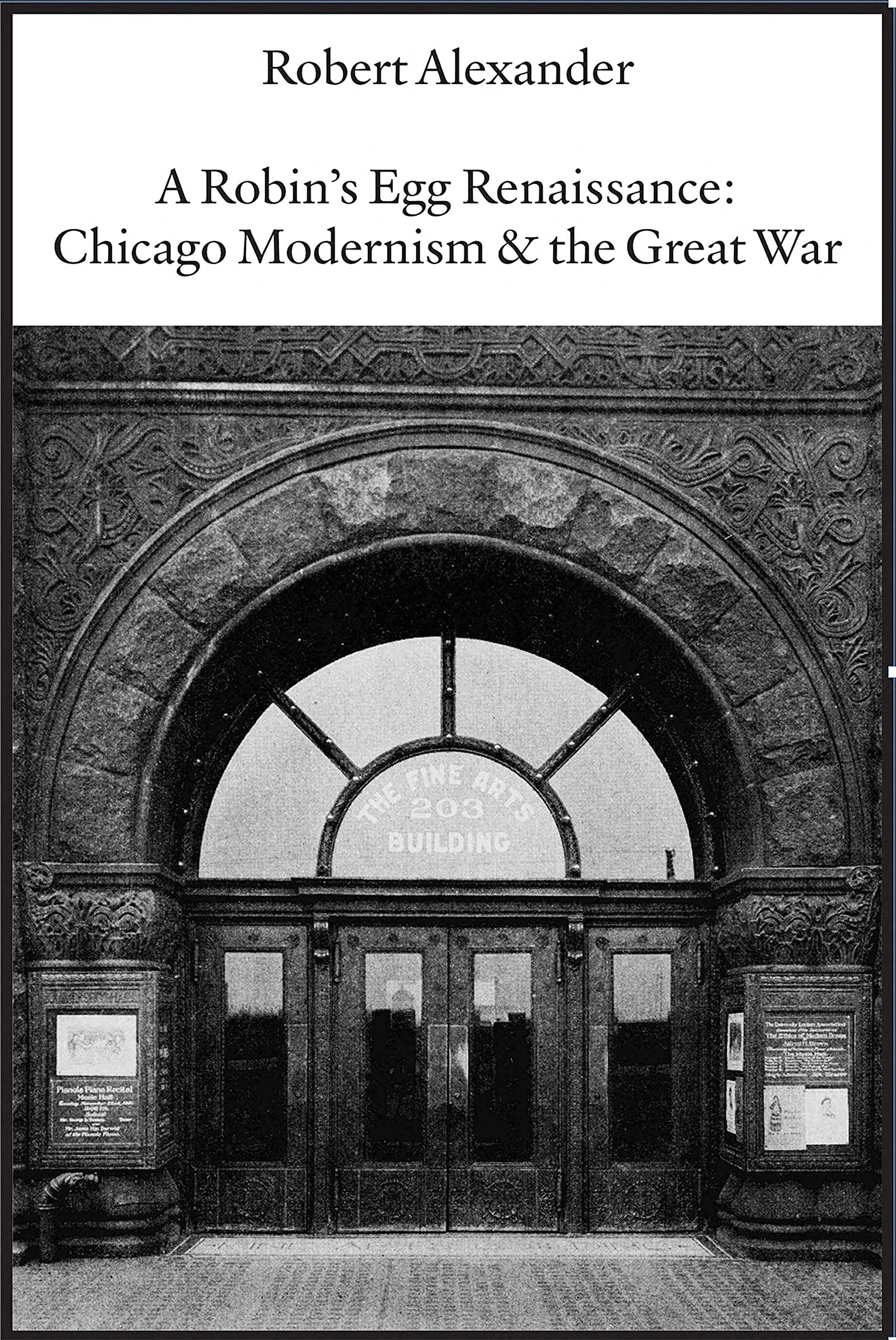



The history of modernism in Chicago, as told by the writers who were there. London, Paris, and New York all have their chroniclers, and now Chicago gets her due. A city of enormous contemporary literary vitality, it also was the home of a profoundly generative burst of creativity that helped shape modernism as we know it. Robert Alexander locates this efflorescence in its historical context, and then lets the participants speak for themselves. Part oral history, part anthology, and assembled from names well known and not (including Ford Madox Ford, Sherwood Anderson, W.E.B. DuBois, Edgar Lee Masters, and Eunice Tietjens), in A Robin’s Egg Renaissance, Alexander has assembled a chorus of voices that shaped modernist aesthetics on the shores of Lake Michigan, with after effects in places and years far beyond. “Anglo-American Modernism has lost none of its fascination over time. We still study the dramatic innovations that seized the early 20th century, for good reason: we can be surprised anew at the artistic vigor, the trenchant squabbles among big personalities, the dramatic innovations in arts that echoed throughout the culture. Focused on the period 1912 to 1917, this collection of documents includes familiar choices—the Imagist manifesto, statements about and from Poetry and The Little Review —and excerpts from opinion pieces, memoirs, speeches, and other historical texts. Readers can retrace what prompted literary Modernism to arise in Chicago and link with energies elsewhere. We share the profound shock of the Great War, via firsthand testimonies of home-front tribulations and the grotesqueries of combat. We are reminded how deeply the arts and the war changed our world. Throughout, these selections testify to the power of creative thinking amid tumultuous times.”—Jayne Marek, author of Women Editing Modernism: “Little” Magazines and Literary History “The pre-war exuberance of the Chicago scene is at once bold, determined, and wildly optimistic. The reader sees the genesis of modern poetic aesthetics and progressive politics unfolding simultaneously through an array of perspectives—Ford Madox Ford, Sherwood Anderson, W.E.B. DuBois, Ezra Pound, Ben Hecht, H.L. Mencken, John Reed, Edgar Lee Masters, William Allen White, Woodrow Wilson, Richard Aldington, Scott Nearing, Eunice Tietjens. Importantly the book gives a place of honor to the “little magazines” that shaped the American modernist movement—Harriet Monroe’s Poetry and Margaret Anderson’s Little Review . The primary sources are memoirs, speeches, correspondence, and newspapers, a generously curated compendium that presents not only the variety of personalities but of perspectives over time—fresh insights erupting in the moment, mournful glances back, memories, revisions of memories. This deeply moving approach lends the anthology poignancy, not only of a fond glance back but also of prescience, of caution, of sorrow for a world at war again and again.”—Holly Iglesias "The reader sees the genesis of modern poetic aesthetics and progressive politics unfolding simultaneously through an array of perspectives."—Holly Iglesias Robert Alexander grew up in Massachusetts. He attended the University of Wisconsin–Madison and for several years taught in the Madison public schools. After receiving his Ph.D. from the University of Wisconsin–Milwaukee, he worked for many years as a freelance editor. From 1993 to 2001, he was a contributing editor at New Rivers Press, serving for the final two years as New Rivers’ creative director. Alexander is the founding editor of the Marie Alexander Poetry Series at White Pine Press. He divides his time between southern Wisconsin and the Upper Peninsula of Michigan. Introduction As with most cultural “renaissances,” it is difficult to find a point of origin for this one. Vincent Starrett has suggested, only half in jest, that the “first note of revolt” was sounded on the night of November 25, 1910, when Mary Garden’s Dance of the Seven Veils in Salomé at the Auditorium Theatre was halted by the Chief of Police. Said Chief Steward, describing Miss Garden’s performance, “she wallowed around like a cat in a bed of catnip.” ―Jackson R. Bryer On March 4, 1913, Woodrow Wilson became the 28th President of the United States. Only the second Democrat to be elected to that august position since the Civil War, he was also the first Southerner since James K. Polk to move into the White House, excepting Andrew Johnson after Lincoln was assassinated. (Lincoln was born in Kentucky but raised in Illinois, and few Southerners outside of Kentucky would have claimed him as one of their own). The Republican Party had split in the summer of 1912 and spawned the Progressive or “Bull Moose” Party, named for its candidate Theodore Roosevelt, and the Electoral College had given Wilson the nod, though the combined popular vote for Taft and Roosevelt would easily have beaten him had circumstances been different. It was a watershed moment