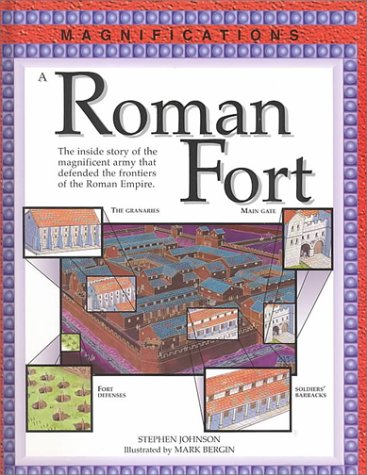



The Roman army’s astonishing conquests would have been impossible without a full time, professional fighting force. While on duty, Roman soldier built and lived in permanent forts all over the Empire. Find out how a fort was planned. See what life was really like for a soldier in the roman army. Watch as the fort’s defenses are built. Grade 4-6-Profusely illustrated series entries that will appeal to children fascinated with detail. The first title examines daily life in a fort during the reign of Hadrian (A.D. 117-138). Two-page spreads cover a range of topics from layout and defense to food storage and consumption. A paragraph of text on each subject is supplemented by informative captions while a number of cutaway drawings reveal the interiors of homes, a bathhouse, a hospital, a temple, and other scenes. Living Tomb covers a much wider time period in a similar format but is not as well organized. Topics include the Valley of the Kings, tomb builders, and "Robbing the Tomb." The illustrations are somewhat clumsy, but informative. The most distinctive aspects of these titles are that sections of the drawings are magnified outside the pictures. Thus, small details, such as a centurion's helmet, can be appreciated. There are also series of drawings in the margins that illustrate various procedures or ideas, such as building a fort or wall treatments; they are very small and must be examined closely. The map in each title is obscured by extraneous pictures. In content and style, Johnson's title is similar to Fiona MacDonald's A Roman Fort (Peter Bedrick, 1993). However, Brian Moses's An Egyptian Tomb (RSVP, 2000) offers a more focused examination than Morley's volume. These books are not for report writers; they are a browser's delight. Carol Durusau, Newton County Public Library, Covington, GA Copyright 2001 Reed Business Information, Inc. Reviewed with Jacqueline Morley's The Living Tomb. Gr. 3-6. These British imports in the Magnifications series offer large pictures, such as the Pharaoh's temple, on two-page spreads and then enlarge some of the elements so they can be seen more clearly. There is usually a paragraph or two of text, with the rest of the information appearing in captions or in borders of small pictures and text. Although there is good information in both Fort and Tomb, the overall effect of magnifying details makes the art look crowded. However, once readers get the hang of seeing small images enhanced, the pictures don't seem so muddled. The information covered in Fort includes the layout, barracks, and fort life, with bits on relaxation, entertainment, religion, and hygiene. Tomb discusses decoration, mummification, and information about Tutankhamun. Glossaries are appended. For larger collections. Ilene Cooper Copyright © American Library Association. All rights reserved Mark Bergin studied at Eastbourne College of Art and has specialized in historical reconstructions, aviation and maritime subjects since 1983. He lives in Bexhill-on-Sea, England, with his wife and three children. Used Book in Good Condition