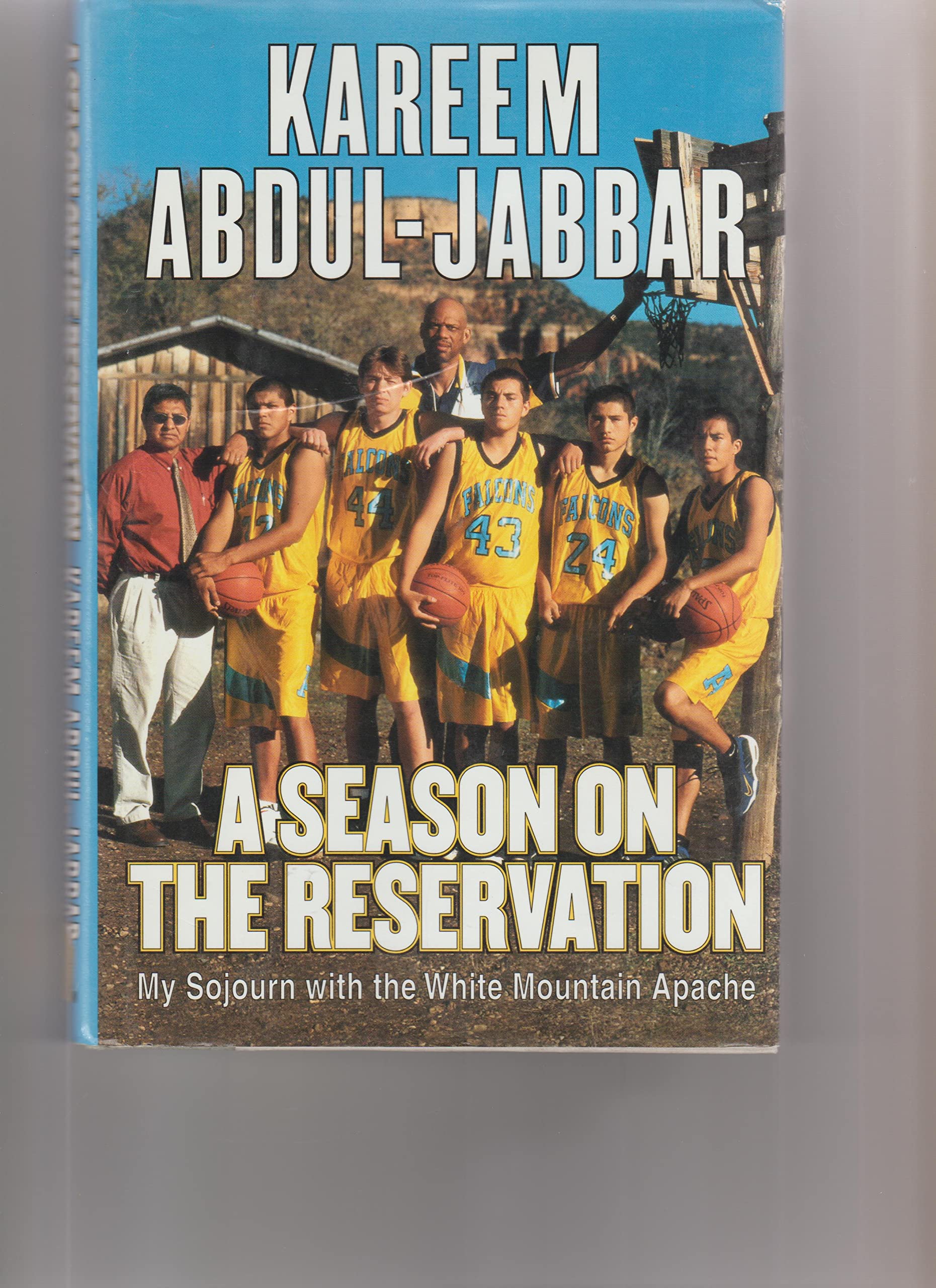
A Season on the Reservation: My Soujourn With the White Mountain Apaches
$8.00
by Kareem Abdul-Jabbar



The basketball legend shares his adventures coaching a team of White Mountain Apache kids in the basics of the game, learning a good deal along the way about his own love of the game Nearly a decade after leaving professional basketball, Kareem Abdul-Jabbar decided to return to the sport he loved by becoming the assistant coach of the Alchesay Falcons--a high school team composed mostly of White Mountain Apaches. But in A Season on the Reservation , he may have actually learned more than he taught. An outsider at the beginning, Abdul-Jabbar found ways to learn more about his athletes and the tribe. He discovered cultural traditions that made it difficult to coach the team (discomfort at being singled out for criticism, for example) and became more sensitive to the special challenges faced by young Native Americans. As Abdul-Jabbar notes, by working with the students he moved from a historical appreciation for the White Mountain Apaches as a people to an understanding of them as individuals. That said, Abdul-Jabbar can't quite seem to shake his romantic image of the young Apaches: "Sometimes I would glance his way and imagine him sitting astride a paint pony two hundred years earlier, ready to ride off into the mountains and hunt." Through his players, Abdul-Jabbar finds himself getting caught up in the competition--his passion for basketball obviously rekindled. Readers may find the end of the Falcons' season rather abrupt, but perhaps that's the nature of high school sports. They also may be a bit put off by Abdul-Jabbar's occasional arrogance, especially when talking about his professional days ("The 1985 Lakers would have taken [Jordan's Bulls] in a championship series.") or when dissing later NBA stars such as Shaq ("He's publicly referred to the way I used to play as 'old man's basketball,' which it may have been, but it earned me six more rings than he's got so far."). Overall, however, A Season on the Reservation is infused with an obvious love of the White Mountain Apaches, their land, and the sport of basketball. --Sunny Delaney YA-The death of his mother, interest in a Buffalo Soldier named Glass, and a growing friendship with Apache Indian Edgar Perry all lead the former NBA star to White River, AZ, and the reservation of the White Mountain Apaches. He came full circle as he volunteered to help coach the Alchesay Falcons during their 1998-99 basketball season. After eight years of retirement, coaching was both frustrating and meaningful for the athlete. He saw the same desire in these players to run and gun in lieu of the fundamentals that he had seen in young professional players who want only the huge bonuses. Just as the former superstar has learned to step out of his own "comfort zone," so too did he want to teach that skill to these young men. This is Abdul-Jabbar's story and readers not only learn his feelings about cultural differences but also about his own need to find his center and have thinking time. Exciting replays of basketball games juxtaposed against a look at one facet of Native American culture from a minority's perspective add up to a solid book. Pam Spencer, Young Adult Literature Specialist, Virginia Beach, VA Copyright 2000 Reed Business Information, Inc. It is not uncommon for ex-athletes to try their hand at writing on predictable subjects such as making sacrifices for the ultimate goal of a championship, or overcoming some adversity. Abdul-Jabbar, happily, goes beyond these subjects and instead writes about his experience coaching a Native American high school basketball team. The book centers on how both Abdul-Jabbar and the boys learn from each other both on and off the court. Native culture, Abdul-Jabbar writes, enriched his own life; likewise, the young ball players learned from Abdul-Jabbar's basketball savvy and his personal experiences. Although the book does tell the expected story of the team's attempt to win a championship, this is not its ultimate message. Instead, it's a book about how a team and its coach handle life's problems and attempt to achieve goals larger than winning a game. Recommended for all public libraries. ---Patrick Mahoney, Kansas City P.L., Overland Park, KS Copyright 2000 Reed Business Information, Inc. In 1998, in response to Colin Powell's call for volunteerism, basketball Hall-of-Famer Kareem Abdul-Jabbar became an assistant coach for the Alchesay Falcons on the Whiteriver Reservation in Arizona. Abdul-Jabbar's challenge was three-fold: to relate a lifetime of basketball experience to the skill level of the players he was coaching; to assert himself yet remain respectful of the permanent coaching staff; and to remember why being a teenager is so difficult. His challenges were compounded by Native American culture, which makes personal criticism difficult to mete out or accept, and by the social ills on the reservation. Abdul-Jabbar is a thoughtful, empathetic, and intelligent man who understands that social change comes abo