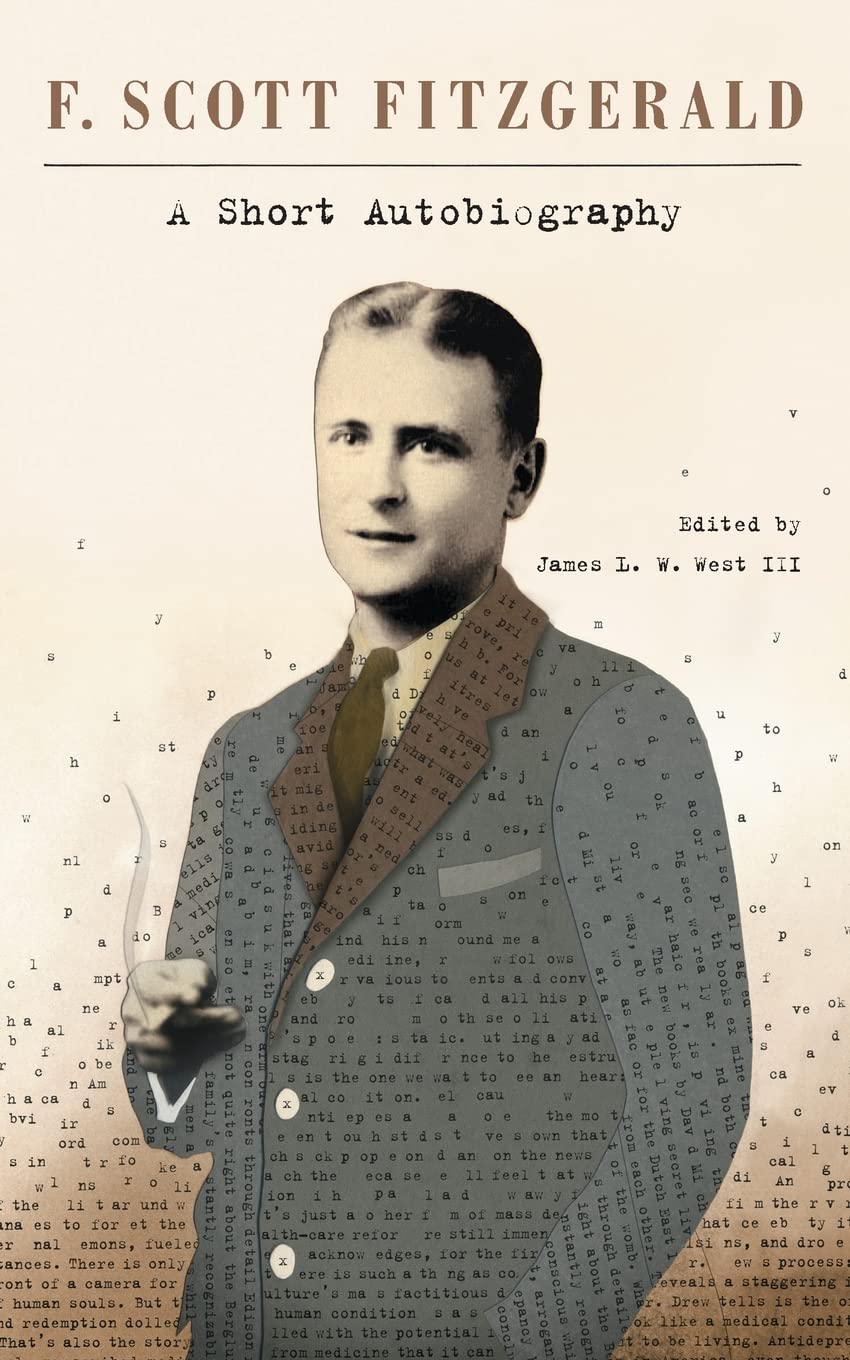



A self-portrait of a great writer. A Short Autobiography charts Fitzgerald's progression from exuberant and cocky with "What I think and Feel at 25", to mature and reflective with "One Hundred False Starts" and "The Death of My Father." Compiled and edited by Professor James West, this revealing collection of personal essays and articles reveals the beloved author in his own words. "Fitzgerald never wrote an autobiography, but this is the next best thing: A collection of 19 personal essays written over the course of his career. They include lighthearted, amusing pieces clearly designed to appeal to magazine editors and casual readers, as well as grimmer fare carved from the center of a broken heart.." -"Chicago Tribune" "Frequently funny and fast-paced." -Associated Press "Jaunty, funny, sparkling, and self-mocking, and beneath the glinting wit, deeply reflective." -"Booklist" "An intellectual autobiography [that] should inspire Fitzgerald readers new or returning...a pleasure to read." -"Library Journal" F. Scott Fitzgerald was born in St. Paul, Minnesota, in 1896. He attended Princeton University, joined the United States Army during World War I, and published his first novel, This Side of Paradise , in 1920. That same year he married Zelda Sayre and for the next decade the couple lived in New York, Paris, and on the Riviera. Fitzgerald’s novels include The Beautiful and Damned , The Great Gatsby , and Tender Is the Night . He died at the age of forty-four while working on The Last Tycoon . Fitzgerald’s fiction has secured his reputation as one of the most important American writers of the twentieth century. A Short Autobiography Who’s Who—and Why The history of my life is the history of the struggle between an overwhelming urge to write and a combination of circumstances bent on keeping me from it. When I lived in St. Paul and was about twelve I wrote all through every class in school in the back of my geography book and first year Latin and on the margins of themes and declensions and mathematic problems. Two years later a family congress decided that the only way to force me to study was to send me to boarding school. This was a mistake. It took my mind off my writing. I decided to play football, to smoke, to go to college, to do all sorts of irrelevant things that had nothing to do with the real business of life, which, of course, was the proper mixture of description and dialogue in the short story. But in school I went off on a new tack. I saw a musical comedy called “The Quaker Girl,” and from that day forth my desk bulged with Gilbert & Sullivan librettos and dozens of notebooks containing the germs of dozens of musical comedies. Near the end of my last year at school I came across a new musical-comedy score lying on top of the piano. It was a show called “His Honor the Sultan,” and the title furnished the information that it had been presented by the Triangle Club of Princeton University. That was enough for me. From then on the university question was settled. I was bound for Princeton. I spent my entire freshman year writing an operetta for the Triangle Club. To do this I failed in algebra, trigonometry, coördinate geometry and hygiene. But the Triangle Club accepted my show, and by tutoring all through a stuffy August I managed to come back a sophomore and act in it as a chorus girl. A little after this came a hiatus. My health broke down and I left college one December to spend the rest of the year recuperating in the West. Almost my final memory before I left was of writing a last lyric on that year’s Triangle production while in bed in the infirmary with a high fever. The next year, 1916–17, found me back in college, but by this time I had decided that poetry was the only thing worth while, so with my head ringing with the meters of Swinburne and the matters of Rupert Brooke I spent the spring doing sonnets, ballads and rondels into the small hours. I had read somewhere that every great poet had written great poetry before he was twenty-one. I had only a year and, besides, war was impending. I must publish a book of startling verse before I was engulfed. By autumn I was in an infantry officers’ training camp at Fort Leavenworth, with poetry in the discard and a brand-new ambition—I was writing an immortal novel. Every evening, concealing my pad behind “Small Problems for Infantry,” I wrote paragraph after paragraph on a somewhat edited history of me and my imagination. The outline of twenty-two chapters, four of them in verse, was made; two chapters were completed; and then I was detected and the game was up. I could write no more during study period. This was a distinct complication. I had only three months to live—in those days all infantry officers thought they had only three months to live—and I had left no mark on the world. But such consuming ambition was not to be thwarted by a mere war. Every Saturday at one o’clock when the week’s work was over I hurried