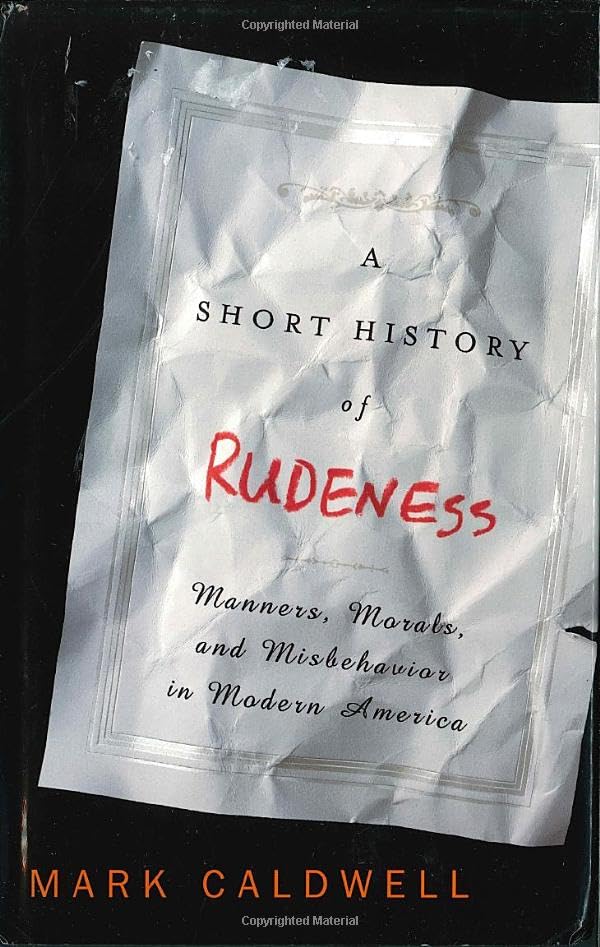
A Short History of Rudeness: Manners, Morals, and Misbehavior in Modern America
$12.34
by Mark Caldwell



A respected social critic offers an insightful and amusing exploration of the slow death of manners and the steady triumph of boorishness in America, showing how the decline of manners has a long and socially significant history. 25,000 first printing. If Americans value civility and good manners so much, then why have they made celebrities out of people like Jerry Springer, Howard Stern, and Dennis Rodman? How is it that political discourse came to be dominated by discussions of semen-stained dresses and mutual accusations of immorality and civic unfitness? Is the United States a nation of hypocrites? No, suggests Mark Caldwell, it's just really confused. "We want to be free, but we long for restraint," he writes. "We insist on openness and cringe when we get it; we strain at trivial offenses and swallow camels of iniquity." A Short History of Rudeness flits around the obsession with good manners and moral behavior, touching upon a number of aspects of public life (the workplace, mass transit, the Internet) and private (child rearing, home design, sexual politics). Along the way, Caldwell strings together an array of primary sources--including newspaper articles, business etiquette manuals, and South Park episodes--that help explain why people pay attention to Martha Stewart, whether Dr. Spock is really responsible for multiple generations of spoiled brats, and how users of the Internet developed a blunt discourse that, while superficially crude, exhibits a desire for decorum at its core. (Why do we feel justified in flaming spammers? Because they violate our sense of privacy.) The cultural obsession with manners and morality unfolds as part of a deeper anxiety over class. While the individual sections of A Short History of Rudeness are not always revelatory, Caldwell's slow but steady approach is at least innovative in the particular way he chooses to fit together these pieces of the social puzzle. --Ron Hogan Are good manners symptoms of an ``inborn urge toward community''? Or devices to control our ``natural drive toward conflict and violence? Social historian Caldwell (The Last Crusade: The War on Consumption, 18621954, 1988) offers some provocative answers. His book doesn't really address rudeness per se but is rather an attractive history of what constitutes good manners as formulated by the likes of Emily Post, Miss Manners, Letitia Baldridge, and others. Etiquetteindeed, civility itselfis the vestige of a once- rigid class structure. Notions of propriety go hand-in-hand with our perceptions of the customs and rituals of ``good society.'' For cultural conservatives, the author notes, the breakdown in our societys infrastructure (that is, in discernible lines of authority in the family, at school, on the job) is manifest in our lack of manners. A return to optional niceties . . . will stiffen our moral spines,'' argue William Bennett and Gertrude Himmelfarb. Caldwell goes to great lengths to demonstrate that what we call manners has little to do with ethics or morals; they are often trivial and generally a matter of personal taste instituted by the dominant culture to distance itself from the masses. He does a marvelous job of dissecting manners and customs in public life, in business and personal relations, and in the political correctness debate over gender and race relations. His examination of customs and rituals in weddings and funerals finds that under the guise of propriety and tradition these events have become occasions for huge, unnecessary expenditures. He takes a look at bulletin boards and chat rooms on the Internet and finds hate-filled language that few would tolerate in person. Caldwell also offers a surprisingly convincing defense of Martha Stewart as a democratizing force who educates ``through attractive example''rather than snobbish proselytizing. An astute critical history of American manners, taste, and etiquette that explores ``what makes manners so compelling a concern.'' -- Copyright ©1999, Kirkus Associates, LP. All rights reserved. He packs in his information with unobtrusive dexterity in a style that is modest, readable, intelligent and companionable. -- The New York Times Book Review , Naomi Bliven Mark Caldwell is a literary critic and the author of an acclaimed socio-medical history of tuberculosis in America, The Last Crusade . He teaches at Fordham University and lives in Manhattan and New York's Hudson Valley.