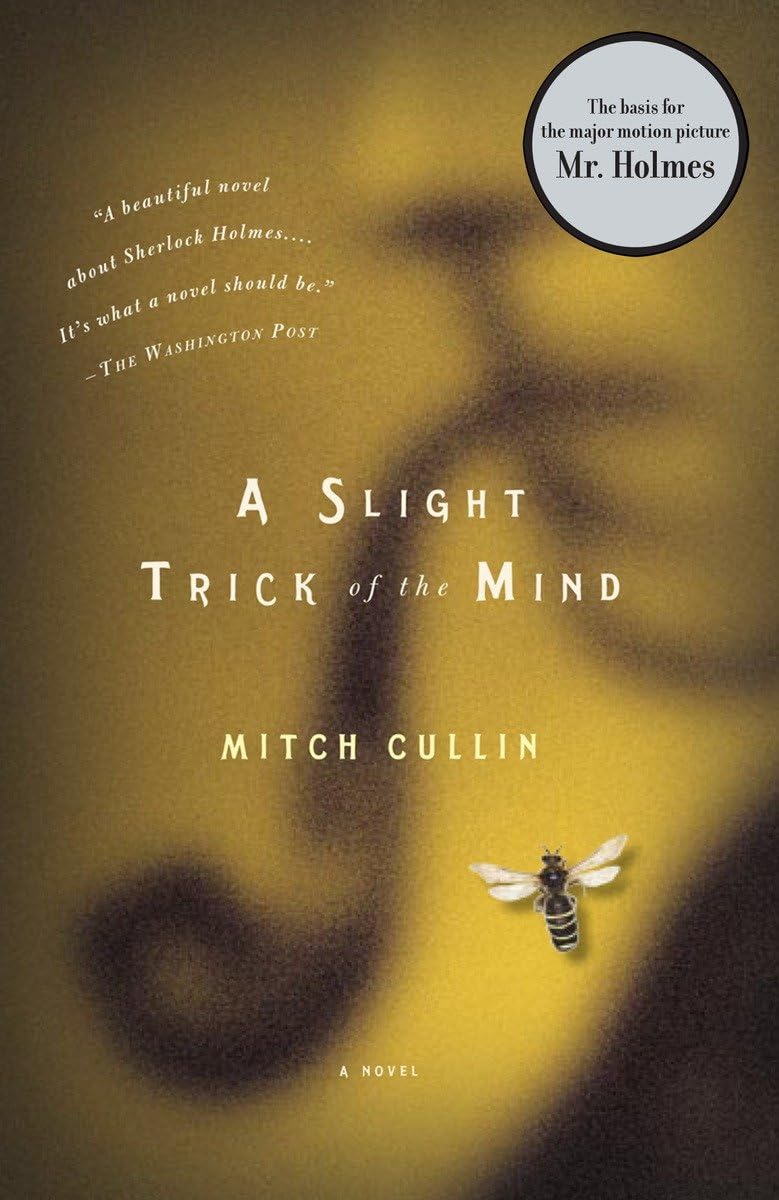



The basis for the Major Motion Picture Mr. Holmes starring Ian McKellen and Laura Linney and directed by Bill Condon. It is 1947, and the long-retired Sherlock Holmes, now 93, lives in a remote Sussex farmhouse with his housekeeper and her young son. He tends to his bees, writes in his journal, and grapples with the diminishing powers of his mind. But in the twilight of his life, as people continue to look to him for answers, Holmes revisits a case that may provide him with answers of his own to questions he didn’t even know he was asking–about life, about love, and about the limits of the mind’s ability to know. A novel of exceptional grace and literary sensitivity, A Slight Trick of the Mind is a brilliant imagining of our greatest fictional detective and a stunning inquiry into the mysteries of human connection. “A beautiful novel about Sherlock Holmes. . . . It’s what a novel should be.” — The Washington Post “Wonderfully written and heartbreaking.” — San Francisco Chronicle “A wise and touching examination of the human condition.” — Los Angeles Times Book Review “Quite extraordinary. . . . Our hero—our eternal hero—has never been more heroic, or more human.” — The Village Voice “Beautiful. . . . Cullin is an unusually sophisticated theorist of human nature.” — The New York Times Book Review Mitch Cullin's absorbing "A Slight Trick of the Mind is an original portrait of literature's most beloved detective, Sherlock Holmes, in the twilight of his illustrious life. Holmes--"a genius in whom scientific curiosity is raised to the status of heroic passion"--is famous for his powers of deduction. His world is made up of hard evidence and uncontestable facts, his observations and conclusions unsullied by personal feelings, until novelist Cullin goes behind the cold, unsentimental surface to reveal for the first time the inner world of an obsessively private man. It is 1947, and the long-retired Holmes, now 93, lives in a remote Sussex farmhouse, where his memories and intellect begin to go adrift. He lives with a housekeeper and her young son, Roger, whose patient, respectful demeanor stirs paternal affection in Holmes. Holmes has settled into the routine of tending his apiary, writing in journals, and grappling with the diminishing powers of his razor-sharp mind, when Roger comes upon a case hitherto unknown. It is that of a Mrs. Keller, the long-ago object of Holmes's deep--and never acknowledged--infatuation. As Mitch Cullin weaves together Holmes's hidden past, his poignant struggle to retain mental acuity, and his unlikely relationship with Roger, Holmes is transformed from the machine-like, mythic figure into an ordinary man, confronting and acquiescing to emotions he has resisted his entire life. This subtle and wise work is more than just a reimagining of a classic character. It is a profound meditation on faultiness of memory and how, as we grow older, the way we see the world is inevitably altered. MITCH CULLIN is the author of ten books, including A Slight Trick of the Mind , Tideland , and Branches , a novel-in-verse. His fiction has been translated into over 20 languages. He currently lives near Los Angeles, where he is working as a photographer while also collaborating on various projects with Peter I. Chang. He can be found on Facebook at www.facebook.com/mitchthecullin. Chapter 1 Upon arriving from his travels abroad, he entered his stone-built farmhouse on a summer’s afternoon, leaving the luggage by the front door for his housekeeper to manage. He then retreated into the library, where he sat quietly, glad to be surrounded by his books and the familiarity of home. For almost two months, he had been away, traveling by military train across India, by Royal Navy ship to Australia, and then finally setting foot on the occupied shores of postwar Japan. Going and returning, the same interminable routes had been taken–usually in the company of rowdy enlisted men, few of whom acknowledged the elderly gentleman dining or sitting beside them (that slow-walking geriatric, searching his pockets for a match he’d never find, chewing relentlessly on an unlit Jamaican cigar). Only on the rare occasions when an informed officer might announce his identity would the ruddy faces gaze with amazement, assessing him in that moment: For while he used two canes, his body remained unbowed, and the passing of years hadn’t dimmed his keen gray eyes; his snow-white hair, thick and long, like his beard, was combed straight back in the English fashion. “Is that true? Are you really him?” “I am afraid I still hold that distinction.” “You are Sherlock Holmes? No, I don’t believe it.” “That is quite all right. I scarcely believe it myself.” But at last the journey was completed, though he found it difficult to summon the specifics of his days abroad. Instead, the whole vacation–while filling him like a satisfying meal–felt unfathomable in hindsight, punctuated here and there by brief rem