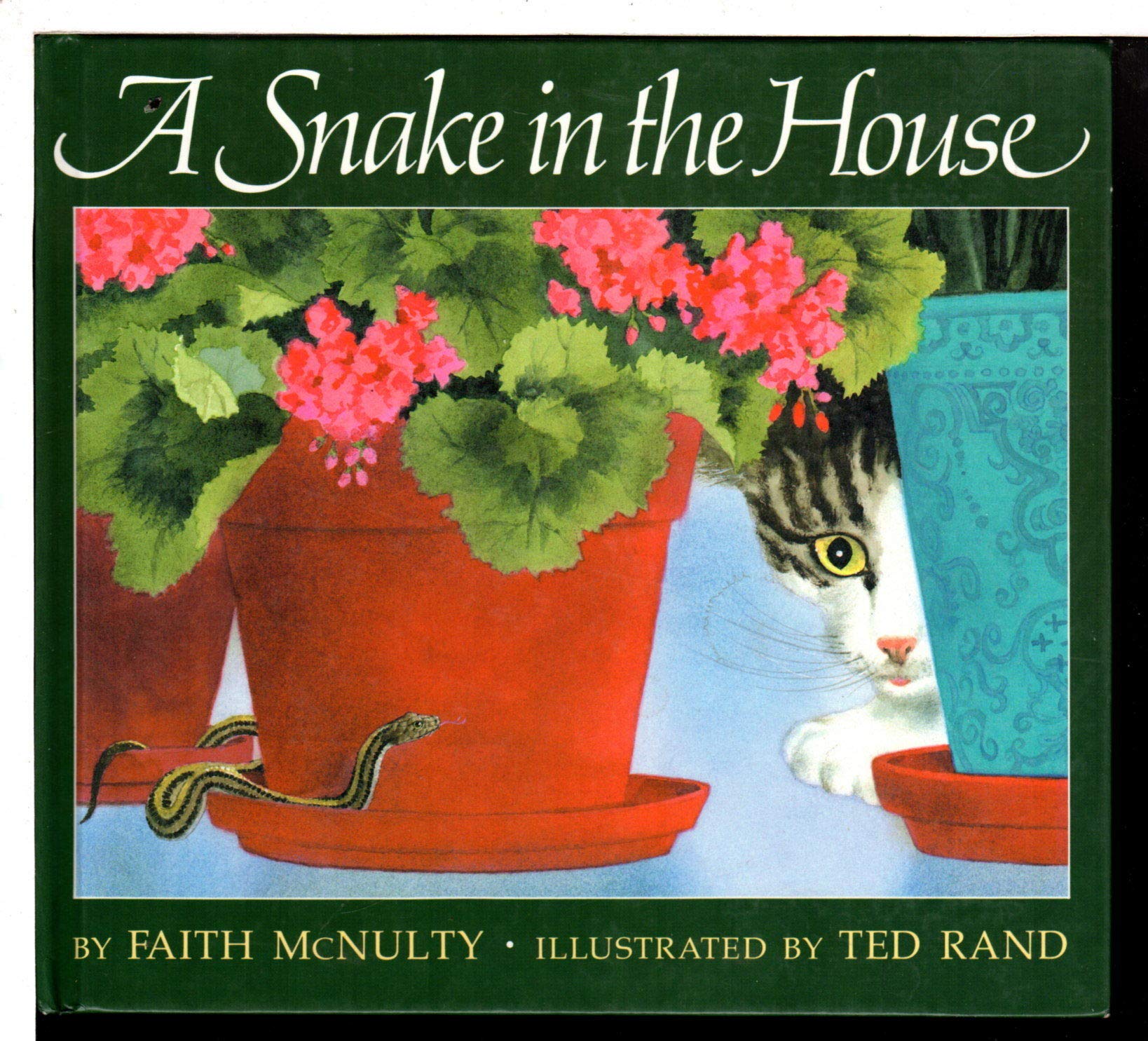



An award-winning nature writer offers young readers a unique tale that employs a common childhood experience--capturing a pet--to provide an ecological message. Kindergarten-Grade 4-In this environmental-awareness piece, a young boy goes out on a hunting expedition, convinced that "anything alive would be exciting to catch." He traps a sleeping grass snake in a jar and takes it home, much to his mother's dismay. The reptile escapes and slithers through the house in search of its wild environs. Instead, it encounters the indoor dangers of rugs, household chemicals, vacuum cleaners, and a cat. Its flight to freedom and the happy ending are a little too pat to be completely credible, but the story is effective overall. The message of appreciating animals in their natural habitats as opposed to trapping them for use as toys or pets comes through clearly without being heavy-handed. The book is saved from preachiness by the light adventure of the snake searching for an exit route and by Rand's engaging artwork. The full-page, full-color illustrations are sure to delight readers, particularly the scenes with the cat. Some of the outdoor scenes are somewhat sentimentalized, but are visually appealing. The text, too, borders on the saccharine at times. This isn't a necessary purchase, but it is entertaining and attractive. Keith Baker's Hide and Snake (Harcourt, 1991) presents a runaway snake in a more playful, less philosophical manner. Heide Piehler, Shorewood Public Library, WI Copyright 1994 Reed Business Information, Inc. Ages 5-9. A boy catches a garter snake by a pond and brings it home in a jar. The snake escapes into the house and spends several days "searching for a way out, a way back to the pond." Eventually, the snake hides in a fishing basket that the boy takes down to the water. When the snake emerges, the surprised boy picks it up: "There was so much power in its tiny body; its will to be free was so strong, that the boy, in amazement, let go." The text and watercolors tell the story from the point of view of the snake, giving the tale an unusual twist, and the large typeface and bright supporting paintings will appeal to young readers as much as the suspenseful, satisfying story. Janice Del Negro On ``a sweet morning in May,'' a boy catches a snake (``small, no bigger around than a pencil'') and takes it home, where it escapes and makes its way from one hiding place to another, evading the cat and subsisting on an occasional ``dry and bitter'' spider until it happens into an outgoing basket and gets back to its pond. Adroitly, McNulty interweaves the boy's point of view (he never considers his prey's needs or comfort until, at the end, he imagines its joy at being free again) with the snake's realistically portrayed movements, a fascinating series of evasions into crevices humans hardly know exist and such familiar items as shoes and sofa springs. Rand is at his best here, with glowing depictions of the snake's idyllic pond- side home, nicely structured indoor scenes (a bowl of fruit, a cupboard full of pots, a pile of boots) where the snake slithers almost unobserved, and the boy wide-eyed with excited curiosity. Uncommonly attractive and carefully wrought, a book that makes its point even more effectively than Barbara Ann Porte's more explicit ``Leave That Cricket Be,'' Alan Lee (1993). (Picture book. 3-8) -- Copyright ©1994, Kirkus Associates, LP. All rights reserved. Used Book in Good Condition