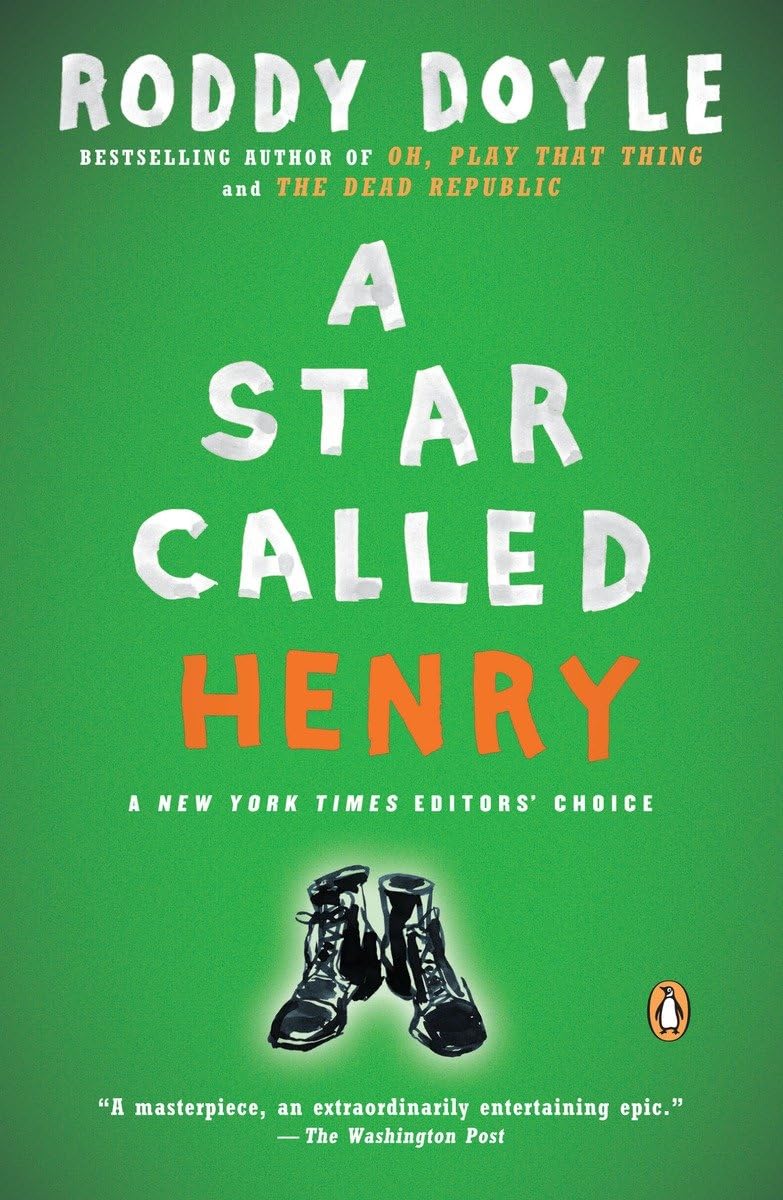



Roddy Doyle’s acclaimed novel about an intrepid Irishman’s years of reckless heroism and adventure – “An extraordinarily entertaining epic.” ( The Washington Post ) Born at the beginning of the twentieth century, Henry Smart lives through the evolution of modern Ireland, and in this extraordinary novel he brilliantly tells his story. From his own birth and childhood on the streets of Dublin to his role as soldier (and lover) in the Irish Rebellion, Henry recounts his early years of reckless heroism and adventure. At once an epic, a love story, and a portrait of Irish history, A Star Called Henry is a grand picaresque novel brimming with both poignant moments and comic ones, and told in a voice that is both quintessentially Irish and inimitably Roddy Doyle's. "A Best Book of '99" --"The Globe and Mail "Marvellous...bloody brilliant." -- "The Toronto Star "A startling achievement...a book where war can rage and love can burrow under the skin--. A fragment of a forgotten folk song and a worm's eye view of Irish history.... A grand thing of beauty." -- "The Globe and Mail "History evoked on an intimate and yet earth-shaking scale, with a huge dash of the blarney, some mythical embellishments and a driving narrative that never falters." -- "Publishers Weekly (starred review) "A triumph of craft and intelligence and toughness of mind." -- "Hamilton Spectator "A masterpiece." -- "The Irish Times "Doyle has [written an] Irish epic, and he wields the style like a sword, with the power and grace of a master." -- "The Village Voice "Maybe the Great American Novel remains to be written, but on the evidence of its first installment, this is the epic Irish one, created at a high pitch of eloquence." -- "Publishers Weekly "Astonishing.... Narrated with a splendor, wit, and excitement that lift Doyle's writing to a new level." -- "The New York Times Book Review An historical novel like none before it, A Star Called Henry marks a new chapter in Booker Prize-winner Roddy Doyle's writing. It is a vastly more ambitious book than any he has previously written. A subversive look behind the legends of Irish republicanism, at its centre a passionate love story, this new novel is a triumphant work of fiction. Born in the slums of Dublin in 1902, his father a one-legged whorehouse bouncer and settler of scores, Henry Smart has to grow up fast. By the time he can walk he's out robbing, begging, charming, often cold, always hungry, but a prince of the streets. At fourteen, already six foot two, Henry's in the General Post Office on Easter Monday 1916, a soldier in the Irish Citizen Army, fighting for freedom. A year later he's ready to die for Ireland again, a rebel, a Fenian, and, soon, a killer. With his father's wooden leg as his weapon, Henry becomes a republican legend - one of Michael Collins' boys, a cop killer, an assassin on a stolen bike, a lover. "From the Hardcover edition. Roddy Doyle is an internationally bestselling writer. His first three novels— The Commitments , The Snapper , and the 1991 Booker Prize finalist The Van —are known as The Barrytown Trilogy. He is also the author of the novels Paddy Clarke Ha Ha Ha (1993 Booker Prize winner), The Woman Who Walked into Doors , and A Star Called Henry , and a non-fiction book about his parents, Rory & Ita . Doyle has also written for the stage and the screen: the plays Brownbread , War , Guess Who's Coming for the Dinner , and The Woman Who Walked Into Doors ; the film adaptations of The Commitments ( as co-writer), The Snapper , and The Van ; When Brendan Met Trudy (an original screenplay); the four-part television series Family for the BBC; and the television play Hell for Leather . Roddy Doyle has also written the children's books The Giggler Treatment , Rover Saves Christmas , and The Meanwhile Adventures and contributed to a variety of publications including The New Yorker magazine and several anthologies. He lives in Dublin. Chapter One My mother looked up at the stars. There were plenty of them up there. She lifted her hand. It swayed as she chose one. Her finger pointed. —There's my little Henry up there. Look it. I looked, her other little Henry sitting beside her on the step. I looked up and hated him. She held me but she looked up at her twinkling boy. Poor me beside her, pale and red-eyed, held together by rashes and sores. A stomach crying to be filled, bare feet aching like an old, old man's. Me, a shocking substitute for the little Henry who'd been too good for this world, the Henry God had wanted for himself. Poor me. And poor Mother. She sat on that step and other crumbling steps and watched her other babies joining Henry. Little Gracie, Lil, Victor, another little Victor. The ones I remember. There were others, and early others sent to Limbo; they came and went before they could be named. God took them all. He needed them all up there to light the night. He left her plenty, though. The ugly ones, the