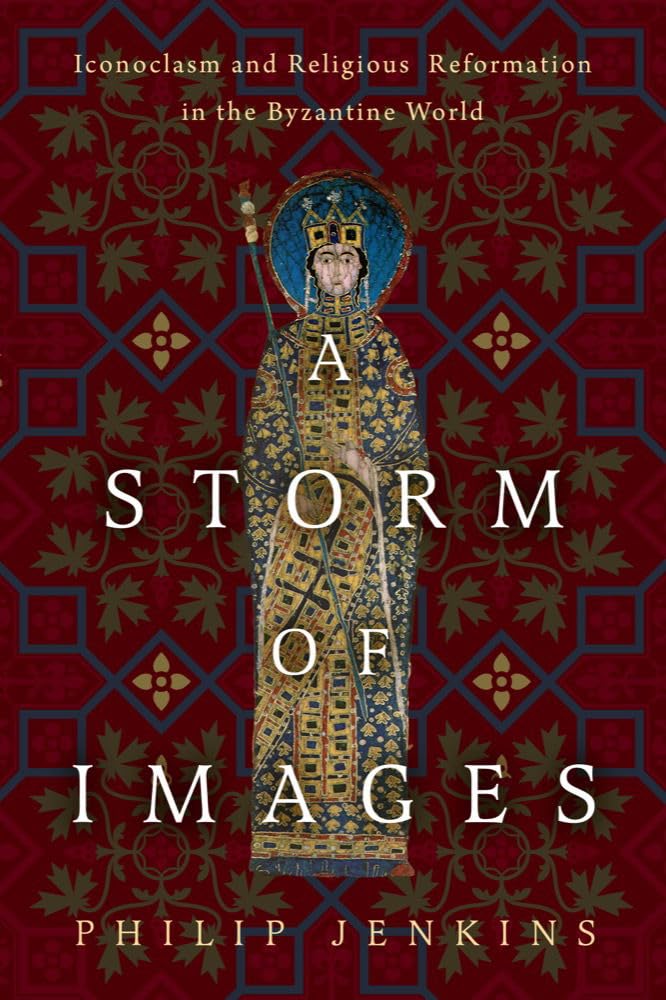
A Storm of Images: Iconoclasm and Religious Reformation in the Byzantine World
$30.66
by Philip Jenkins



In the eighth century, the Byzantine Empire began a campaign to remove or suppress sacred images that depicted Christ, the Virgin, or other holy figures, whether in paintings, mosaics, murals, or other media. In some cases, the campaign extended to breaking or wrecking images through what became known as iconoclasm. Over the following years, the emperors' zealous movement involved other acts that closely foreshadowed the Reformation movement that would sweep Western Europe in the sixteenth century. Like that later Reformation, iconoclasm marked an authentic revolution in religious sensibility, with all that implied for theology, culture, and visual perceptions of holiness. This was a pivotal moment in the definition of Christianity and its relationship to the material creation. It was also a time of critical encounters with the other Abrahamic religions of Judaism and Islam. With A Storm of Images , Philip Jenkins offers a compelling retelling of the saga of how the iconoclastic movement detonated ferocious controversy within the church and secular society as icon supporters challenged the image breakers. Decades of internal struggle followed, marked by rebellions and civil wars, purges and persecutions, plotting and coups d’état. After their cause triumphed, image supporters made the cult of icons ever more central to the faith of Orthodox Christianity. Iconoclasm marked a watershed in the history of Late Antiquity and the Early Middle Ages, and it contributed to Western attempts to establish new empires. The questions raised during these struggles are all the more relevant at a time when such controversy rages over public depictions of history and the removal of statues, monuments, and names associated with hated figures. As in those earlier times, debates over images serve as vehicles for authentic cultural revolutions. In A Storm of Images , Philip Jenkins takes us back to the Eastern Roman Empire, a misty and opaque era that Western people fail to understand well. In this history of iconoclasm ('image smashing'), Jenkins brings great clarity not only to the world of Orthodox Christianity, but to the glittering splendor of the east, the cutthroat politics, the infidelity, and the ultimate destruction of the Byzantine Empire by the overwhelming power of Islam. This book is the new gold standard for understanding the iconoclastic era and its profound impact on the Christian faith. -- Dyron B. Daughrity, Professor of Religion, Pepperdine University Jenkins provides a solid and accessible history of the Byzantine religious/political circumstances immediately leading to and concurrent with the eighth- and early-ninth-century conflict over the use of images. He presents a wealth of material, helpfully arranged with clear explanations helpful to nonspecialists, and with a balanced consideration of current historiographical issues. The resulting work is a well reasoned and informative general resource that covers a good deal of historical ground and provides insight into key issues factoring into the Byzantine debates about images. -- Katherine Marsengill, Independent Scholar, Brooklyn, New York I could not have imagined how interesting the subject of iconoclasm could be until I read A Storm of Images by Philip Jenkins. You can't put this book down. Although its focus is on the eighth and ninth centuries of the eastern Roman (or Byzantine) Empire, it has relevance for understanding the entire history of the Christian Church. It's a must-read. -- Craig A. Evans, John Bisagno Distinguished Professor of Christian Origins, Houston Christian University I could not have imagined how interesting the subject of iconoclasm could be until I read A Storm of Images by Philip Jenkins. You can't put this book down. Although its focus is on the eighth and ninth centuries of the eastern Roman (or Byzantine) Empire, it has relevance for understanding the entire history of the Christian Church. It's a must-read. -- Craig A. Evans, John Bisagno Distinguished Professor of Christian Origins, Houston Christian University Philip Jenkins is Distinguished Professor of History at Baylor University. He is also the author of Fertility and Faith: The Demographic Revolution and the Transformation of World Religions .