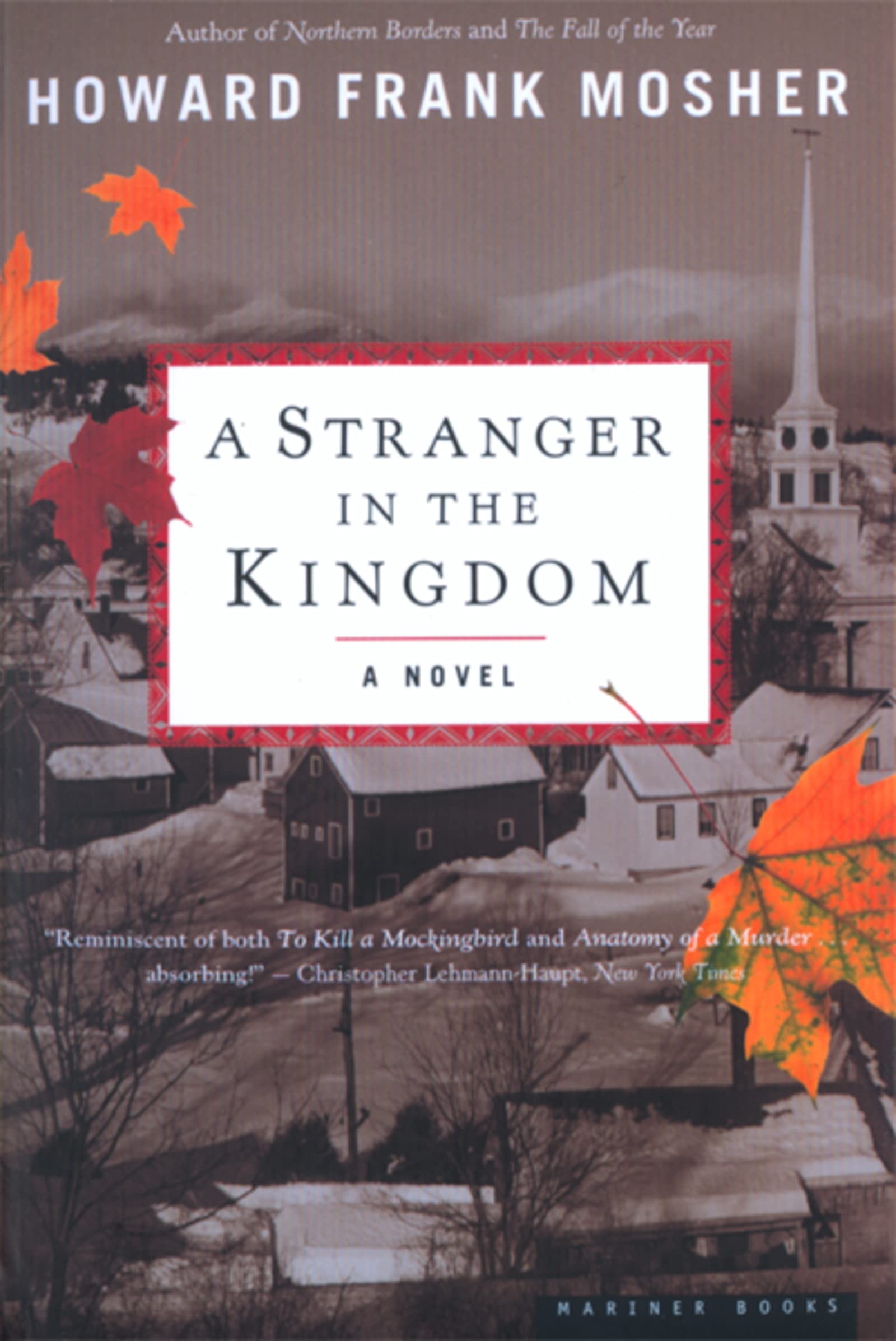



This novel of murder and its aftermath in a small Vermont town in the 1950s is “reminiscent of To Kill a Mockingbird... Absorbing” ( New York Times ). In Kingdom County, Vermont, the town’s new Presbyterian minister is a black man, an unsettling fact for some of the locals. When a French-Canadian woman takes refuge in his parsonage—and is subsequently murdered—suspicion immediately falls on the clergyman. While his thirteen-year-old son struggles in the shadow of the town’s accusations, and his older son, a lawyer, fights to defend him, a father finds himself on trial more for who he is than for what he might have done. “Set in northern Vermont in 1952, Mosher’s tale of racism and murder is powerful, viscerally affecting and totally contemporary in its exposure of deep-seated prejudice and intolerance... [A] big, old-fashioned novel.”— Publishers Weekly “A real mystery in the best and truest sense.”—Lee Smith, New York Times Book Review A Winner of the New England Book Award HOWARD FRANK MOSHER is the author of ten books, including Waiting for Teddy Williams, The True Account, and A Stranger in the Kingdom, which, along with Disappearances, was corecipient of the New England Book Award for fiction. He lives in Vermont. A Stranger in the Kingdom By Howard Frank Mosher Houghton Mifflin Harcourt Publishing Company Copyright © 1989 Howard Frank Mosher All rights reserved. ISBN: 978-0-618-24010-4 CHAPTER 1 When I was a boy growing up on the Kingdom gool, my father and my older brother Charlie couldn't say two words to each other without getting into an argument. In and of itself, I don't suppose that their quarreling was so very unusual. Fathers and sons, elder sons especially, often have problems seeing eye to eye. What distinguished Kinneson family arguments from most others is that once they got up a head of steam, Dad and Charlie refused to speak to each other directly. Instead, they conducted their running verbal battles through the nearest available third person, who, more frequently than not, turned out to be me. Their disagreements constitute some of my earliest memories, and they disagreed continually, over everything from the editorial policy of our family-owned weekly newspaper to the individual and team batting averages of the 1918 World Champion Boston Red Sox. It's a well-known fact, at least in northern New England, that the enthusiasm of Red Sox fans tends to increase in direct proportion to their distance from Fenway Park. Certainly this axiom held true for our family. We lived as far away from Boston as it's possible to live and still be in Vermont and not Canada, yet to this day I've never met more ardent baseball fans than the Kinnesons. Even my mother, who was otherwise not much interested in sports, avidly followed the ups and downs of our beloved Sox. Once a season we all made the long trip south on the Boston and Montreal Flyer (a misnomer if there ever was one) to see a game in person. And since there was no local radio station within seventy miles of Kingdom County, Dad and Charlie and I often drove up the logging road above our place into the high wild country known as the Kingdom gore to hear a game over the car radio from a downcountry station in Burlington or Montpelier. Or, depending on the weather conditions and the team Boston happened to be playing, we might pick up the Sox over enemy stations from far-flung cities that I connected more closely with their clubs' current positions in the American League pennant standings than with any particular geographical locations — cities like Detroit and Cleveland, Philadelphia, St. Louis, Washington, and Chicago. And, of course, New York — which for a number of years in my early boyhood I assumed must be situated somewhere to the north of Boston because of the Yankees' perennial ranking at the top of the league. Those long ago summer evenings usually started out as good ones. We would park in the clearing on the height of land near the tall cyclone fence enclosing the white-domed army radar station we called Russia (soon to be rendered obsolete by the DEW line far to the north). I can still see us clearly: my father sitting with the driver's door ajar and one long leg propped on the sagging running board of his old De Soto, fiddling with the radio dial while Charlie and I played catch nearby. Using the steel cyclone fence as a backstop, I'd crouch down with my hand plunged deep into the vast recesses of my brother's catcher's mitt while Charlie, who'd been a standout catcher at Dartmouth and was widely considered to be the best catcher in Vermont's Northern Border Town League, stood about sixty feet away and lobbed me an old waterlogged baseball wrapped in several layers of scruffy black electrical tape. "Put some mustard on it, Charles," my father would call from the car. "Uncork one. Smoke her right in there." Charlie would grin at me wickedly, double pump, heave his leg high, and pretend to uncork one.