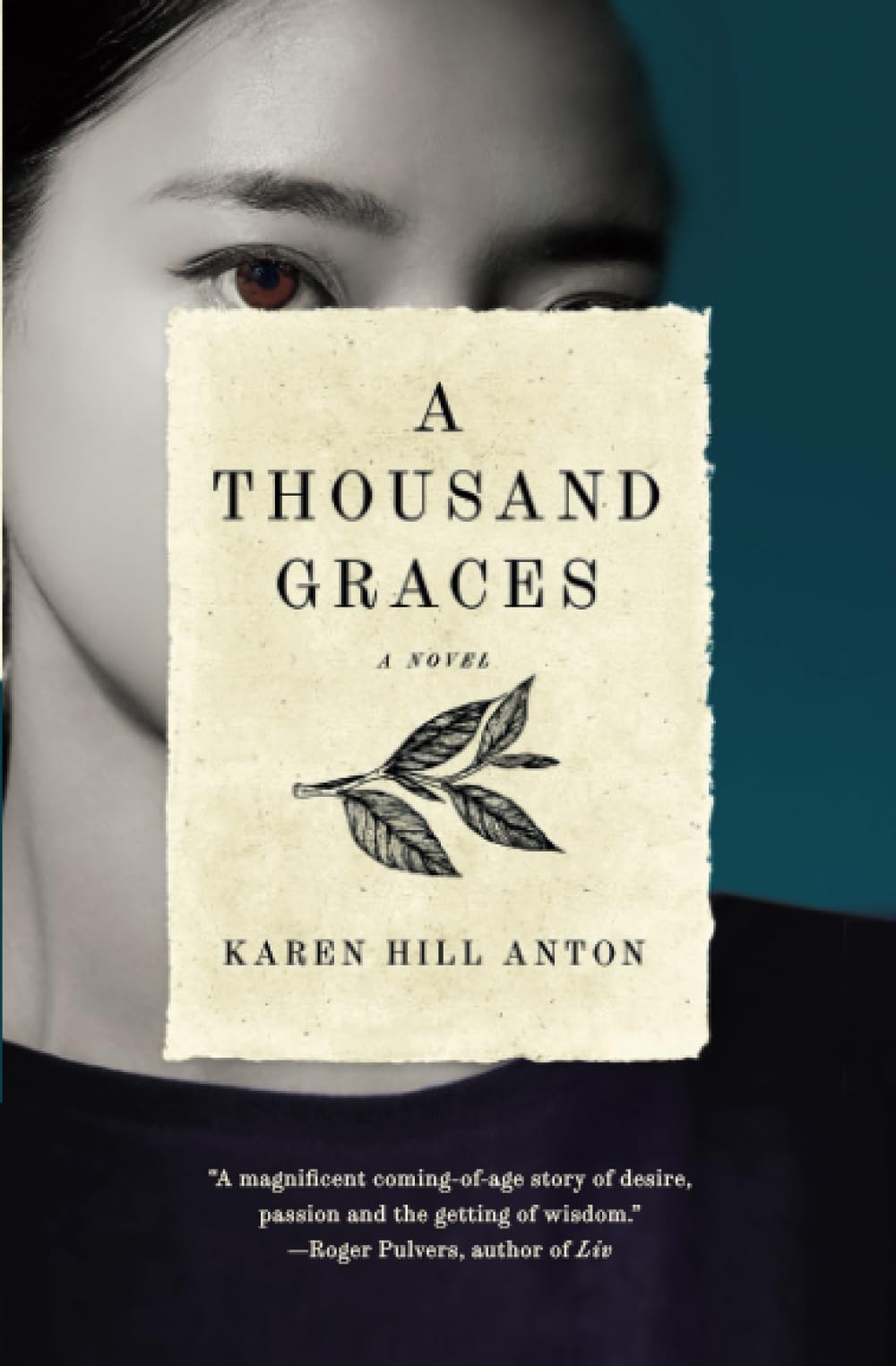



Chie Uchida, a talented student , does not fit the mold of her countryside life and provincial upbringing. She’s not certain what she wants, but knows that unlike her beloved brother, her future does not spell contentment on a tea farm. Her self-absorbed best friend has a rebellious streak but doesn’t present a model Chie wants to follow. Entering college, Chie plunges headlong into emotional turmoil as she takes her first misguided steps into womanhood—she misreads the attention of one professor and the aspirations of another. Set in 1970s Japan, the Showa era, the story evokes nostalgia for a simpler time as traditional customs and values fade away and Japanese society inexorably changes to meet the expectations and demands of a more modern world. The characters in this novel, drawn with a deft deliberation and intimate distance, arouse empathy as they struggle , submit , and surrender . A Thousand Graces is an absolute gem . The characterization is masterful, the narrative never wanes. The chronicle moves forward seamlessly as Anton, well-versed in the traditions of Japan, weaves in descriptions and explanations of Japanese terms, customs, and lifestyle. The ubiquitous comment from all who've read it is that they couldn't put it down. Acclaimed author Karen Hill Anton has produced a masterfully crafted novel that will remain with you long after the final page is turned. It would be surprising if A Thousand Graces does not succeed in winning literary awards in the manner of her highly praised memoir. -- Paul de Vries , JAPAN Forward
I can't think of any other fiction written by a non-Japanese to capture Japan so perfectly. And to do everything else so perfectly, too. I was particularly impressed by the sense of control the novel exhibited in regard to language, which was beautiful to read; the characters, who felt absolutely real and whose conflicts were portrayed with great love, consistency, and care; and with the emotional tone of the story from beginning to end. It's been a long time since I felt so involved and invested in a story. A Thousand Graces is nothing less than a masterpiece ." -- David Joiner , author of The Heron Catchers
Without relying on cultural or gendered stereotypes, Karen Hill Anton offers a highly accurate portrayal of Japan and its people. I loved every page of this novel, and the characters will remain in my head for a long time. In fact, I would give this book ten stars if I could . This is a must-read for anyone interested in Japan! -- Diane Hawley Nagatomo , author of The Butterfly Cafe
Karen Hill Anton's debut novel, A Thousand Graces , unfurls a mesmerizingly haunting and evocative tale of coming-of-age that resonates with raw power and poignant beauty . Anton's poetic prose brings to life a story that lingers in the heart and mind, capturing the essence of a profound journey of self-discovery and growth. -- Jeffrey Miller , author of No Way Out
Drawing on her decades living in Japan, in A Thousand Graces, Karen Hill Anton has crafted an exquisite novel set in the late 1960s/early 1970s when social roles were circumscribed. While some characters might seem familiar, the story veers from the predictable path, springing surprises along the way, until it arrives as its stunning, yet inevitable conclusion. A Thousand Graces is a powerful and haunting work of art . -- Suzanne Kamata , author of The Baseball Widow Karen Hill Anton wrote the columns "Crossing Cultures" for the Japan Times and "Another Look" for the Japanese daily Chunichi Shimbun for fifteen years. Her writing appears in various collections, including A Passion for Japan , and The Broken Bridge: Fiction from Expatriates in Literary Japan . Among other literary awards, her memoir The View From Breast Pocket Mountain is the Grand Prize Winner of the 2022 Memoir Prize for Books. Originally from New York City, Karen has made her home in the rural province of Shizuoka, Japan, since 1975.