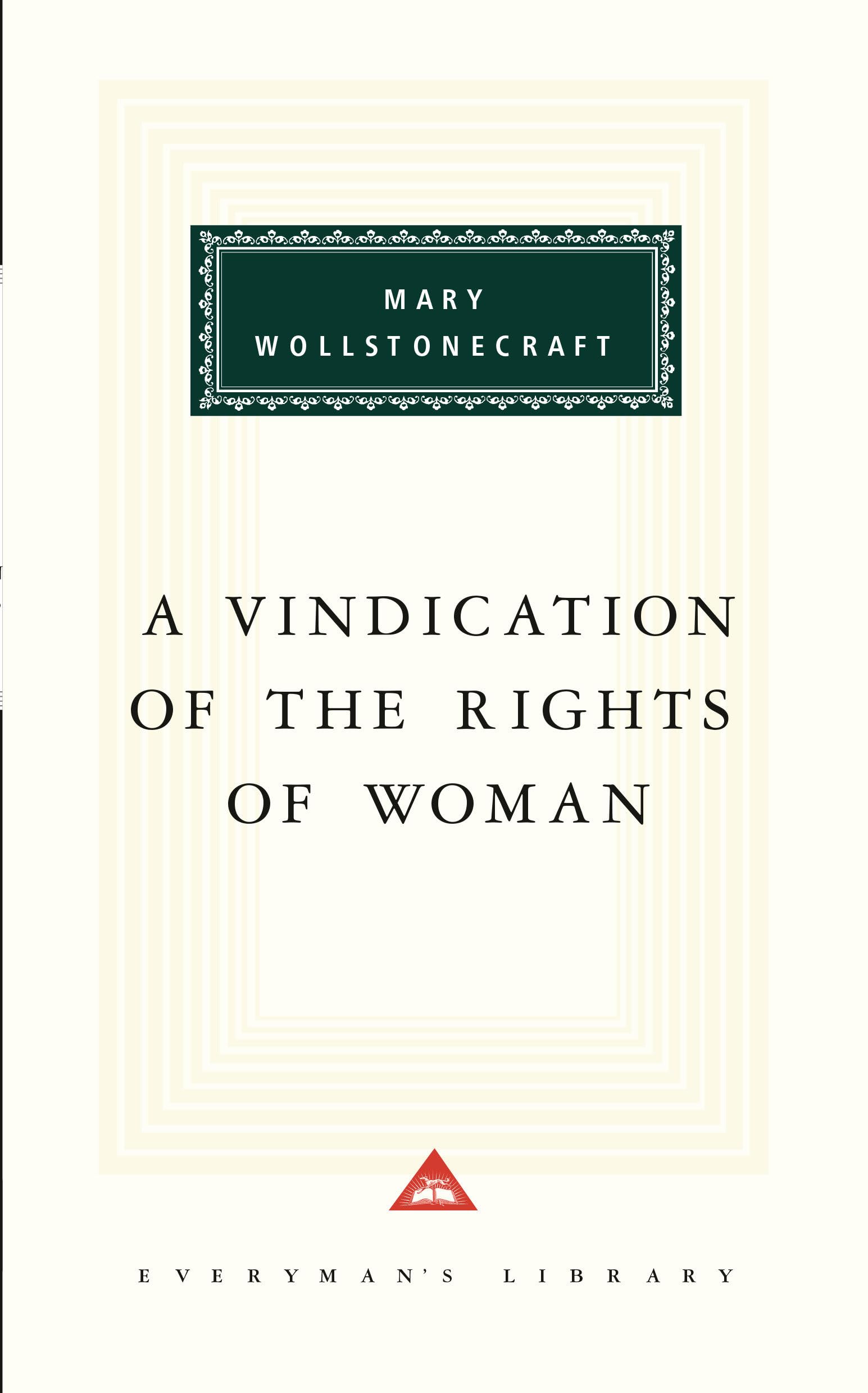
A Vindication of the Rights of Woman: Introduction by Barbara Taylor (Everyman's Library Classics Series)
$20.73
by Mary Wollstonecraft



Presented here in a stunning hardcover edition with an introduction by Barbara Taylor, this first great manifesto of women’s rights, published in 1792 and an immediate best seller, made Mary Wollstonecraft the toast of radical circles and the target of reactionary ones. Writing just after the French and American revolutions, Mary Wollstonecraft firmly established the demand for women’s emancipation in the context of the ever-widening urge for human rights and individual freedom that surrounded those two great upheavals. She thereby opened the richest, most productive vein in feminist thought, and her success can be judged by the fact that her once radical polemic, through the efforts of the innumerable writers and activities she influenced, has become the accepted wisdom of the modern era. Challenging the prevailing culture that trained women to be nothing more than docile, decorative wives and mothers, Wollstonecraft was an ardent advocate of equal education and the full development of women’s rational capacities. Having supported herself independently as a governess and teacher before finding success as a writer, and having conducted unconventional relationships with men, Wollstonecraft faced severe criticism both for her life choices and for her ideas. In A Vindication of the Rights of Woman she dared to ask a question whose urgency is undiminished in our time: how can women be both female and free? Everyman's Library pursues the highest production standards, printing on acid-free cream-colored paper, with full-cloth cases with two-color foil stamping, decorative endpapers, silk ribbon markers, and European-style half-round spines. Everyman’s Library Classics include an introduction, a select bibliography, and a chronology of the author's life and times. “We hear [Mary Wollstonecraft's] voice and trace her influence even now among the living.”—Virginia Woolf The first novel of Samuel Beckett's mordant and exhilarating midcentury trilogy introduces us to Molloy, who has been mysteriously incarcerated, and who subsequently escapes to go discover the whereabouts of his mother. In the latter part of this curious masterwork, a certain Jacques Moran is deputized by anonymous authorities to search for the aforementioned Molloy. In the trilogy's second novel, Malone, who might or might not be Molloy himself, addresses us with his ruminations while in the act of dying. The third novel consists of the fragmented monologue -- delivered, like the monologues of the previous novels, in a mournful rhetoric that possesses the utmost splendor and beauty -- of what might or might not be an armless and legless creature living in an urn outside an eating house. Taken together, these three novels represent the high-water mark of the literary movement we call Modernism. Within their linguistic terrain, where stories are taken up, broken off, and taken up again. where voices rise and crumble and are resurrected, we can discern the essential lineaments of our modern condition, and encounter an awesome vision, tragic yet always compelling and always mysteriously invigorating, of consciousness trapped and struggling inside the boundaries of nature. The first novel of Samuel Beckett's mordant and exhilarating midcentury trilogy introduces us to Molloy, who has been mysteriously incarcerated, and who subsequently escapes to go discover the whereabouts of his mother. In the latter part of this curious masterwork, a certain Jacques Moran is deputized by anonymous authorities to search for the aforementioned Molloy. In the trilogy's second novel, Malone, who might or might not be Molloy himself, addresses us with his ruminations while in the act of dying. The third novel consists of the fragmented monologue -- delivered, like the monologues of the previous novels, in a mournful rhetoric that possesses the utmost splendor and beauty -- of what might or might not be an armless and legless creature living in an urn outside an eating house. Taken together, these three novels represent the high-water mark of the literary movement we call Modernism. Within their linguistic terrain, where stories are taken up, broken off, and taken up again. where voices rise and crumble and are resurrected, we can discern the essential lineaments of our modern condition, and encounter an awesome vision, tragic yet always compelling and always mysteriously invigorating, of consciousness trapped and struggling inside the boundaries of nature. MARY WOLLSTONECRAFT (1759–97) was an educational, political, and feminist writer who early in her life worked as a companion, teacher and governess. In 1788 she settled in London as a translator and reader for the publisher Joseph Johnson, becoming part of the radical set that included Paine, Blake, Godwin and the painter Fuseli. Her great work, A Vindication of the Rights of Woman , was published in 1792. She lived in Paris during the French Revolution and had a child by the American Gilbert Imlay, who deserted