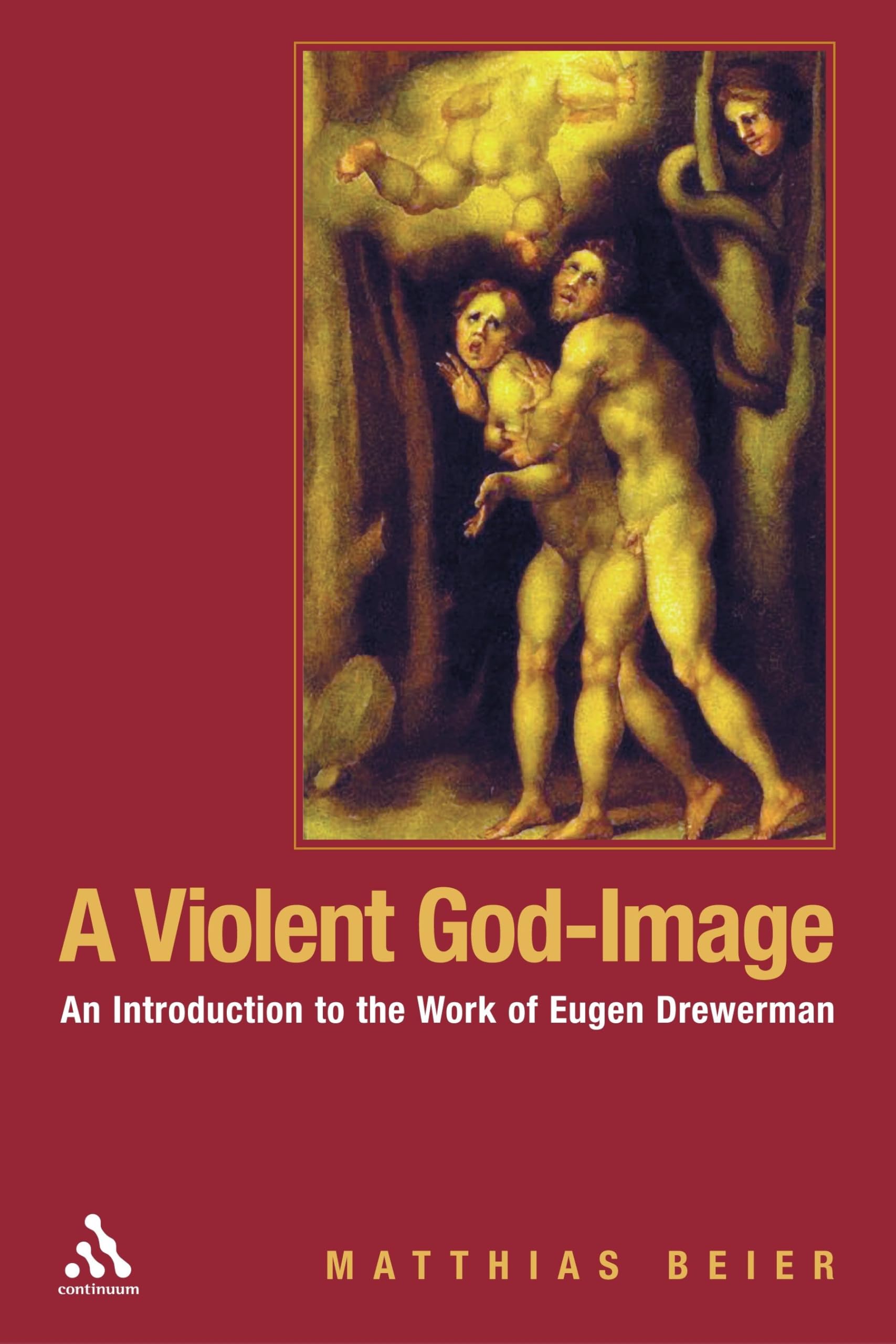
A Violent God-Image: An Introduction to the Work of Eugen Drewermann
$120.00
by Matthias Beier



Theologian and psychotherapist Eugen Drewermann has been the most significant, the most prolific, and the best-selling theological writer in the German language over the past quarter century. Drewermann shows that religion, including Christianity, turns violent mentally, spiritually, and even physically if it uses fear as a motive for faith― fear of exclusion from the group, fear of hell, and fear of God. At the heart of Drewermann's nonviolent interpretation of key Christian beliefs is his analysis of a violent image of God that characterizes traditional interpretations of sin and the cross. It is this God-image, opposed to human desires and self-realization, that sanctified the killings of millions of peoples in wars declared to be "just" and legitimated the violent exploitation of nonhuman nature and the aggressive economic exploitation of non-Christian cultures. The sheer enormity of Drewermann's principal books has thwarted publication of his works in English translation to date. His empathic critique of the clerical mentality, ideology, and culture (The Cleric), based on his psychotherapeutic work with clergy, led to his being silenced by Roman Catholic authorities in 1991 and suspended from the priesthood in 1992. This is the first full-length introduction to Drewermann in English and includes extensive quotations from his works. Praise for A Violent God-Image "Drewermann's contribution is indispensable for two reasons: because he takes mental/spiritual suffering seriously and works for the liberation of those who, 'crippled by fear all their lives, are prevented from risking themselves.' Secondly, because he does something for the world-wide church that Latin-American liberation theologians cannot achieve but need: he challenges the mega institution's attempt to stabilize power by means of fear and names authoritarian religion 'a form of violence.'" Dorothee Sölle, author of The Silent Cry and Suffering "Thank you, Matthias Beier, for introducing Eugen Drewermann to American pastoral theologians and pastoral psychotherapists. A Violent God-Image is a gift to psychotherapists and should be added to our pastoral theology canon. Drawing upon his depth of personal experience and brilliant scholarship, Eugen Drewermann also understands violence through the lens of depth psychology. His insights about the biological and psychological origins of violence can be directly applied to clinical practice. However, A Violent God-Image deserves a wider audience. The world is desperate for Drewermanns wisdom in this fearful time." Margaret Kornfeld, Past President, American Association of Pastoral Counselors, author of Cultivating Wholeness: A Guide to Care and Counseling in Faith Communities "A Violent God-image is the first theological treatment I have seen that takes the integration of psychoanalysis and religion seriously. The result is a profoundly more human cast to otherwise abstract theological propositions.... Drewermanns approach ... opens the way to a potential new era of theological reflection centered on the integration of theological principles and doctrines with fundamental human concerns and psychic realities.... I would recommend Beiers treatise for its inherent interest and for its potential for stimulating more psychologically meaningful theological reflection." W. W. Meissner, author of Psychoanalysis and Religious Experience and Treatment of Patients in the Borderline Spectrum "This first full-length volume in English on the thought of Eugen Drewermann is a welcome and long-overdue introduction to the groundbreaking work of the most prolific theological writer in the German language over the past twenty years.
We are indebted to Beier for undertaking a translation task only a native German speaker could accomplish, given the complexity and technicality of Drewermanns prose." Review of Biblical Literature , 2005 "A fascinating book! Beier brings to an English-speaking audience a profound and challenging Christian voice from Germany. In his homeland that voice has elicited the twin responses of excitement from a reading public that made his works bestsellers and of fear from his churchs hierarchy that sought to silence him. The book will be welcomed by those who labor on that frontier where faith and life collide." John Shelby Spong, author of A New Christianity for a New World "Our time has known two thinkers of dazzling brilliance: the German Eugen Drewermann and the French René Girard. Girards thought has penetrated numerous fields: literary criticism, psychoanalysis, economics, and, not least, theology. Though a sensation in Europe, Drewermann is virtually unknown in America, due to the lack of translation. Matthias Beier has done the next best thing: he has provided a condensation and commentary that makes Drewermanns thought accessible, in hopes that some enterprising press will see to the publication of more by this seminal thinker." Walter Wink, author of