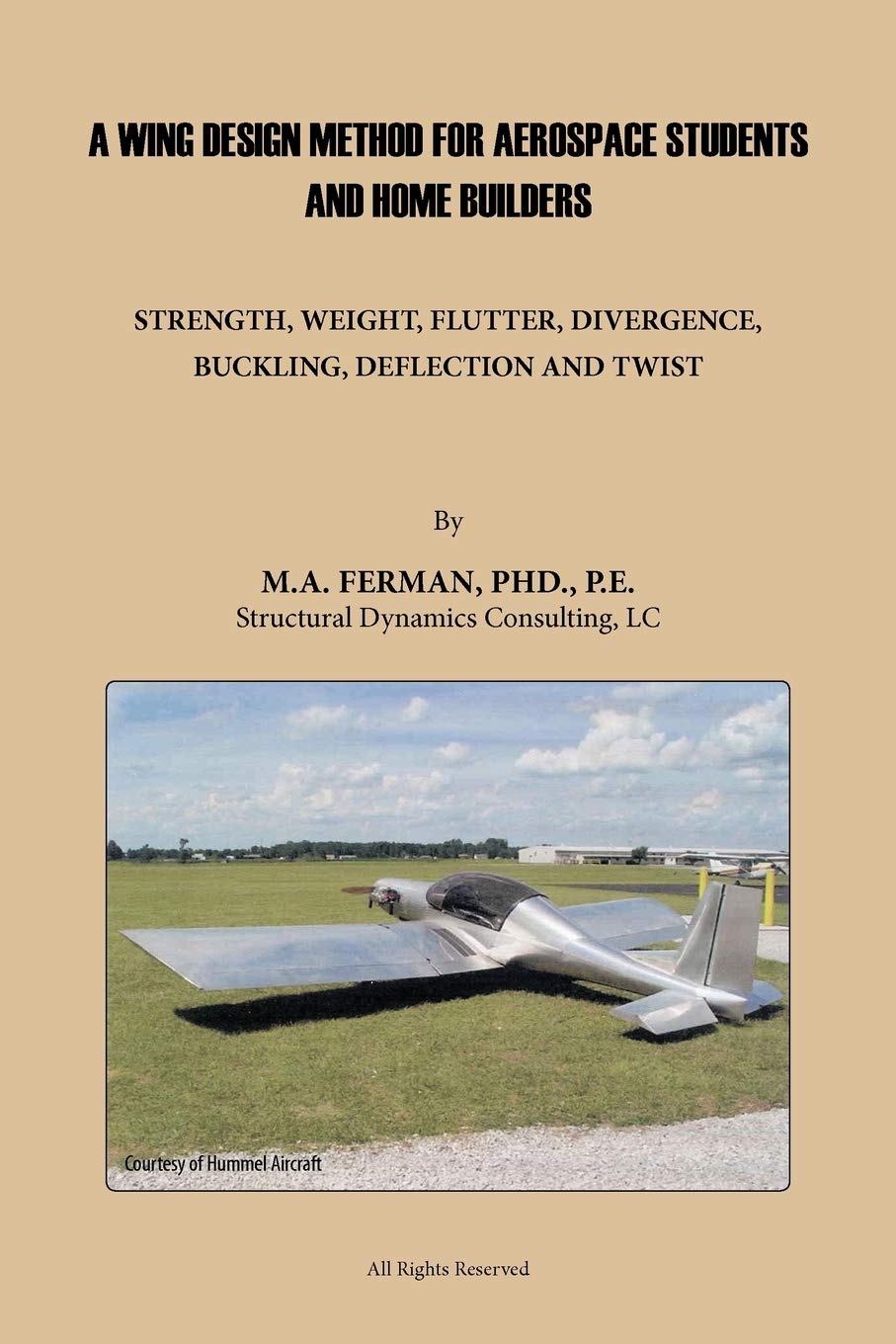
A Wing Design Method for Aerospace Students and Home Builders: Strength, Weight, Flutter, Divergence, Buckling, Deflection, and Twist
$45.00
by M. A. Ferman



Marty Ferman has developed a wing design method for use by Aerospace students in their senior design classes, and for the Home Builders of aircraft. The method allows for rapid determination of strength, weight, flutter, divergence, buckling, deflection, and twist. The method allows for preliminary design phase for a basic sizing, and then the interim and final phases follow to fill out the structure to a fabrication level. The flutter and divergence aspects are rarely covered in most design books, so there can be enhanced safety. The method presents a unique representation for the preliminary design phase where the wing skin thickness is a key factor readily found and used for the stiffness and weight calculations. Here the user can see what is needed. The method uses many closed-form expressions for the straight, unswept cantilevered wing of constant spanwise properties, with suggested forms for the non-uniform wing. This method was evolved by Ferman during his fifty-six years in Aerospace Industry and Academia. A Wing Design Method for Aerospace Students and Home Builders Strength, Weight, Flutter, Divergence, Buckling, Deflection, and Twist By M. A. Ferman Trafford Publishing Copyright © 2011 M. A. Ferman, PhD, PE All rights reserved. ISBN: 978-1-4269-7310-9 Contents 1. Introduction / Approach.................................................12. Detailed Preliminary Design.............................................63. Interim/Final Designs...................................................234. Examples Of Wing Design.................................................335. References..............................................................516. About The Author........................................................53Appendix A – Aerodynamic Coefficients......................................55 CHAPTER 1 INTRODUCTION / APPROACH This Wing Design Method is based on a technique the Author originallydeveloped for use in the Aircraft Industry, and modified to enhance usagefor aerospace students, and more recently, home builders. Originally, Ref.(1) presented the method of structural idealizations using statistical weightprediction, employing the V-G flutter solution of Ref (2), primarily. ThoseReferences are now property of the Structural Dynamics Consulting Co, since2003. Ferman's Simplified Flutter method is summarized in Ref. (3). The formof the flutter solution in the Wing Design Method has been simplified to theConceptual Flutter Solution (CFA), Ref. (4), 1964. The design method wasused at Parks College in various forms since 1992. Anyone can readily solvea quadratic equation for flutter as used here, rather than the more complexV-G solution. The CFA flutter technique was covered in detail in Flutter andAeroelasticity classes at both St. Louis Univ. and Parks College by the Author,Refs. (5) & (6), from 1965-2008. Those classes helped to diffuse the CFAmethod as widely as possible. Now, this book will open the method to homebuilders as well. Basically the Wing Design Method uses a sequence of models of theair loads, and structures to initiate design iterations, leading ultimately toan acceptable configuration. The process may be stopped at any convenientstage. Likewise, testing of models, coupons, and actual structures may be usedat any stage depending on one's needs and goals. Three cycles are shown in thecharts of the next three pages figures, Fig 1, 2, and 3. The initial cycle here isreferred to as "Preliminary Design- Phase 1" where a simple modeling is usedto define the basic requirements. A second cycle of design, called "InterimDesign –Phase 2" allows a closer definition to be made of the structure. Inboth of these stages, structural weight will be compared to target values toinsure the design is close. Both cases will address allowable stresses and willcheck for flutter and divergence. Skin Buckling can be verified to assure ribspacing. The third cycle is the "Final Design- Phase 3" wherein the differencebetween preliminary and interim designs will largely be in the degree of skinvs. ribs and spars modeled and used to provide strength and rigidity. Likewise,the refinement of the torque box vs. the overall wing detail will be anotherdifference. "Final Design" will be the end process of the refinement wherea near optimum weight vs. strength vs. rigidity (stiffness) is achieved witha more detailed structure. Here ribs, spars, skins, leading edge (L.E.) andtrailing edge (T.E.) structures are defined along with fuselage attachmentsaddressed, and with carry-through structure as needed. In some critical cases,wing store pylons, control surfaces, and landing gear may need addressing,specifically. Students may make Finite Element models, vibration models,and flutter and divergence models (scaled) if need ed. Tests can be used toconfirm deflection results, as well as using scaled models. The main focusis on metal wings, with the general approach also being useful for wood o