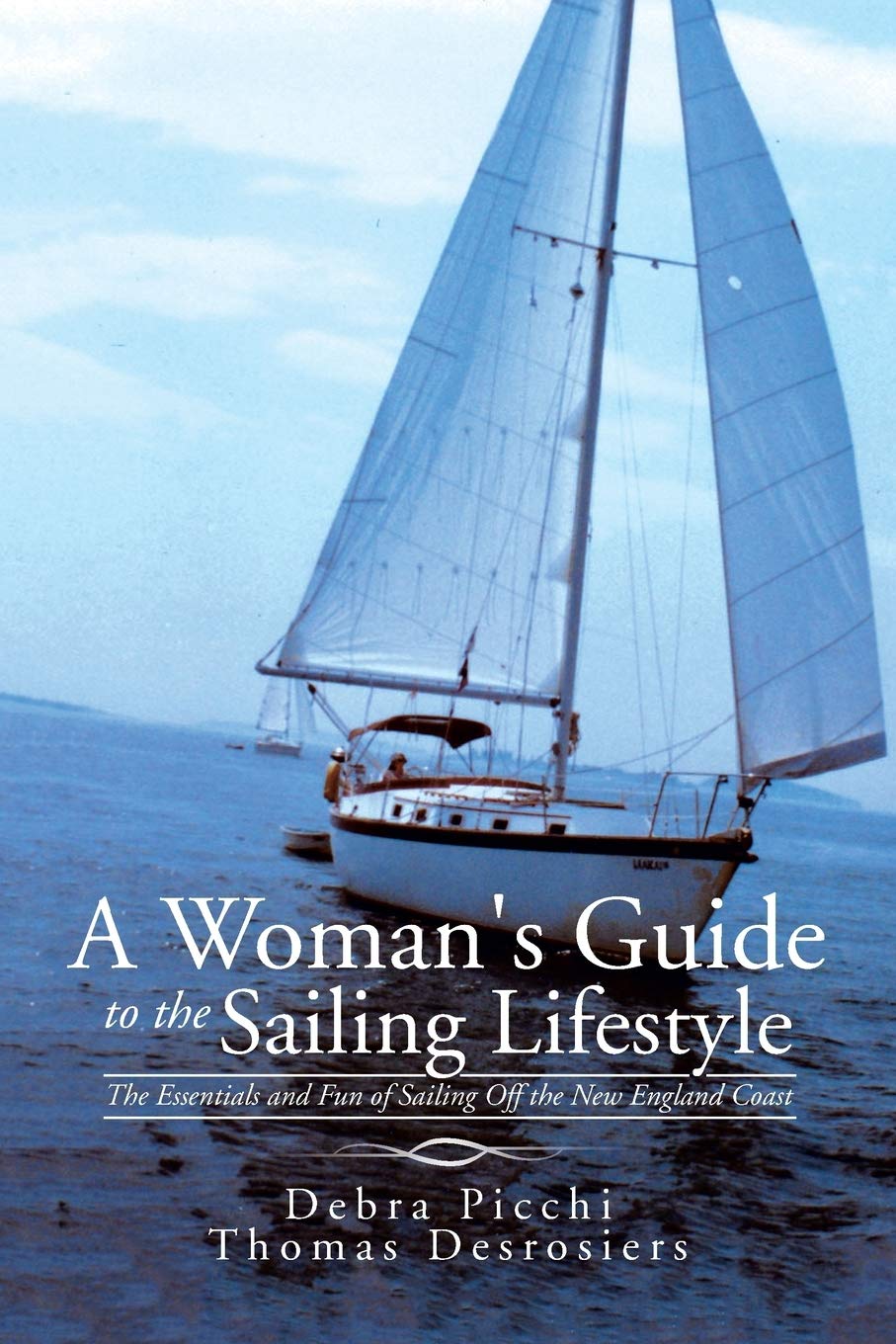
A Woman's Guide to the Sailing Lifestyle: The Essentials and Fun of Sailing Off the New England Coast
$16.95
by Debra Picchi



A chance sailing trip with a friend from work led me to wonder if I could learn to sail. After all, I'm a woman, and the sailing world seems to favor men. I am not athletic; I didn't grow up in a family where we learned about boating; I would be starting late, since I was in my thirties; and I suffer from seasickness. What I discovered over the next twenty-five years is that I could indeed learn to be a competent sailor. But I didn't expect to be an expert overnight. Instead, as a novice, I layered on new knowledge slowly, over time, through experiential learning. This book describes the process whereby this happened. Using examples from trips along the coast of Maine, New Hampshire, and Massachusetts, it reviews the essential knowledge needed to be a sailor as well as explanations about the parts of a sailboat, major boat systems, and tasks associated with maintaining a sailboat. It also discusses some Zen-like attitudes that lead to successful and fun sailing, such as focusing, the no-blame rule, and stripping down to the essentials. Unlike some other sailing guides, this book points out that sailing can be a lifestyle that includes many dimensions. It's not just about getting a boat to sail. Traveling by boat is a unique experience, and visiting small coastal New England communities is an adventure. Learning about history, art, ecology, star constellations, technology, and birds are only a few of the kinds of activities that can be built into a rich and rewarding sailing experience. This book will be helpful for people who would like to learn to sail but who are intimidated by the process, particularly women, fledgling sailors just starting out, and families with children. A Woman's Guide to the Sailing Lifestyle The Essentials and Fun of Sailing Off the New England Coast By Debra Picchi, Thomas Desrosiers AuthorHouse Copyright © 2015 Debra Picchi; Thomas Desrosiers All rights reserved. ISBN: 978-1-5049-2844-1 Contents Dedication, v, Acknowledgement, vii, Chapter One An Introduction: Two Sailing Episodes, 1, Chapter Two Getting to Know the Boat, 19, Chapter Three Beginning the Sailing Season, 35, Chapter Four Intangibles and Tangibles: Bringing What You Need on Board, 55, Chapter Five The Southwestern Coast of Maine: Learning the Basics About Sailing, 75, Chapter Six Provincetown: My First Big Passage, 92, Chapter Seven The Magic of Casco Bay, 108, Chapter Eight Maine's River Region Between Casco and Penobscot Bays, 122, Chapter Nine The Vastness of Penobscot Bay, 137, Chapter Ten "Down-and-Out" In Moose Island, Off Stonington, Maine, 152, Chapter Eleven You and Sailing, 165, Terms I Learned, 177, References Cited, 187, Biographies, 189, CHAPTER 1 An Introduction: Two Sailing Episodes The Beginning One spring day a friend from work named Tom invited me to go sailing. It was a sunny, warm Saturday when I drove from Keene in southwestern New Hampshire to a marina on Great Bay and the Piscataqua River in the eastern part of the state. I was in high spirits. I had never been sailing before and knew absolutely nothing about boats. But I was ready for an adventure. I found Tom polishing what seemed to me to be a large sailboat. It was named Trull II, and he told me it was a 25-foot Cape Dory which I later discovered was a kind of a boat, much like a Ford is a kind of a car. I lent a hand with the cleaning until it was time for us to go out into the river. At that point I learned that we were going to take the boat down the Piscataqua River to Portsmouth Harbor and then into a small inlet named Pepperrell Cove where Tom had a permanent place for the boat. I cheerfully readied myself for the trip, grabbing my light jacket and a few other things from my car. Tom started an outboard engine that sat in a well at the back of the boat and cast off the ropes that bound Trull II to the docks. He steered by moving a tiller which looked like a stick located in the center of the cockpit. We went into the river where there was a strong current that made the water churn and froth. (I later learned that the Piscataqua River is the third fastest navigable river in the world.) We struck out toward green and red cans that stood in the middle of a curve in the river in front of a large bridge. Tom explained that we had to go between the two cans because that was where the channel lay. The green can should be on our right side, the starboard side, and the red one should be on our left side, the port side. I silently tried to absorb as much information as I could and not to seem the novice I was. Trull II chugged along valiantly through the turbulent waters. We passed between the cans toward the tall Memorial Bridge which soared above us when we went under it. I was having a wonderful time. The breeze was fresh, the water was a grey-blue, and the wooded shores revealed secluded homes every once in a while. Tom and I chatted about his boat and his personal sailing history. I lear