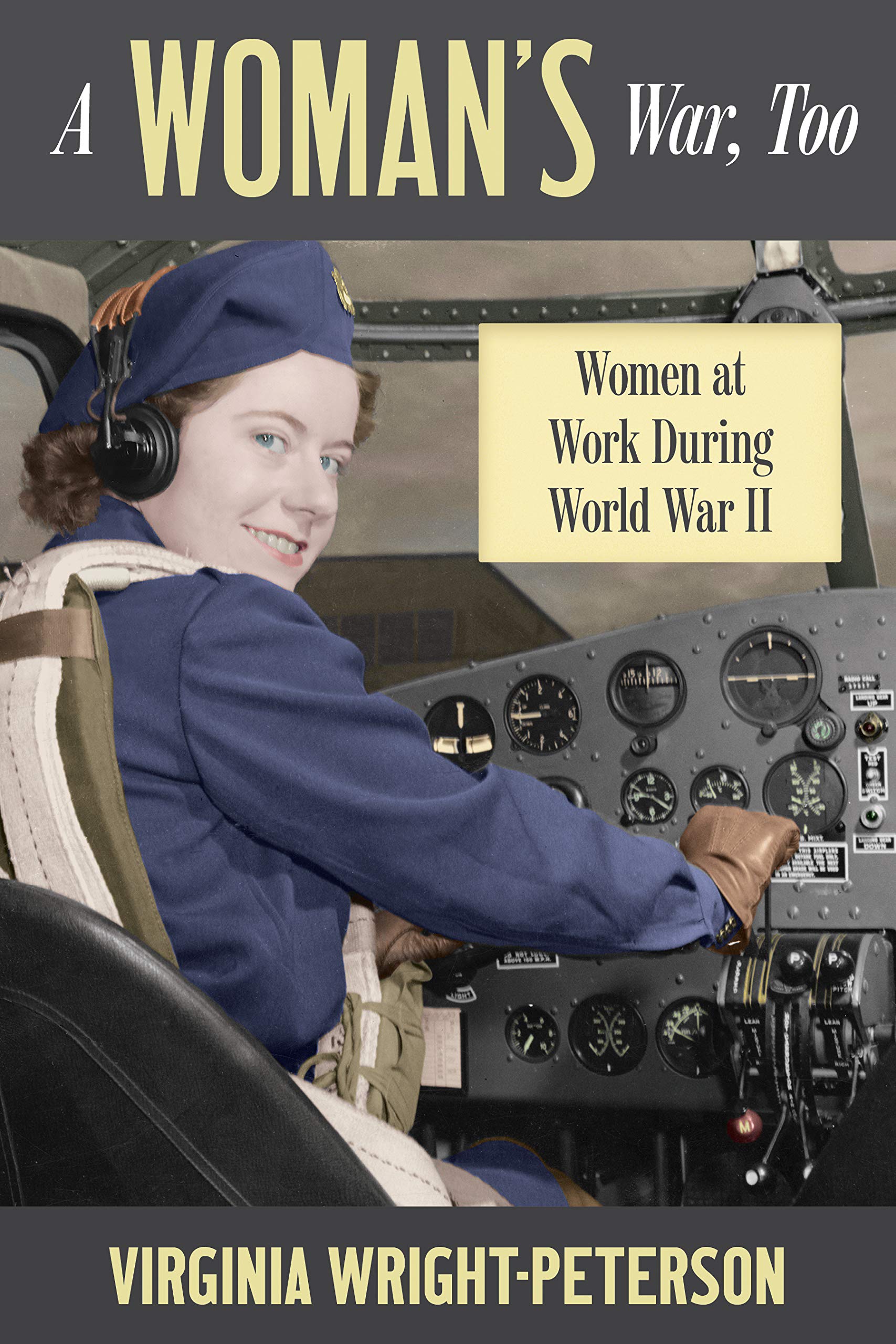



World War II was a total war, devouring the military and civilian resources of nations. Women in Minnesota—like women across the country—made bold, unconventional, and important contributions to the effort. They enlisted in all branches of the military and worked for the military as civilians. They labored in factories, mines, and shipyards. They were also tireless peace activists, and they worked to relocate interned Japanese American citizens and European refugees. They served as cryptologists, journalists, pilots, riveters, factory workers, nurses, entertainers, and spies. In 1938, before the United States joined the conflict, a Minnesota woman was covering the war in Europe as a reporter. Another was a military nurse at Pearl Harbor when the bombs fell. Minnesota women witnessed the fall of France, the defeat of Axis forces in North Africa and Italy, the Battle of the Bulge, D-Day and the invasion of Normandy, the liberation of France and of the concentration camp at Dachau, and the dropping of the atomic bomb on Hiroshima. In this rich chronological account, Virginia Wright-Peterson reframes our understanding of the war through the specific and powerful stories of individual women. It was their war, too. Virginia Wright-Peterson has taught writing for over fifteen years and is on the administrative team at the University of Minnesota Rochester. She is the author of Women of the Mayo Clinic: The Founding Generation . Julia Herrick, a biophysicist working at Mayo Clinic, was invited by the U.S. War Department to conduct research on radar. In 1942, she was granted a leave of absence by Mayo Clinic to allow her to become a civilian working at the Army Signal Corps Engineering Laboratories, Fort Monmouth, New Jersey. During her nearly three years of research, she was also assigned to the Radio Direction Finding Receiver Subsection of the Equipment Subsection at the Evans Signal Laboratory at Bradley Beach, New Jersey. Her research focused on radio direction finding. Her team was charged with designing a direction finder that could be transported in a small vehicle of a size and weight three men could set up and make operational within twenty minutes. Development began in August 1943 and concluded in August 1945. The project was successful for its intended use of radiocommunication direction finding, and she and her team found that "it may also have important application to homing and navigation for position finding for rescue operations.” [break] Julia Herrick’s path to radar research began early in her career. She was born in 1893 in North St. Paul and after completing a bachelor’s degree in math from the University of Minnesota in 1915, Julia Herrick taught high school math, chemistry, and physics in Pine City and Ely, and in Minneapolis at a private high school later be known as Blake School. She returned to the University of Minnesota, and in 1919, after completing a master’s degree in physics, she became head of the physics department at Rockford College, Illinois. Frustrated by the lack of funding for her physics lab and changes in the curriculum that discouraged students from taking physics, Julia applied to the Mayo Clinic. In 1927, she was accepted as a fellow in biophysics at Mayo Clinic. By 1931, she completed her doctorate and became an associate in experimental surgery and pathology, conducting research in Mayo’s Institute of Experimental Medicine. She studied the impact of ultrasound on bone and made important contributions to the development of the thermistor, a device used for physiologic thermometry by biophysicists, anesthesiologists, and experimental surgeons. She had thirteen years of experience working in the field of biophysics when the war broke out. When Dr. Herrick first arrived at Fort Monmouth, she was assigned to a technician with a few college credits and a couple of years of experience in electronics, Gustav Shapiro. He said Julia “was a fish out of water, but a smart woman. She had a lot of mathematics, and that’s why they assigned her to me. She was able to supplement what I didn’t know. I started to work on cavity resonators (what did I know about cavity resonators?) I had the feel, but not the mathematics. Between the two of us, we managed to figure things out.” He also got to know her personally and learned about her family. “Dr. Herrick came from a Minneapolis banking family. There were three children, two sons and she was the daughter. When the father died, he left control of the bank to her because he trusted her common sense more than that of his sons. She was a smart gal in her late forties I would say, and prematurely gray. She was an extremely good looking and appealing woman and it was very easy to get along with her. She had the common touch. We once had a Thanksgiving party at our house and played charades. When it was her turn to act out something, she took a long-stemmed flower in her hand and stretched out on the floor facing the ceiling with her eyes