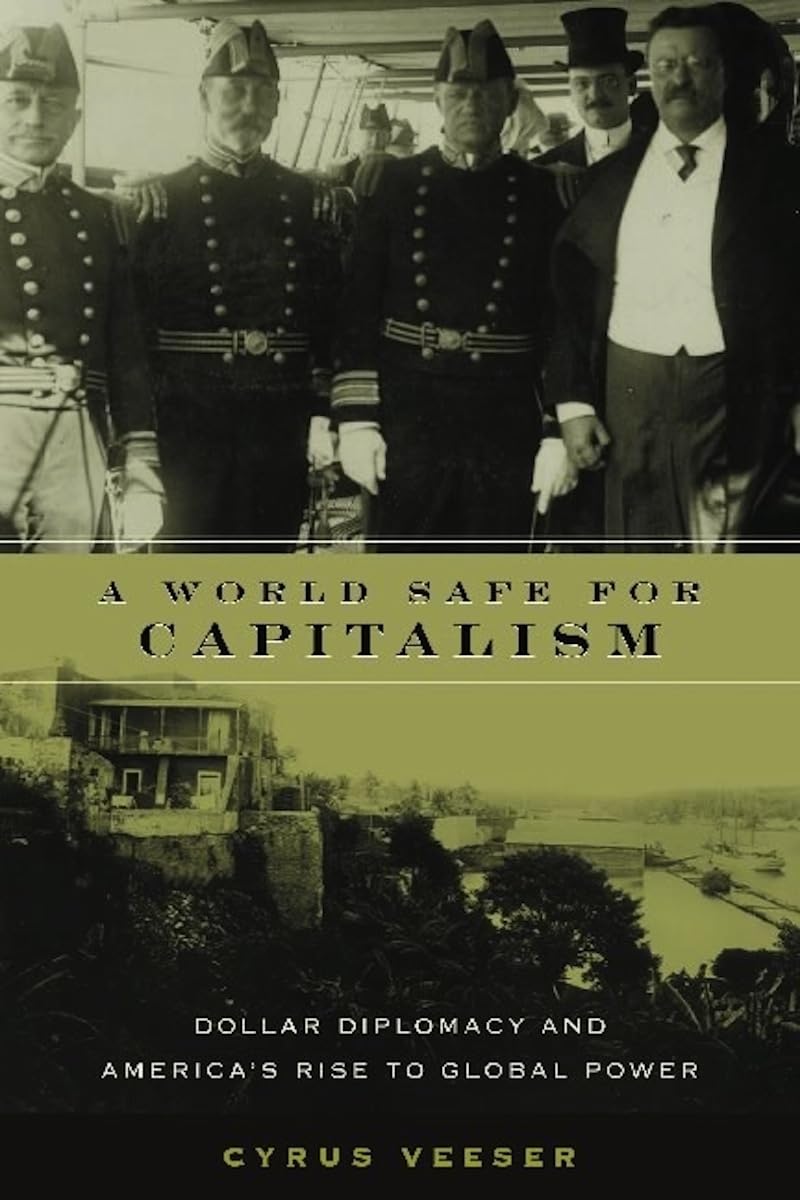



This award-winning book provides a unique window on how America began to intervene in world affairs. In exploring what might be called the prehistory of Dollar Diplomacy, Cyrus Veeser brings together developments in New York, Washington, Santo Domingo, Brussels, and London. Theodore Roosevelt plays a leading role in the story as do State Department officials, Caribbean rulers, Democratic party leaders, bankers, economists, international lawyers, sugar planters, and European bondholders, among others. The book recounts a little-known incident: the takeover by the Santo Domingo Improvement Company (SDIC) of the foreign debt, national railroad, and national bank of the Dominican Republic. The inevitable conflict between private interest and public policy led President Roosevelt to launch a sweeping new policy that became known as the Roosevelt corollary to the Monroe Doctrine. The corollary gave the U. S. the right to intervene anywhere in Latin American that "wrongdoing or impotence" (in T. R.'s words) threatened "civilized society." The "wrongdoer" in this case was the SDIC. Imposing government control over corporations was launched and became a hallmark of domestic policy. By proposing an economic remedy to a political problem, the book anticipates policies embodied in the Marshall Plan, the International Monetary Fund, and the World Bank. Based on Veeser's Bancroft Dissertation Prize-winning thesis, this work examines a little-known but important event in the history of U.S. foreign policy. During the early 1890s, the Dominican Republic's finances were controlled by a Dutch company to insure payment of the country's foreign debt. In 1892, a small group of American politicians and financiers formed the Santo Domingo Improvement Society and purchased the right to manage the country's finances. The U.S. government supported the society as a cheap means of protecting American economic and political interests. However, Dominican dictator Ulises Heureaux's exploitation of the society and the imposition of a managed cash-crop farming system led to a decade of social unrest. President Theodore Roosevelt concluded that running foreign policy through a private firm was unsuccessful, which led him to order a U.S. occupation in January 1905. Vesser draws from American, English, French, and Dominican archival materials to present a detailed and well-written account of the early growth of U.S. overseas influence. Highly recommended. Stephen L. Hupp, West Virginia Univ. Lib., Parkersburg Copyright 2002 Cahners Business Information, Inc. A detailed and well-written account of the early growth of U.S. overseas influence. Highly recommended. ― Library Journal A well-documented study... recommended. ― Choice Veeser argues that the origins of Dollar Diplomacy can be found in the story of an American firm, the San Domingo Improvement Company (SDIC), and its efforts in the Dominican Republic in the 1890s. ― Enterprise & Society This book is the first comprehensive study of the company and its role in the shaping of the Dominican economy and U.S. foreign policy... A major contribution to the fields of U.S. economic and diplomatic history as well as Dominican history. ― Journal of American History [I]n his excellent new analysis... Veeser disrupts the simplistic notion of foreign policy as window dressing for the gradually accumulating class interests of finance capitalists.... [E]asy to recommend. -- Jesse Hoffnung-Garskof ― Business History Review This well-wrought book will stand as an authoritative monograph―useful to both scholars and teachers. -- Seth Fein ― Hispanic American Historical Review The book is an interesting and intricate account of how Dollar Diplomacy worked in practice and how, over time, it went terribly wrong. -- Gregory Weeks ― Latin Americanist Cyrus Veeser is associate professor of history at Bentley College. He won the Bancroft Dissertation Prize for the work on which this volume is based. Cyrus Veeser, an assistant professor of history at Bentley College, won the Bancroft Dissertation Prize for the work on which this volume is based. He lives in Arlington, Massachusetts.