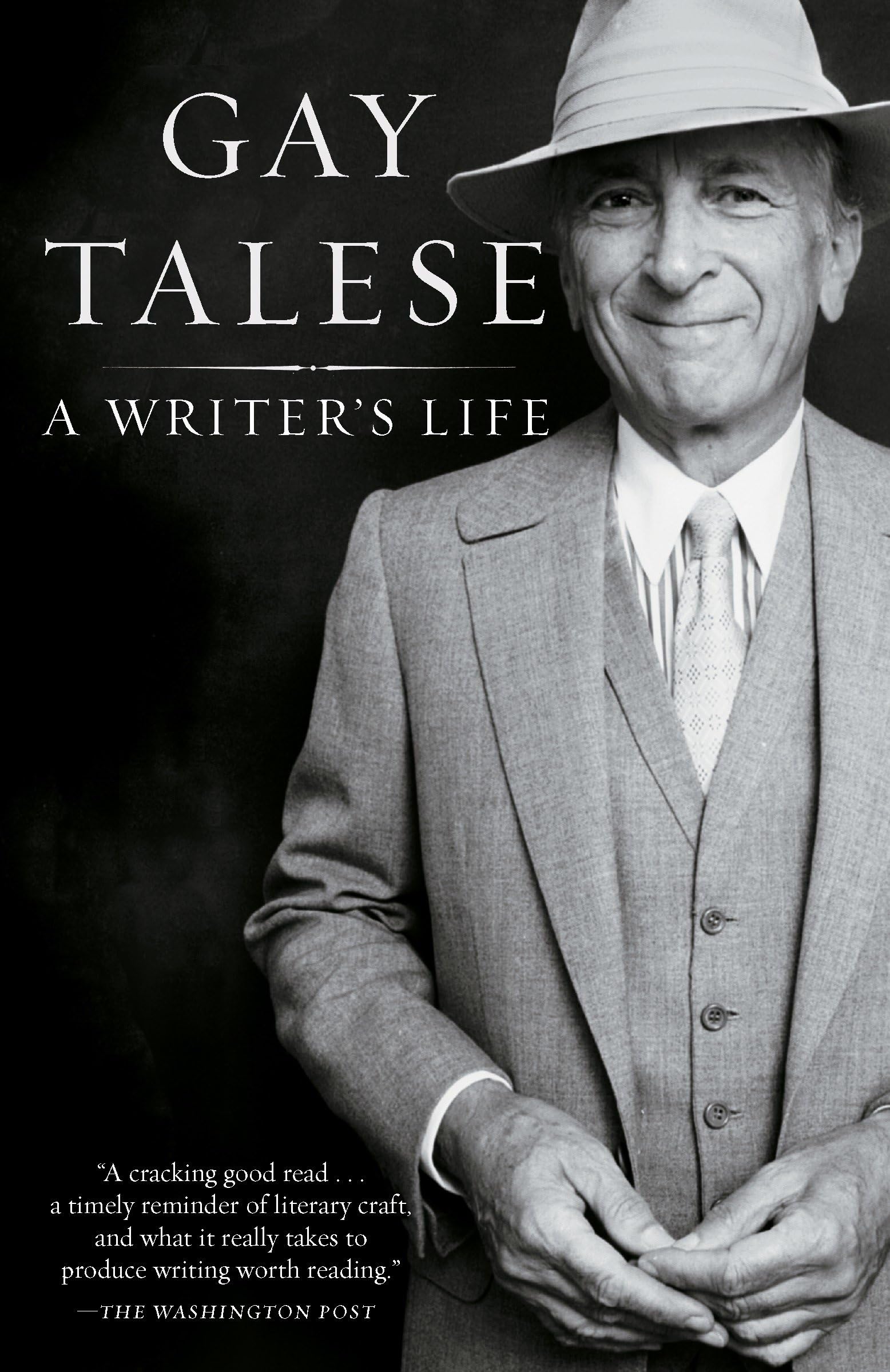



The inner workings of a writer’s life, the interplay between experience and writing, are brilliantly recounted by a master of the art. Gay Talese now focuses on his own life—the zeal for the truth, the narrative edge, the sometimes startling precision, that won accolades for his journalism and best-sellerdom and acclaim for his revelatory books about The New York Times (The Kingdom and the Power), the Mafia (Honor Thy Father), the sex industry (Thy Neighbor’s Wife), and, focusing on his own family, the American immigrant experience (Unto the Sons). How has Talese found his subjects? What has stimulated, blocked, or inspired his writing? Here are his amateur beginnings on his college newspaper; his professional climb at The New York Times; his desire to write on a larger canvas, which led him to magazine writing at Esquire and then to books. We see his involvement with issues of race from his student days in the Deep South to a recent interracial wedding in Selma, Alabama, where he once covered the fierce struggle for civil rights. Here are his reflections on the changing American sexual mores he has written about over the last fifty years, and a striking look at the lives—and their meaning—of Lorena and John Bobbitt. He takes us behind the scenes of his legendary profile of Frank Sinatra, his writings about Joe DiMaggio and heavyweight champion Floyd Patterson, and his interview with the head of a Mafia family.But he is at his most poignant in talking about the ordinary men and women whose stories led to his most memorable work. In remarkable fashion, he traces the history of a single restaurant location in New York, creating an ethnic mosaic of one restaurateur after the other whose dreams were dashed while a successor’s were born. And as he delves into the life of a young female Chinese soccer player, we see his consuming interest in the world in its latest manifestation.In these and other recollections and stories, Talese gives us a fascinating picture of both the serendipity and meticulousness involved in getting a story. He makes clear that every one of us represents a good one, if a writer has the curiosity to know it, the diligence to pursue it, and the desire to get it right.Candid, humorous, deeply impassioned—a dazzling book about the nature of writing in one man’s life, and of writing itself. Gay Talese was a reporter for The New York Times from 1956 to 1965. Since then he has written for the Times, Esquire, The New Yorker, Harper’s Magazine, and other national publications. He is the author of eleven books. He lives with his wife, Nan, in New York City. 1I am not now, nor have I ever been, fond of the game of soccer. Part of the reason is probably attributable to my age and the fact that when I was growing up along the southern shore of New Jersey a half century ago, the sport was virtually unknown to Americans, except to those of foreign birth. And even though my father was foreign-born—he was a dandified but dour custom tailor from a Calabrian village in southern Italy who became a United States citizen in the mid-1920s—his references to me about soccer were associated with his boyhood conflicts over the game, and his desire to play it in the afternoons with his school friends in an Italian courtyard instead of merely watching it being played as he sat sewing at the rear window of the nearby shop to which he was apprenticed; yet, as he often reminded me, he knew even then that these young male performers (including his less dutiful brothers and cousins) were wasting their time and their future lives as they kicked the ball back and forth when they should have been learning a worthy craft and anticipating the high cost of a ticket to immigrant prosperity in America! But no, he continued in his tireless way of warning me, they idled away their afternoons playing soccer in the courtyard as they would later play it behind the barbed wire of the Allied prisoner of war camp in North Africa to which they were sent (they who were not killed or crippled in combat) following their surrender in 1942 as infantrymen in Mussolini's losing army. Occasionally they sent letters to my father describing their confinement; and one day near the end of World War II he put aside the mail and told me in a tone of voice that I prefer to believe was more sad than sarcastic, "They're still playing soccer!"The World Cup soccer finale between the women of China and the United States, held on July 10, 1999, in Pasadena, California, before 90,185 spectators in the Rose Bowl (the largest turnout for any women's sporting contest in history), was scheduled to be televised to nearly 200 million people around the world. The live telecast that would begin on this Saturday afternoon in California at 12:30 would be seen in New York at 3:30 p.m. and in China at 4:30 a.m. on Sunday. I had not planned to watch the match. On this particular Saturday in New York I had already made arrangements for midday doubles in Ce