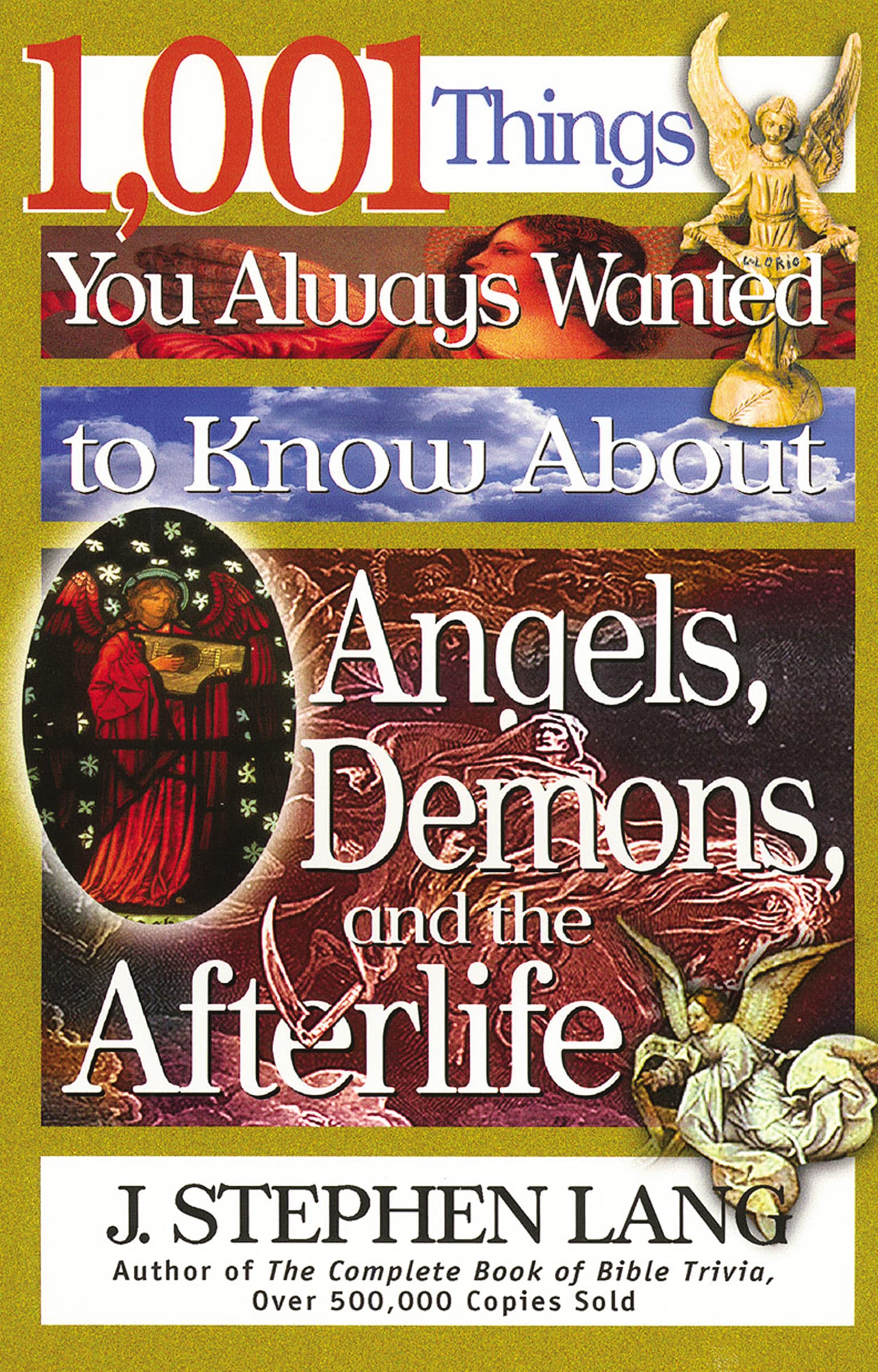
1,001 Things You Always Wanted to Know About Angels, Demons, and the Afterlife
$24.63
by J. Stephen Lang



With wit and candor, bestselling author J. Stephen Lang expertly guides you on a fascinating exploration of those things "seen through a mirror dimly." Digging deep into the rich history of Christian thinking and surveying important figures, biblical references, and popular culture, Lang compiles an easy-to-read, comprehensive list to satisfy curiosity and increase your knowledge on such subjects as: What does the Bible actually say about guardian angels? - Why is hell described as "fire and brimstone"? - What is Limbo? - What does the Apostles' Creed mean when it says Jesus "descended into hell"? - What (and where) is the "seventh heaven"? - Who played the angel Michael in a 1996 film? In 1,001 Things You Always Wanted to Know About Angels, Demons, and the Afterlife , romp through history and the Bible learning key scriptural passages and helpful information on such matters as the afterlife in pop culture, controversial beliefs, favorite hymns, and symbolism in Christian art. Whether used as a reference book or a treasury of trivia, this intriguing book will be a joyful companion to further study and inquiries. J. Stephen Lang is the author of the bestseller The Complete Book of Bible Trivia and sixteen other books, including 1,001 Things You Always Wanted to Know About the Bible and 1,001 Things You Always Wanted to Know About the Holy Spirit . 1,001 Things You Always Wanted to Know about Angels, Demons, and the Afterlife By J. Stephen Lang Nelson Books Copyright © 2000 J. Stephen Lang All right reserved. ISBN: 9780785268611 Chapter One How They Behave, and Why The Habits We Like 1 The purr-fect sound of contentment To a cat lover, it is one of the most pleasant sensations in the world: the contented vibration that we know as purring. Why do they do it? Scientists think it is a kind of "homing device" used by a mother cat to help her newborn kittens (whose sight, hearing and sense of smell are all underdeveloped) locate her when it's time to nurse. Purring is a kind of "dinner bell" to young kittens. A mother cat purrs, the kittens fasten on, and the purring stops. We can't be sure, but it appears that from kittenhood on they associate purring with pleasure. 2 Share the purr Your contented cat may purr in your lap or lying near you, but you won't hear (or feel) him purr as he lies contented in the sun. Purring is never a solitary act; cats only purr in the close proximity of a human-or another cat. Cat experts think purring indicates not only contentment but also submission. That is, purring is the kitten's signal to his mother and the adult cat's signal to his owner that "I'm yours." No wonder owners take such pleasure in it. 3 They knead you Kneading refers to a cat's habit of using its front paws to massage a person's chest or stomach. It goes back to kittenhood, when a nursing kitten uses its tiny paws to massage its mother's udder while sucking. Kneading is inevitably accompanied by purring, and both adults and kittens are clearly in cat heaven while kneading. Some cat owners love this evidence that cats can pet their owners as well as be petted. On the other hand, kneading can be downright painful to people, because a cat's claws are definitely out while kneading. Owners of declawed cats (including the author) find kneading to be a perfectly painless and delightful aspect of cat ownership. 4 There's a name for it: "bunting" There's a fabric called "bunting," and you can "bunt" a baseball. Likewise, your cat will "bunt" you and your furniture as part of a familiar habit: rubbing the side of his head against a person or an object. This isn't just affection; the cat is actually leaving behind some glandular secretions from his face as a kind of "I was here" signal to himself and other cats. We can be thankful that this form of scent marking is practiced on us instead of the much more obnoxious spraying of urine. 5 Mad dashes It amuses us as much as it mystifies us: for no apparent reason a cat suddenly makes a mad dash through the house. Many cat owners claim cats do so after using the litter box, perhaps to express a sense of relief and release. Conversely, some do it right after eating. But often the cat's mad dash is connected to no other event. Experts in animal behavior suggest that running fits might relieve tension, but tension doesn't seem to be much of a problem for many cats. Perhaps the best and most satisfying explanation is that it just feels really good to run and frolic, even if it's just for a few seconds. 6 The "I see you" call Cats vary greatly in their "talkativeness," but most of them will give an "acknowledgment" call to people with whom they are familiar. This is a very short, soft "meow" uttered when, for example, you walk through a room where the cat is sitting. The acknowledgment call isn't urgent or pleading, and you won't hear it if you've just walked into the house after being gone for two weeks. Cat owners find it to be a pleas