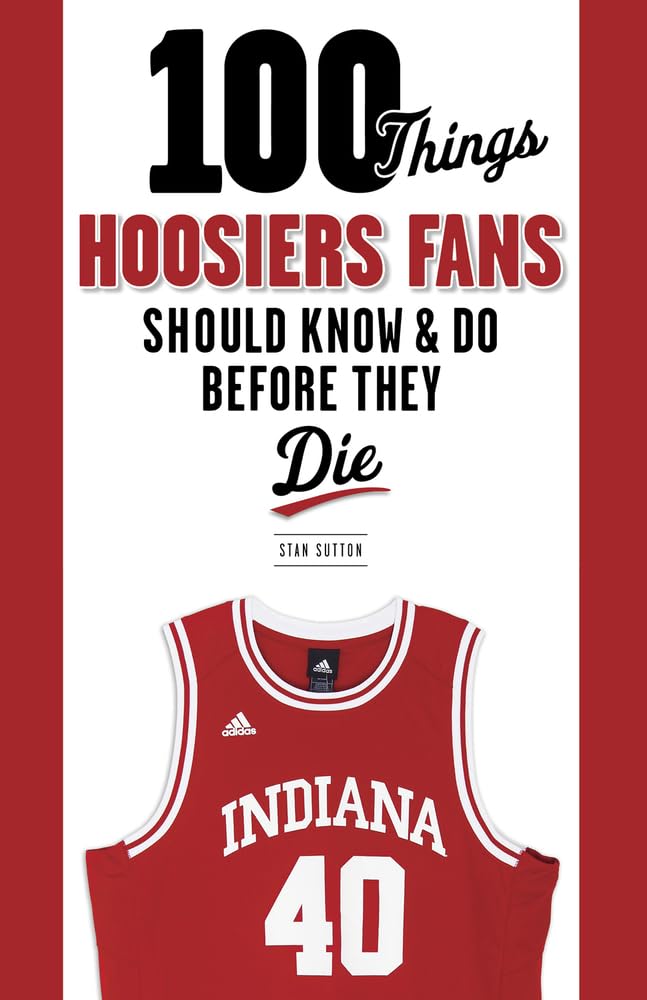
100 Things Hoosiers Fans Should Know & Do Before They Die (100 Things...Fans Should Know)
$10.47
by Stan Sutton



This guide to all things Hoosiers tells the history of Indiana University basketball across several decades and covers anything and everything a fan should know. It takes years of Hoosiers history and distills it to the absolute best and most compelling, identifying the personalities, events, and facts that every living and breathing fan should know without hesitation. Numbers, nicknames, memorable moments, singular achievements, and signature plays all highlight the list of 100. Stan Sutton, a longtime IU beat writer, has assembled all the information and achievements that are sure to educate and entertain new and old fans alike. In its century-plus of college basketball, Indiana University has established a winning tradition that includes five NCAA championships and 20 Big Ten conference championships, all of which is celebrated in this entertaining resource. Stan Sutton is a member of the Indiana Sports Writers and Sportscasters Hall of Fame and has covered the Hoosiers since 1984. During his career, Sutton worked for six newspapers in the Midwest, including a 25-year stint with the Courier-Journal . He is the coauthor of Tales from the Indiana Hoosiers Locker Room and Tales from the 1980-81 Indiana Hoosiers. He lives in Bloomington, Indiana. 100 Things Hoosiers Fans Should Know & Do Before They Die By Stan Sutton Triumph Books Copyright © 2012 Stan Sutton All rights reserved. ISBN: 978-1-60078-731-7 CHAPTER 1 The Hoosiers Are a Perfect 32–0 From November 29 in St. Louis until March 29 in Philadelphia, the 1975–76 Indiana Hoosiers were unblemished, unbeaten, and unfazed. Over the course of four months and 32 games they reached a level of perfection that no one has equaled in the 36 years since. There were unbeaten teams before them but none since. Each season hence, Indiana fans have watched another university open with 10 — or maybe even 15 — straight victories only to know that somewhere before or during March Madness, that team was almost certain to fall. There are multiple reasons why Indiana's perfect season may not be matched again. For one thing, the season is longer. By November 29, the date the 1976 Hoosiers launched the season, the 2012 IU team had played six games and one exhibition contest. Since '76, major college powers are more likely to play in an early-season tournament, sometimes meeting a couple of teams that could contend for the national title. One may argue that the Maui Invitational or preseason National Invitation Tournament (NIT) have the second strongest field of the year, trailing only the NCAA. Another factor might be intersectional battles in the middle of the conference season, something such as North Carolina vs. Michigan State as a national television showpiece. These games offer great exposure but can detract from the conference games at hand. Finally, the 1976 Hoosiers enjoyed a slightly shorter road to the title, playing five opponents that were all ranked in the top 20. The current winner must play at least six games and often is shipped across the country to increase parity in the field. The only break IU received in that area was to play its first game in South Bend, prior to two in Baton Rouge and two in Philadelphia. Other teams received breaks no longer available through rule changes. Kentucky won the 1958 NCAA without leaving its home state. UCLA's string of national titles was easier because it always played in the West Regional, which was deemed weaker at the time. The building blocks that led the Hoosiers into college basketball's throne room began with the hiring of West Point coach Bob Knight in 1971. The once-proud Hurryin' Hoosiers of Branch McCracken had become an average team while archrival Purdue was enjoying more success. The Boilermakers recruited three straight Indiana Mr. Basketballs between 1964 and '66, landing Denny Brady, Billy Keller, and Rick Mount. Mount had led Purdue to the national championship game in 1969 and Purdue had a new playing facility, Mackey Arena, while the Hoosiers were still playing in a building largely used for track and field. Knight, who became head coach at West Point at age 24, wasn't timid about making changes. He switched the team's nickname from Hurryin' Hoosiers to Hoosiers then replaced McCracken's hurry-up offense with a slower-paced one. Both changes struck a nerve with some of the old-time IU fans who liked both the name and game of McCracken's teams. The cupboard wasn't bare when Knight arrived; the roster included Steve Downing, Joby Wright, John Ritter, and Bootsie White but was missing George McGinnis who turned pro after his sophomore season. In short order Knight supplemented them by adding Steve Green, John Laskowski, Quinn Buckner, Bobby Wilkerson, Kent Benson, and Jim Crews. Indiana went to the NIT in Knight's first season then rallied to overcome Minnesota and win the Big Ten in 1973. He then reached the Final Four while starting two freshmen guards, Buckner and Crews, and build