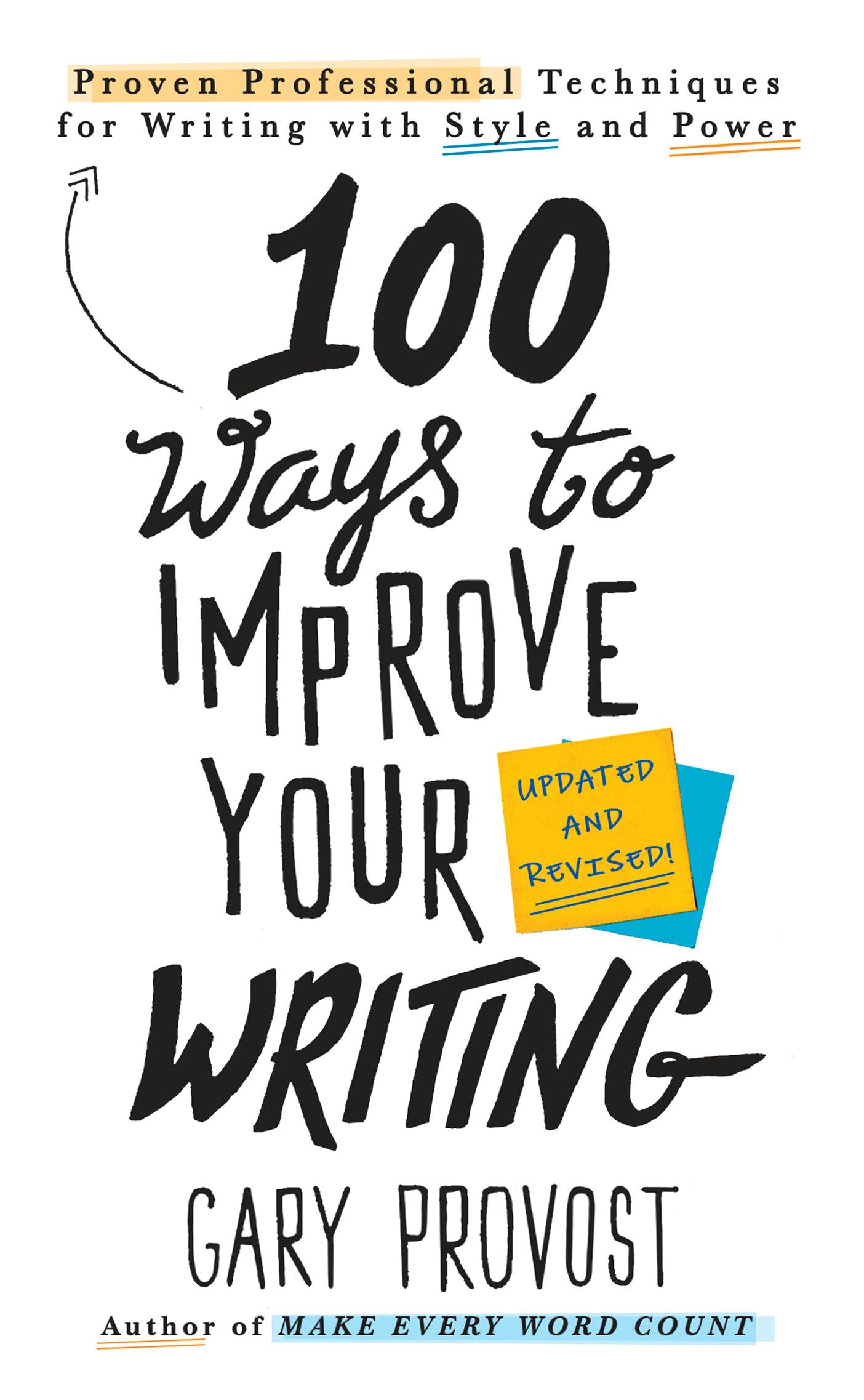
100 Ways to Improve Your Writing (Updated): Proven Professional Techniques for Writing with Style and Power
$9.02
by Gary Provost



The classic text on writing well, now refreshed and updated—an essential text for writers of all ages. This is the one guide that anyone who writes—whether student, businessperson, or professional writer—should keep on his or her desk. Filled with professional tips and a wealth of instructive examples, 100 Ways to Improve Your Writing can help solve any writing problem. In this compact, easy-to-use volume you'll find the eternal building blocks of good writing—from grammar and punctuation to topic sentences—as well as advice on challenges such as writer's block and creating a strong title. It is a must-have resource—perfect for reading cover to cover, or just for keeping on hand for instant reference—now updated and refreshed for the first time. Gary Provost was a writing teacher and the author of more than a thousand published articles and stories. His two dozen books include both adult and YA fiction, and nonfiction such as The Freelance Writer's Handbook . His methods continue to be taught at the semiannual writer's conference he established, the Writer's Retreat Workshop (www.wakeupandwritewrw.com). CHAPTER 5. TEN WAYS TO DEVELOP STYLE Think About Style In any discussion of writing, the word style means the way in which an idea is expressed, not the idea itself. Style is form, not content. A reader usually picks up a story because of content but too often puts it down because of style. There is no subject that cannot be made fascinating by a well-informed and competent writer. And there is no subject that cannot be quickly turned into a literary sleeping pill by an incompetent writer. You probably would not buy Ray Bradbury's book Dandelion Wine if while browsing in the bookstore you turned to version (A). Contrast it with version (B), Bradbury's actual opening paragraph. You will see that while both paragraphs contain the same information, version (B) has style, and that makes all the difference. (A) There wasn't any noise at 6 a.m. and nobody was up yet. The wind was about the way you'd want it, and everything was pretty much okay. If you got up and looked out the window, you could tell that summer was beginning. (B) It was a quiet morning, the town covered over with darkness and at ease in bed. Summer gathered in the weather, the wind had the proper touch, the breathing of the world was long and warm and slow. You had only to rise, lean from your window, and know that this indeed was the first real time of freedom and living, this was the first morning of summer. Listen to What You Write Writing is not a visual art any more than composing is a visual art. To write is to create music The words you write make sounds, and when those sounds are in harmony, the writing will work. So think of your writing as music. Your story might sound like the Hungarian Rhapsody No.2 , or it might sound like "Satisfaction." You decide. But give it unity. It should not sound like a musical battle between the Cleveland Symphony Orchestra and the Rolling Stones. Read aloud what you write and listen to its music. Listen for dissonance. Listen for the beat. Listen for gaps where the music leaps from sound to sound instead of flowing as it should. Listen for sour notes. Is this word a little sharp, is that one a bit flat? Listen for intruments that don't blend well. Is there an electric guitar shrieking amid the whispers of flutes and violins? Imagine the sound of each word as an object falling onto the eardrum. Does it make a soft landing like the word ripple , or does it land hard and dig in like inexorable ? Does it cut off all sound for an instant, like brutal , or does it massage the reader's ear, like melodious ? There are no good sounds or bad sounds, just as there are no good notes or bad notes in music. It is the way in which you combine them that can make the writing succeed or fail. It's the music that matters Mimic Spoken Language Writing should be conversational. That does not mean that your writing should be an exact duplicate of human speech; it should not. Your writing should convey to the reader a sense of conversation. It should furnish the immediacy and warmth of a personal conversation. Most real conversations, if committed to paper, would dull the senses. Conversations stumble; they stray; they repeat; they are bloated with, you know, like, meaningless words; and they are often cut short by intrusions. But what they have going for them is human contact, the sound of a human voice. And if you put that quality into your writing, you will get the reader's attention. So mimic spoken language in the variety of its music, in the simplicitity of its words, in the directness of its expression. But do not forfeit the enormous advantages of the written word. Writing provides time for contemplation. Use it well. In conversation the perfect word is not always there. In writing we can try out fifteen different words before we are satisfied. In conversation we spread our thoughts thin. In writing we