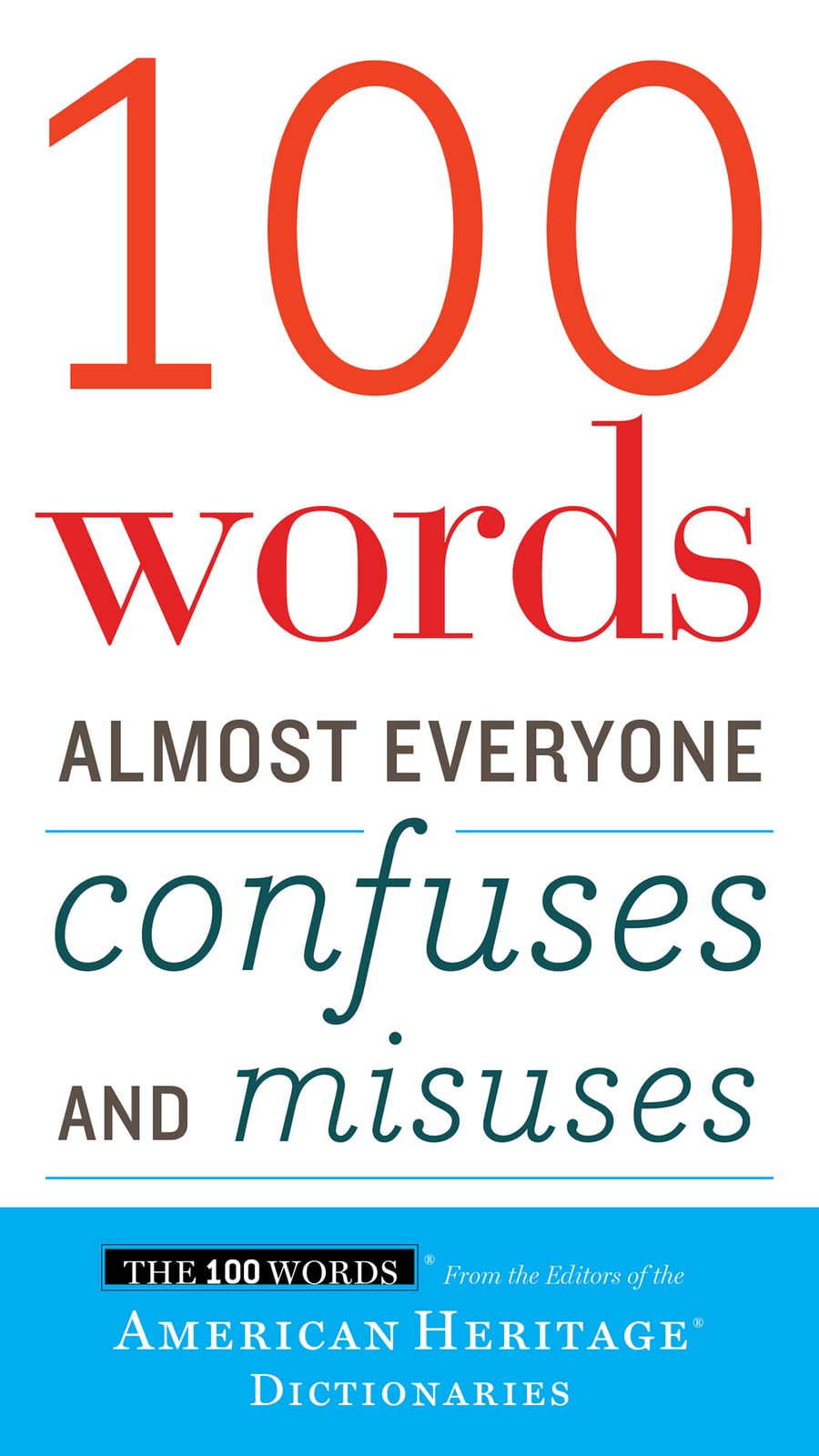
100 Words Almost Everyone Confuses And Misuses: The American Heritage Guide to Troublesome Word Pairs, Sound-Alikes, and Grammar (We Do Not Care Club,
$7.99
by Of The American Editors



Do you know how to use these 100 words? 100 Words Almost Everyone Confuses and Misuses is the perfect book for anyone seeking clear and sensible guidance on avoiding common pitfalls of the English language. Each word is fully defined and accompanied by a concise, authoritative usage note based on the renowned usage program of the American Heritage® Dictionaries. Each note discusses why a particular usage has traditionally been criticized and explains the rules and conventions that determine what’s right, what’s wrong, and what falls in between. This edition has updated usage notes that have been reanalyzed and rewritten to account for language trends that have occurred since its initial publication in 2004. Troublesome pairs such as affect / effect, blatant / flagrant, and disinterested / uninterested are disentangled, as are vexing sound-alikes such as discrete / discreet and principal / principle . Other notes tackle such classic irritants as hopefully, impact, and aggravate, as well as problematic words like peruse and presently . 100 Words Almost Everyone Confuses and Misuses is guaranteed to help keep writers and speakers on the up-and-up! THE EDITORS OF THE AMERICAN HERITAGE DICTIONARIES are a team of professional lexicographers with advanced degrees in various scholarly fields. The editors familiarize themselves with the vocabulary in specific subject areas, collect materials on new developments and usage, and work with expert consultants to ensure that their publications are accurate and up-to-date. 100 Words Almost Everyone Confuses and Misuses By American Heritage Dictionaries Houghton Mifflin Harcourt Publishing Company Copyright © 2016 Houghton Mifflin Harcourt Publishing Company All rights reserved. ISBN: 978-0-544-79119-0 Contents Title Page, Contents, Copyright, Preface, Guide to the Entries, Pronunciation Guide, Pronunciation Key, 100 Words Almost Everyone Confuses and Misuses, CHAPTER 1 1 ad·verse (ad-vûrs', ad'vûrs') adjective 1. Acting or serving to oppose; antagonistic: "And let thy blows, doubly redoubled, / Fall like amazing thunder on the casque / Of thy adverse pernicious enemy" (William Shakespeare, King Richard II ). 2. Contrary to one's interests or welfare; harmful or unfavorable: "[M]ost companies are fearful of adverse publicity and never report internal security breaches ... to law enforcement agencies, security analysts contend" (Peter H. Lewis, New York Times ). 3. Moving in an opposite direction: As it ascended, the balloon was caught in an adverse current and drifted out to sea. [Middle English, from Old French advers, from Latin adversus, past participle of advertere, to turn toward : ad –, ad– + vertere, to turn.] RELATED WORD: adverb — ad·verse'ly SEE NOTE AT averse (#13). 2 af·fect (I-fekt') transitive verb Past participle and past tense: af·fect·ed Present participle: af·fect·ing Third person singular present tense: af·fects 1. To have an influence on or effect a change in: Inflation affects the buying power of the dollar. 2. To act on the emotions of; touch or move: " Then, far off in the distance, from the mountains on each side of us began a louder and a sharper howling — that of wolves — which affected both the horses and myself in the same way" (Bram Stoker, Dracula ). 3. To attack or infect, as a disease: Rheumatic fever is one of many afflictions that can affect the heart. noun (af'ekt') 1. Feeling or emotion, especially as manifested by facial expression or body language: "The soldiers seen on television had been carefully chosen for blandness of affect" (Norman Mailer, Vanity Fair ). 2. Obsolete A disposition, feeling, or tendency. [Middle English affecten, from Latin afficere, affect –, to do to, act on : ad –, ad– + facere, to do.] SEE NOTE AT effect (#28). 3 af·fect (I-fekt') transitive verb Past participle and past tense: af·fect·ed Present participle: af·fect·ing Third person singular present tense: af·fects 1. To put on a false show of; simulate: "He wheedled, bribed, ridiculed, threatened, and scolded; affected indifference, that he might surprise the truth from her" (Louisa May Alcott, Little Women ). 2. To have or show a liking for: affects dramatic clothes. 3. To tend to by nature; tend to assume: In my chemistry class, we study substances that affect crystalline form. 4. To imitate; copy: "Spenser, in affecting the ancients, writ no language" (Ben Jonson, Timber ). [Middle English affecten, from Latin affectare, to strive after, frequentative of afficere, affect –, to affect, influence; see AFFECT.] RELATED WORD: noun — af·fect'er SEE NOTE AT effect (#28). 4 ag·gra·vate (ag'rI-vat') transitive verb Past participle and past tense: ag·gra·vat·ed Present participle: ag·gra·vat·ing Third person singular present tense: ag·gra·vates 1. To make worse or more troublesome: "Drinking alcohol (especially hea