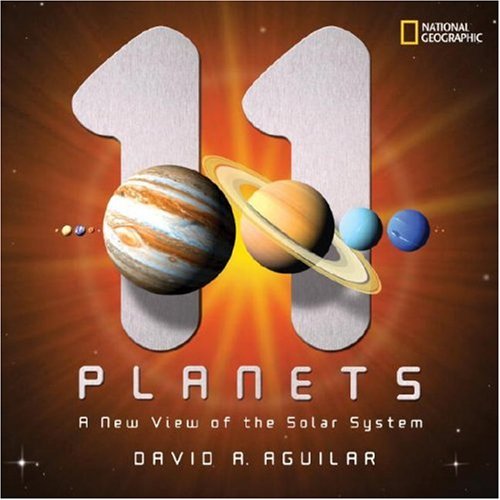



National Geographic proudly presents the essential reference book for what is now officially a NEW AGE in space. In August 2006, the International Astronomical Union redefined the word "planet" and relegated Pluto to the status of a dwarf planet, along with Ceres and Eris. Naturally, National Geographic is there to map out this new view of our solar system. In 11 Planets, David Aguilar, an expert who works on the leading edge of this astounding shift, explains and explores our new galactic knowledge. Using spectacular computer artwork, exclusive to National Geographic, and simple engaging text, this colorful book profiles all 11 planets in our newly categorized solar system: terrestrial Mercury, Venus, Earth, and Mars; gas giants Jupiter, Saturn, Uranus, and Neptune; and dwarf planets Pluto, Ceres, and Eris. The author of the hugely popular Planets, Stars, and Galaxies now leads young minds through into this exciting new view of space, giving readers a vivid "you are there" sensation through his photorealistic artwork. David Aguilar’s 11 Planets is a simple yet compelling introduction to the solar system as it is now classified. This beautiful volume also includes informative spreads on: The Sun Earth’s moon Mars’ moons, Phobos and Diemos Ceres, one of the new dwarf planets The Asteroid Belt Pluto and its moon, Charon Sedna and Eggland, two large Kuiper Belt objects Saturn's rings and moons Comets and the Oort Cloud Other new worlds now being discovered This engaging volume also includes fun activities for young readers. Aguilar’s text presents the latest discoveries in space to young imaginations in a compelling and scientifically accurate way, encouraging understanding of mankind’s new view of our solar system. This is the volume that every library needs; and the book that every child should have access to as the ultimate reference for the new age in space. Grade 4–6—Though trailing the main rush of solar system updates that followed the International Astronomical Union's 2006 reclassification of the planets, this fluently written, handsomely designed tour makes a good choice for smaller and less-well-budgeted collections. Steering a typical itinerary, Aguilar begins with the Sun, visits each terrestrial planet, dwarf planet, and gas giant from Mercury to Eris, then closes with glimpses of other solar systems, plus a compressed set of comparative charts and useful Web sites. His grasp of classical mythology is not firm (Apollo was not "the mightiest of all the gods"), but his astronomical information is both accurate and expressed in lively ways: "A soda can dropped on the surface [of Venus] would be crushed by the atmospheric pressure. These thick clouds also work like windows in a car, trapping incoming sunlight." The author's big, bright digital paintings, supplemented by an occasional photo, offer a gallery of close-ups, group portraits, moons, comets, diagrammatic views, and cutaways that will attract casual browsers as well as budding astronomers and assignment-driven readers. Use as a replacement; it's past time to retire any title on your shelves that refers to "nine planets."— John Peters, New York Public Library Copyright © Reed Business Information, a division of Reed Elsevier Inc. All rights reserved. Although the title sounds unorthodox, Aguilar uses the classification by the International Astronomical Union (which demoted Pluto to dwarf status in 2006). In addition to the eight full-fledged planets, the group of 11 includes the three dwarf planets, Ceres in the asteroid belt beyond Mars and Pluto, and Eris in the outlying Kuiper belt. The book offers a visually impressive tour of major objects in the solar system, whether one defines them as planets or not. A typical double-page presentation of a planet, moon, or other topic includes a dramatic full-page, color image, one or more smaller ones, as well as a paragraph of text and several informative captions. Fast facts, such as diameter and temperature range, appear on an appended chart, along with a glossary and a seemingly down-to-earth project that demonstrates the relative sizes and distances between objects in the solar system. An attractive and timely addition to astronomy collections. Grades 5-8. --Carolyn Phelan David Aguilar, author of Planets, Stars, and Galaxies, is the Director of Science Information at the Harvard-Smithsonian Center for Astrophysics in Cambridge, Massachusetts. Previously, he was the Director of the Fiske Planetarium and Science Center at the University of Colorado. He is an accomplished astronomy illustrator and an experienced educator with an enormous enthusiasm for bringing science to children. David Aguilar lives in Boston, MA. Used Book in Good Condition