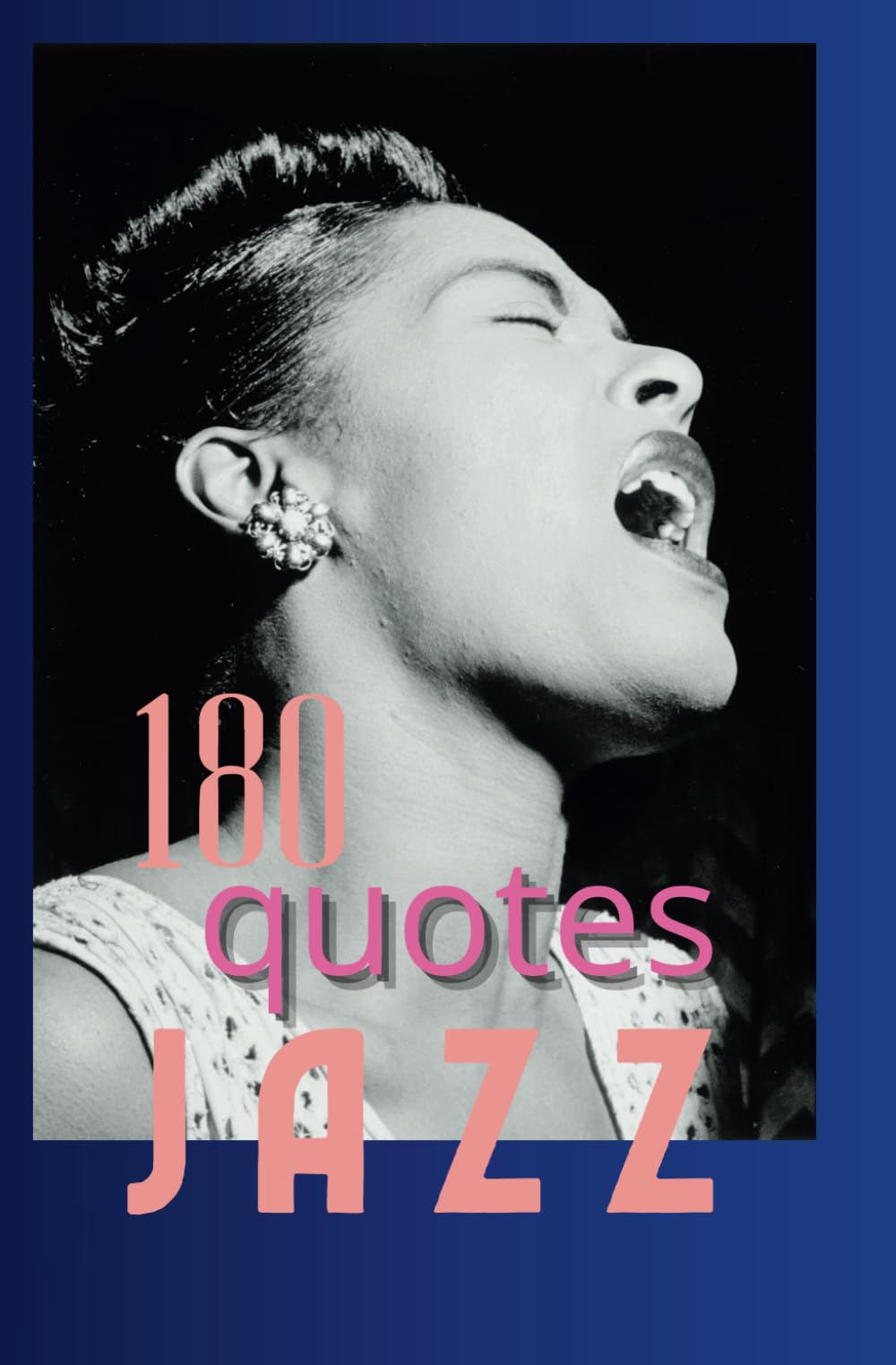
180 Jazz Quotes: A Blank Notebook Featuring Select Quotations on the Jazz Genre from a broad spectrum of Writers, Artists and Musicians
$9.99
by Miss Diane Bonneau



180-pp in 5.2x8" formatted with one quote per page from luminaries in the music world and significant critical voices; - Included are John Coltrane , Wynton Marsalis, Bill Evans Miles Davis, Dave Brubeck, Duke Ellington; and many other voices from a broad group of opinions and ideas across the cultural spectrum; - The dot-grid forma t offers ample space for doodling, writing, drawing and chronicling your own thoughts; - Wonderful birthday gift, present for family and friends who love all things Jazz; - Jazz is a music genre that originated in the African-American communities of New Orleans, Louisiana, in the late 19th and early 20th centuries, with its roots in blues and ragtime] Since the 1920s Jazz Age, it has been recognized as a major form of musical expression in traditional and popular music. Jazz is characterized by swing and blue notes, complex chords, call and response vocals, polyrhythms and improvisation. Jazz has roots in European harmony and African rhythmic rituals. - As jazz spread around the world, it drew on national, regional, and local musical cultures, which gave rise to different styles. New Orleans jazz began in the early 1910s, combining earlier brass band marches, French quadrilles, biguine, ragtime and blues with collective polyphonic improvisation. Jazz did not begin as a single musical tradition in New Orleans or elsewhere In the 1930s, arranged dance-oriented swing big bands, Kansas City jazz (a hard-swinging, bluesy, improvisational style), and gypsy jazz (a style that emphasized musette waltzes) were the prominent styles. Bebop emerged in the 1940s, shifting jazz from danceable popular music toward a more challenging "musician's music" which was played at faster tempos and used more chord-based improvisation. Cool jazz developed near the end of the 1940s, introducing calmer, smoother sounds and long, li near melodic lines. - The mid-1950s saw the emergence of hard bop, which introduced influences from rhythm and blues, gospel, and blues to small groups and particularly to saxophone and piano. Modal jazz developed in the late 1950s, using the mode, or musical scale, as the bas is of musical structure and improvisation, as did free jazz, which explored playing without regular meter, beat and formal structures. Jazz-ro ck fusionappeared in the late 1960s and early 1970s, combining jazz improvisation with rock music's rhythms, electric instr uments, and highly amplified stage sound. In the early 1980s, a commercial form of jazz fusion called smooth jazz became successful, garnering significant radio airplay. Other styles and genres abound in the 21st century, such as Latin and Afro-Cuban jazz. - For many African Americans, jazz has drawn attention to African-American contributions to culture and history. For others, jazz is a reminder of "an oppressive and racist society and restrictions on their artistic visions" Amiri Baraka argues that there is a "white jazz" genre that expresses whiteness. White jazz musicians appeared in the Midwest and in other areas throughout the U.S. Papa Jack L aine, who ran the Reliance band in New Orleans in the 1910s, was called "the father of white jazz"The Original Dixi eland Jazz Band, whose members were white, were the first jazz group to record, and Bix Beiderbecke was one of the most prominent jazz soloists of the 1920s. The Chicago Style was developed by white musicians s uch as Eddie Condon, Bud Freeman, Jimmy McPartland, and Dave Tough. Others from Chicago such as Benny Goodman and Gene Krupa became leading members. T he origins of the blues are undocumented, though seen as the secular counterpart of the spirituals. Gerhard Kubik stated t, whereas the spirituals are homophonic, rural blues and early jazz "was largely based on concepts of heterophony".