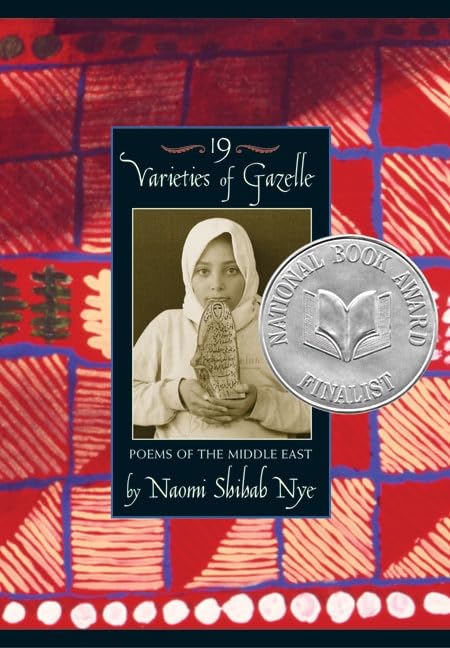



"Tell me how to live so many lives at once ..." Fowzi, who beats everyone at dominoes; Ibtisam, who wanted to be a doctor; Abu Mahmoud, who knows every eggplant and peach in his West Bank garden; mysterious Uncle Mohammed, who moved to the mountain; a girl in a red sweater dangling a book bag; children in velvet dresses who haunt the candy bowl at the party; Baba Kamalyari, age 71; Mr. Dajani and his swans; Sitti Khadra, who never lost her peace inside. Maybe they have something to tell us. Naomi Shihab Nye has been writing about being Arab-American, about Jerusalem, about the West Bank, about family all her life. These new and collected poems of the Middle East -- sixty in all -- appear together here for the first time. As she grieved over the "huge shadow [that] had been cast across the lives of so many innocent people and an ancient culture's pride" after September 11, 2001, poet and author Naomi Shihab Nye's natural response was to write, to grasp "onto details to stay afloat." Accordingly, Nye has gathered over four dozen of her own poems about the Middle East and about being an Arab American living in the United States. Devoted followers of the award-winning and beloved poet will recognize some of their favorites from her earlier collections ( The Space Between Our Footsteps: Poems and Paintings from the Middle East , etc.), while absorbing themselves in her new haunting and evocative poems. Nye writes of figs and olives, fathers' blessings and grandmothers' hands that "recognize grapes, / and the damp shine of a goat's new skin." She writes of Palestinians, living and dead, of war, and of peace. Readers of all ages will be profoundly moved by the vitality and hope in these beautiful lines from Nye's heart. (Ages 9 to adult) --Emilie Coulter Grade 6 Up-Nye is well known as an anthologist for children, but adults have enjoyed her poetry collections for years, and many of those selections, as well as new ones, are gathered here. In her introduction, she describes the effects of the events of September 11th on her and other Arab-Americans. An introductory poem is about that day in particular; otherwise, the selections are about her family, her visits to the Middle East, and her observations of events there in general. This offering is a celebration of her heritage, and a call for peace. In "Jerusalem," she says, "I'm not interested in who suffered the most. I'm interested in people getting over it," using her poetic voice to make her point clearly and powerfully. Other poems are more particular, using family members, or meetings with friends or strangers as the frames around which her image-rich world unfolds. "My Father and the Figtree": "For other fruits my father was indifferent. He'd point at the cherry trees and say, `See those? I wish they were figs.' In the evenings he sat by our beds weaving folktales like vivid little scarves. They always involved a figtree. Even when it didn't fit, he'd stick it in." Of particular use today, this is the kind of book that young and older readers of poetry will turn back to over and over. Nina Lindsay, Oakland Public Library, CA Copyright 2002 Cahners Business Information, Inc. Gr. 5-10. A Palestinian American raised in St. Louis and Jerusalem, Nye is a writer and anthologist whose poetry, fiction, and essays speak to a wide audience. This small, timely collection brings together her poems about the Middle East and about being Arab American. In her introduction she says that poetry cherishes the small details that big disasters erase, and her simple, concrete words show those details and their connections among soldiers, children, "cousins," everywhere. Sometimes the details go on too long, and her quiet nature images carry too much message. It's the drama of the present war that will most move young readers, and the best poems bring big and small together, personalizing the disasters, showing the effects on one child, the loss inside a home, the fragile facts of daily life ("A brother and sister were playing with toys / when their room exploded"). There's no rhetoric, no sentimentality. Like Israeli writer Amos Oz, Nye takes no sides; her call for peace is to Arabs and Jews ("I'm not interested in / who suffered the most / I'm interested in / people getting over it"). The first poem is dated September 11, 2001, and this book will spark discussion and bring readers up close to what war and vengeance mean to people like themselves. Hazel Rochman Copyright © American Library Association. All rights reserved “An excellent way to invite exploration and discussion of events far away and their impact here at home.” - Publishers Weekly “Clear and haunting.” - The Horn Book (starred review) “Poem after poem will elicit a gasp of surprise.” - Kirkus Reviews (starred review) “There is no rhetoric, no sentimentality.” - ALA Booklist (boxed review) “This is the kind of book that young and older readers of poetry will turn back to over and over.” - School Libr