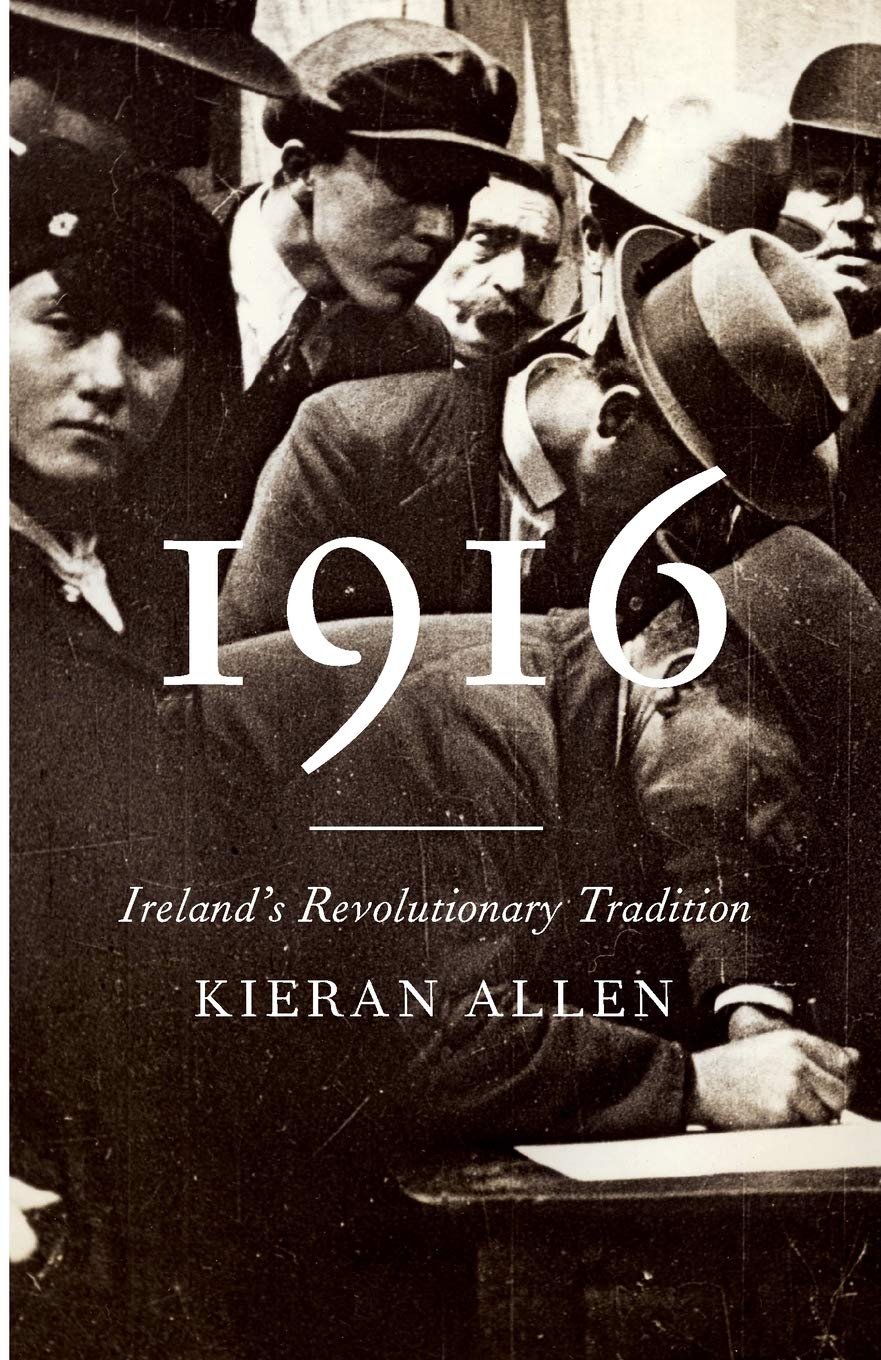



The Easter Rising of 1916, in which just over a thousand Irish rebels seized key locations in Dublin and proclaimed the independence of the Irish Republic before being brutally suppressed by the vastly larger and better-equipped British Army, is an event whose meaning remains contested to this day. For some it represents a blood sacrifice without the hope—or even the intention—of success. For others, it was the first act in a tumultuous political drama played out in Dublin streets and London cabinet rooms that led to the eventual formation of an independent Irish state. In 1916 , Kieran Allen argues that this pivotal moment in Irish history has been obscured by those who see it only as a prelude for a war of independence. Emphasizing an often ignored social and political radicalism at the heart of the rebellion, he shows that it gave birth to a revolutionary tradition that continues to haunt the Irish elite. Socialist aspirations mixed, and sometimes clashed, with the republican current, but both were crushed in a counterrevolution that accompanied the Anglo-Irish treaty of 1921. The result today is a partitioned Ireland that acts as a neoliberal tax haven for multinational corporations—a state of affairs quite alien to both Connolly’s and Pearse’s vision. Published to coincide with the Rising’s centennial, 1916: Ireland’s Revolutionary Tradition re-establishes the political role of socialist republican figures, offers a highly accessible history of the Easter Rising, and explores the militancy and radicalism that continues to haunt the Irish elite one hundred years later. "The Easter Rising has been widely mythologised as a handful of visionaries giving their lives to rouse a slumbering nation. But it also represented the ripening of deep-seated contradictions within Irish society. Allen has provided a vivid and vital account of how class shaped the national movement which arose in the wake of the Rising – and thus shaped the Ireland we live in today." ― Eamonn McCann, author of War and an Irish Town "A fluent, indignant book. Allen frames his argument with straightforward energy, slicing through much of the fog that has sometimes obscured the air in this decade of commemoration." ― Irish Times Kieran Allen is a sociology lecturer at University College Dublin. His books include Marx and the Alternative to Capitalism and Max Weber: A Critical Introduction , both published by Pluto Press. 1916 Ireland's Revolutionary Tradition By Kieran Allen Pluto Press Copyright © 2016 Kieran Allen All rights reserved. ISBN: 978-0-7453-3632-9 Contents Preface, vi, 1 Ireland Turned Upside Down, 1, 2 1916: Armed Insurrection, 27, 3 The Irish Revolution, 60, 4 Republicanism and Counter-revolution, 82, 5 A Most Conservative Country, 110, 6 The Rise and Fall of Radical Republicanism, 135, 7 From the Ashes a Phoenix is Born, 162, Conclusion, 192, Notes, 197, Select Bibliography, 216, Index, 220, CHAPTER 1 Ireland Turned Upside Down Who fears to speak of the 1916 Easter Rising? A year before the hundredth anniversary of the Rising, the Irish government issued a video, Ireland Inspires 2016. It did not mention the executions of the signatories of Ireland's proclamation and instead the camera focused on such luminaries as Ian Paisley, Queen Elizabeth and Bob Geldof. The appearance of Elizabeth Windsor rather than, say, Patrick Pearse or James Connolly was highly unusual. 1916, the video proclaimed, was 'where we came from' but Reconciliation was 'where we are now' Somebody, somewhere, it appeared was worried about the commemoration and they covered their fears with slick public relations banalities. The video provoked such outrage that it had to be withdrawn. The 1916 rebellion set off a chain of events which expelled British rule from the 26 counties. It was the beginning of a phase of revolution that is commonly – but rather narrowly – called the 'War of Independence. What started as an insurrection of the few became a revolt of the many. The current political elite owe their positions to the series of violent events that followed the Rising. Yet they do not like to be reminded of how their ancestors came to power through a revolution that culminated in a bloody counter-revolution, preferring to think of themselves as self-made men or women who rose through the ranks by their own merits. They are embarrassed by connections that are often made between the modern IRA, who fought the Northern state, and the 'old IRA, who fought the British. So they want to put all that behind them – except, of course, for a heritage-linked tourist opportunity. Major, earth-shaking events are supposed to belong to a distant past and need to be packaged up purely for cultural memories. Moreover, too much talk of revolution can be dangerous. There are many angry people suffering from the policies of austerity in modern Ireland and you don't want to give them too many ideas. If the pop