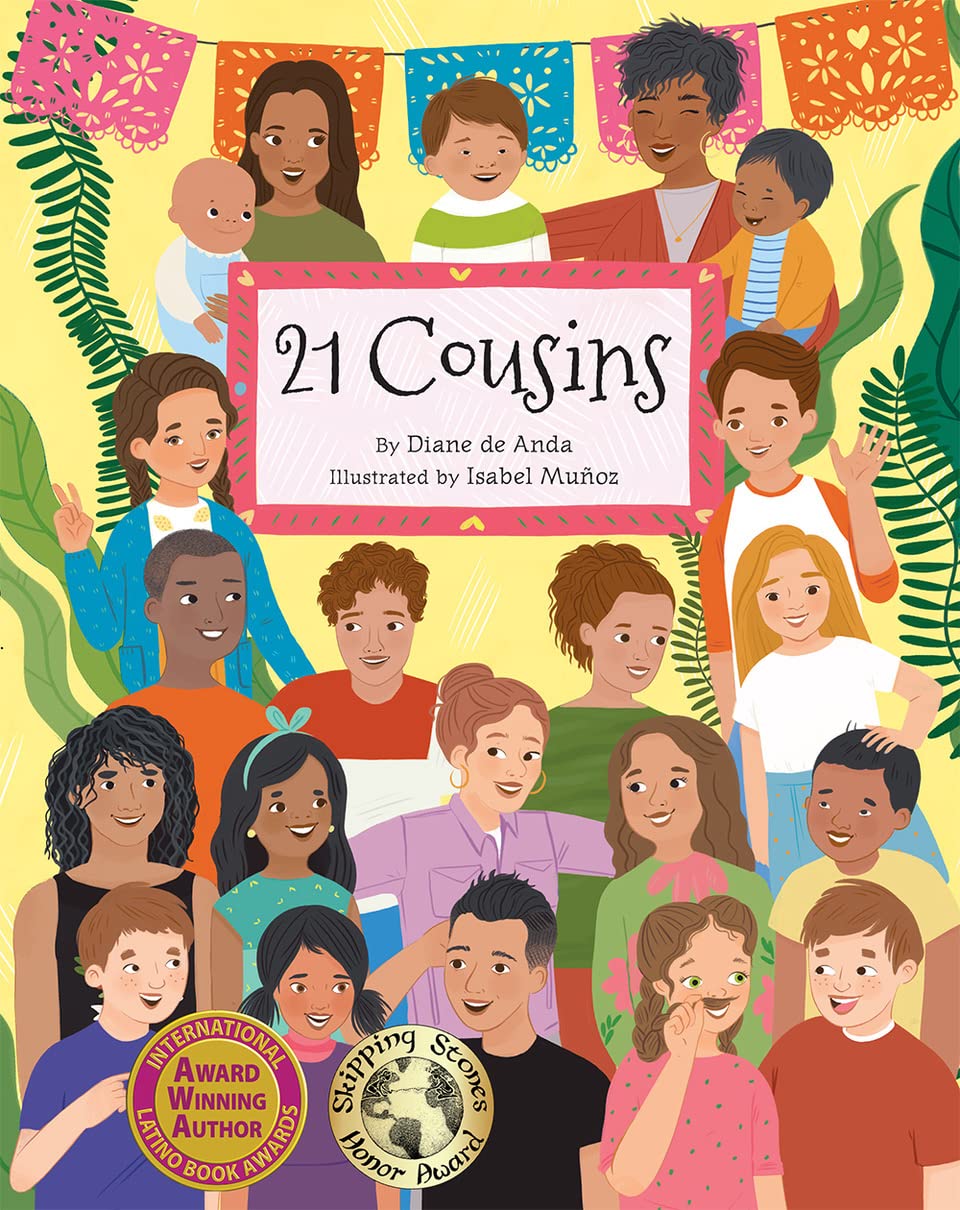



Siblings Alejandro and Sofia celebrate their rich Latinx and mestizo heritage, as well as the traits that make each of their cousins unique, when they gather for a special family reunion. Spanish words and their meanings are interspersed in the text. “De Anda and Muñoz introduce 21 first cousins, each vastly different from the next. The sibling narrators describe the family as “mestizo,” with a makeup of “the different people and cultures in Mexico: Indian, Spanish, French, and others. This is the reason people in our family look different in many ways. But we are still one family.” Readers meet fair-skinned Elena, dark-skinned Enrique, Teresa with “milk-chocolate skin,” and the rest, ranged along a wide, colorful spectrum. One has Down syndrome; another uses a wheelchair. Each cousin varies in interests, hobbies, talents, and ages as well. There is an aspiring Olympic runner, baseball players, a gymnast, a college student, a drummer, and a dancer. Readers who don’t pay attention to the title page may be surprised to discover the identities of the dual narrators, revealed to be grade schoolers Alejandro and Sofia at the end of the book. Muñoz’s clean illustrations present the cousins in settings that reflect their interests, but they do not interact until a final group portrait with Baby Cristina, the 22nd cousin. As is typical in many Latinx cultures, Spanish terms that describe cousins’ physical attributes―güera, morena, chata―are used as terms of endearment, familiarity, and identification. It must be noted that those terms today are occasionally met with some resistance, as they often point back to origins in colorism and racism. Latinx readers with diverse families will appreciate seeing themselves within these pages. (Picture book. 3-8)” --Kirkus Reviews “Diane de Anda is a third generation Latina reared in Los Ángeles, now retired from UCLA‘s department of social welfare. She has authored several articles on adolescent issues and four books on multicultural social work. Seeing a need for children’s books in which they themselves are the main characters, Ms. de Anda has composed eight award-winning children’s books, and 21 Cousins is one of the latest. In this delightful book, Isabel Muñoz illustrates each page not only with the appropriate cousins and their corresponding activities but also scatters representations of cultural notes such as bright colors, flowers, cacti, tropical vegetation, the use of fruit for desert and the famous “papel picado” at their party on the last two pages and the front cover of the book. In the beginning of this book, we are introduced to what constitutes a familia and to other Spanish words such primo hermano, prima hermana, primos, primas, and mestizo―one of the most important words of all because it explains the Mexican physiognomy. In essence, she explains how the greater family is comprised of blonds, brunettes, and all the shades in between! Throughout the pages devoted to the cousins, we learn about their custom of assigning nicknames to people and the use of descriptive words such as “Teenie,” “Baldy,” “Little Button Nose,” “Blondy,” or “Darky” which capture a physical characteristic of the person and is used instead of their name. Just imagine “Baldy” when he becomes a teen with a head of full wavy hair? Well, chances are his friends and family will still call him “Baldy”! The other thing you notice throughout is the togetherness of the family. They go to each other’s contests, they support each other and just love being with each other.” --Skipping Stones Using a bright spectrum of colors, soft strokes, and a lot of background detail, Isabel Muñoz’s created her vibrant, expressive artwork on a digitally manipulated “canvas.” Writing and illustrating a children’s picture book that describes the lives of 21 individuals in a family―and holds the attention and imagination of very young children―is no easy task. But Diane de Anda and Isabel Muñoz have pulled it off, seemingly effortlessly. Diane de Anda’s outstanding writing and Isabel Muñoz’s gorgeous artwork give new meaning to the term, “We are all related.” 21 Cousins is highly, highly recommended.” ―De Colores: The Raza Experience in Children's Books --De Colores: The Raza Experience in Children's Books Diane de Anda is a professor emerita of social welfare at UCLA and a community voice on violence prevention and stress management among adolescents. She has written eight children’s books and edited four books on multicultural social work. Her work focuses on empowering Latino youth. Diane lives in Play del Rey, California. 21 Cousins is her first book with Star Bright Books.