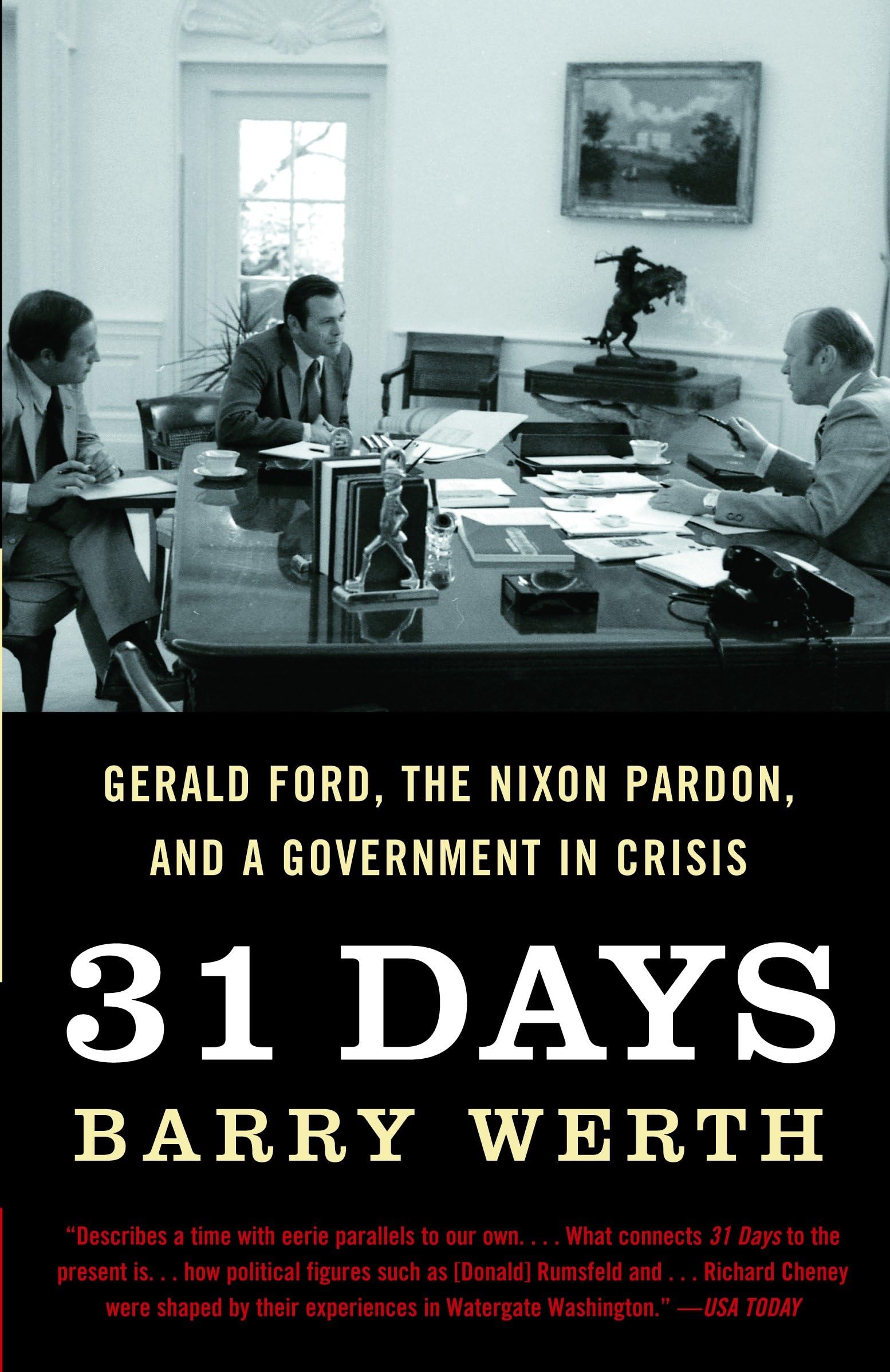



In 31 Days , acclaimed historian Barry Werth takes readers inside the White House during the tumultuous days of August 1974, following Richard Nixon's resignation and the swearing-in of America's "accidental president," Gerald Ford. The Watergate scandal had torn the country apart. In a dramatic, day-by-day account of the new administration’s inner workings, Werth shows how Ford, caught between political expedience, the country’s demands for justice, and his own moral compass, struggled valiantly to restore the nation’s tarnished faith in its leadership. With deft and refreshing analysis Werth illuminates how this unprecedented political upheaval produced new fissures and battle lines, as well as new opportunities for political advancement for ambitious young men such as Donald Rumsfeld, who had been Nixon’s ambassador to NATO, and Dick Cheney, already coolly efficient as Rumsfeld’s former deputy. A superbly crafted presidential history with all of the twists and turns of a thriller, 31 Days sheds new light on the key players and political dilemmas that reverberate in today’s headlines. “Describes a time with eerie parallels to our own…What connects 31 Days to the present is . . . how political figures such as [Donald] Rumsfeld and . . . Richard Cheney were shaped by their experiences in Watergate Washington” — USA Today “Compelling. . . . [A] gripping narrative account of Ford’s first weeks in office. . . . A period in which some of the key players in the Bush administration rose to power and established their mastery of intra-administration battles, a period that . . . serves as a bookend to our own .” — The New York Times “Never has the Ford administration seemed so gripping.” — The Atlantic Monthly Barry Werth is the author of The Scarlet Professor , which was a finalist for the National Book Critics Circle Award. He is also the author of The Billion Dollar Molecule and Damages , and wrote the text for Alexander Tsiaras's Architecture and Design of Man and Woman and From Conception to Birth . He lives in Northampton, Massachusetts. DAY 1 Friday, August 9, 1974 "Then you destroy yourself . . ." On his last morning in power, President Richard Nixon arose in the predawn darkness after just a few hours of sleep. He ordered his favorite breakfast of poached eggs and corned-beef hash served to him, alone, in the Lincoln sitting room, the same room where twenty-two months earlier he had retreated by himself to watch on TV as he and Vice President Spiro Agnew were reelected in one of the greatest landslides in American history. The most inward, solitary, and reclusive of presidents--who paradoxically was determined to ensure that every word he spoke, and that was spoken to him, was recorded for history--Nixon to a rare degree determined exactly what he hoped to do and say in public beforehand, by himself, by filling yellow legal pads with notes, arguments, talking points, and exhortations to himself. In a few hours he would say good-bye to the people whom he most depended upon, and whom he'd most let down, betrayed, disappointed, and infuriated--his top administration, who'd served and defended him through the agonies of Watergate and Vietnam. As through much of this "impeachment summer," the morning sky was dull and overcast, a soggy heat blanketing the South Lawn and the Ellipse, all but hazing out the Washington Monument less than a half mile away. A fire smoldered in Nixon's sitting room fireplace, one of several throughout the White House as aides tossed potentially troublesome documents into the flames. Already assistants had removed the contents of the president's three historic desks--Woodrow Wilson's, in the Oval Office; Dwight Eisenhower's, in room 175 of the Executive Office Building, which Nixon used as a hideaway; and the smaller Lincoln desk, in the president's sitting room in the residence--and packed them carefully into moving boxes now stacked for removal in the hallways. The office of retired General Alexander M. Haig, Jr., Nixon's chief of staff, was cluttered with oversized plastic bags stuffed with shredded files that Haig said were duplicates. After finishing breakfast, Nixon took a pad from his briefcase, slouched down on the small of his back in an armchair near the hearth, and started writing. Haig, who for the past fifteen months had handled the business of the presidency while Nixon struggled to stay in power, knocked and entered. A tireless regent, whose prideful West Point bearing was never quite concealed by the dark business suits he favored, and whose tenure was circumscribed by a thankless choice between deserting Nixon or going down with him, Haig had defended Nixon even as he concluded that he had to resign and so engineered his abdication. "There is something that will have to be done, Mr. President, and I thought you would rather do it now," he said, apologizing. He took a sheet of thick White House stationery and placed it on the Lincoln desk. Nixon read t