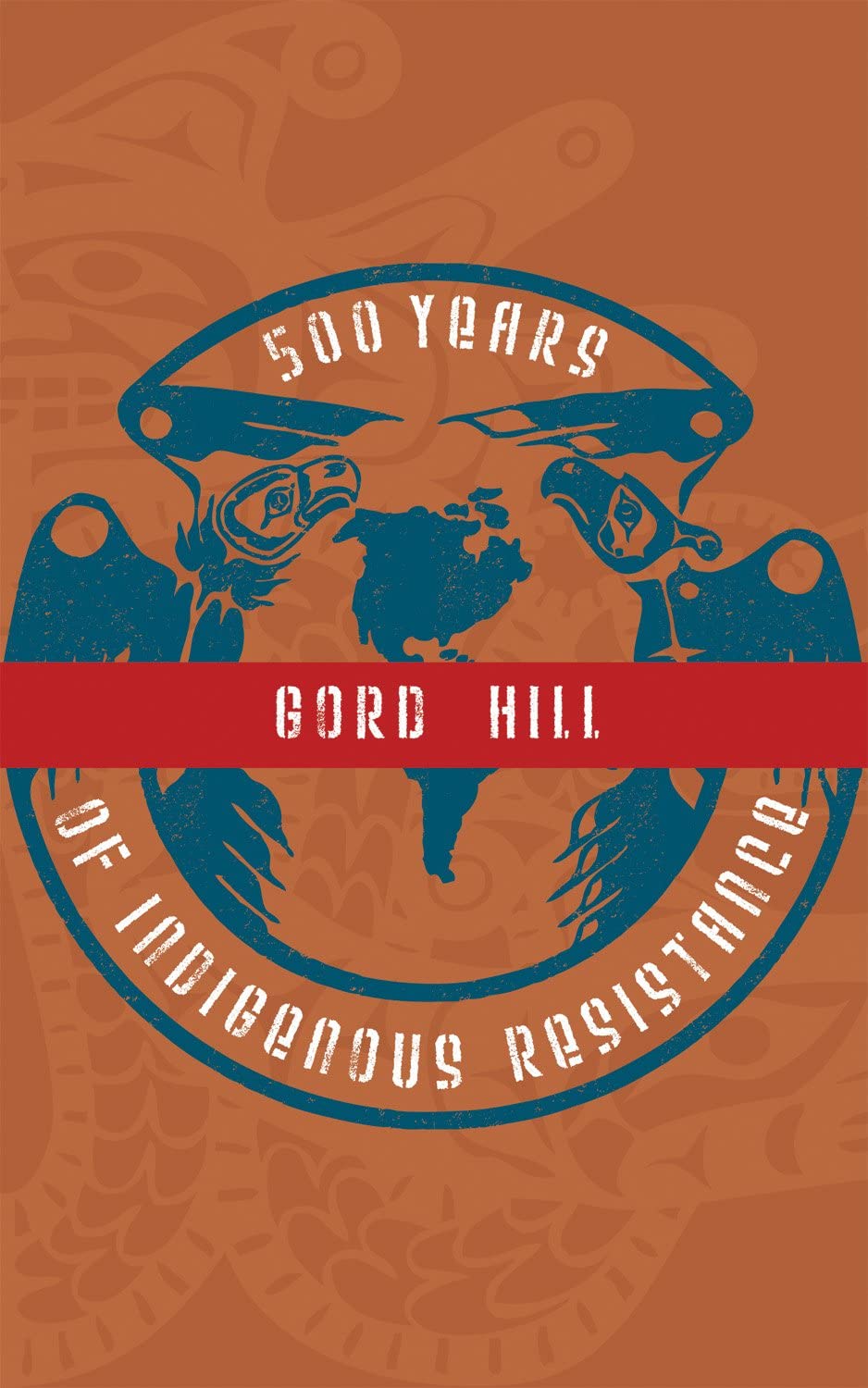



The history of the colonization of the Americas by Europeans is often portrayed as a mutually beneficial process, in which ”civilization” was brought to the Natives, who in return shared their land and cultures. A more critical history might present it as a genocide in which Indigenous peoples were helpless victims, overwhelmed and awed by European military power. In reality, neither of these views is correct. 500 Years of Indigenous Resistance is more than a history of European colonization of the Americas. In this slim volume, Gord Hill chronicles the resistance by Indigenous peoples, which limited and shaped the forms and extent of colonialism. This history encompasses North and South America, the development of nation-states, and the resurgence of Indigenous resistance in the post-WW2 era. "It would be an amazing thing to make copies of this work and slip into every school in America and slide it into every history book for children to read. Well, it is no less crucial and eye-opening a book for existing simply on its own." —Feminist Review CA 500 Years of Indigenous Resistance By Gord Hill PM Press Copyright © 2009 Gord Hill All rights reserved. ISBN: 978-1-60486-106-8 Contents Foreword, Introduction, The Pre-Columbian World, The Genocide Begins, Expansion, Exploitation, and Extermination, The Penetration of North America, The European Struggle for Hegemony, Tragedy: The United States is Created, Revolutions in the "New World", Manifest Destiny and the U.S. Indian Wars, Afrikan Slavery, Afrikan Rebellion, and the U.S. Civil War, Black Reconstruction and Deconstruction, The Colonization of Canada, Extermination and Assimilation: Two Methods, One Goal, The People AIM for Freedom, The Struggle for Land, In Total Resistance, CHAPTER 1 THE PRE-COLUMBIAN WORLD Before the European colonization of the Americas, in that time of life scholars refer to as "Pre-history" or "Pre-Columbian", the Western hemisphere was a densely populated land. A land with its own peoples and ways of life, as varied and diverse as any of the other lands in the world. In fact, it was not even called "America" by those peoples. If there was any reference to the land as a whole it was as Turtle Island, or Cuscatlan, or Abya-Yala. The First Peoples inhabited every region of the Americas, living within the diversity of the land and developing cultural lifeways dependent on the land. Their numbers approached 70-100 million peoples prior to the European colonization. Generally, the hundreds of different nations can be summarized within the various geographical regions they lived in. The commonality of cultures within these regions is in fact a natural development of people building lifeways dependent on the land. As well, there was extensive interaction and interrelation between the people in these regions, and they all knew each other as nations. In the Arctic region live(d) the Inuit and Aleut, whose lifeways revolve(d) around the hunting of sea mammals (Beluga whales, walruses, etc.) and caribou, supplemented by fishing and trading with the people to the south. South of the Arctic, in the Subarctic region of what is today Alaska, the Northwest Territories, and the northern regions of the Canadian provinces, live(d) predominantly hunting and fishing peoples. The variations of these lands range from open tundra to forests and lakes, rivers, and streams. The Cree, Chipewyan, Kaska, Chilcotin, Ingalik, Beothuk, and many other nations inhabit(ed) this region, hunting bear, goats, and deer in the west, musk oxen and caribou further north, or buffalo further south in the prairies. Altogether in the Arctic and Subarctic regions there lived perhaps as many as 100,000 people. On the Pacific Northwest coast, stretching from the coasts of Alaska and British Columbia (BC) down to northern California, live(d) the Tlingit, Haida, Tsimshian, Kwakwaka'wakw, Nuu-chah-nulth, Nuxalk, Salish, Yurok, and many others. These peoples developed a lifeway revolving around fishing. The peoples of this region numbered as many as four million. Between the Pacific coastal mountain range and the central plains in what is today southern BC, Washington, Oregon, Idaho and Montana, live(d) the Sahaptin (Nez Perce), Chopunnish, Shoshone, Siksikas (Blackfeet), and others. These peoples numbered around 200,000. To the east were people of the plains, encompassing a vast region from Texas up to parts of southern Alberta, Saskatchewan, and Manitoba, eastward to North and South Dakota, Minnesota, Wisconsin, Missouri, and Arkansas. Here, the Lakota (Sioux), Cheyenne, Arapaho, plains Cree, Siksikas (of the Blackfeet Confederacy, including the Blood and Peigan), Crow, Kiowa, Shoshone, Mandan, and many others, numbered up to one million, and the buffalo as many as 80 million before their slaughter by the Europeans. Further east, in the lands stretching from the Great Lakes to the Atlantic coast, live(d) hunting, fishing, and farming