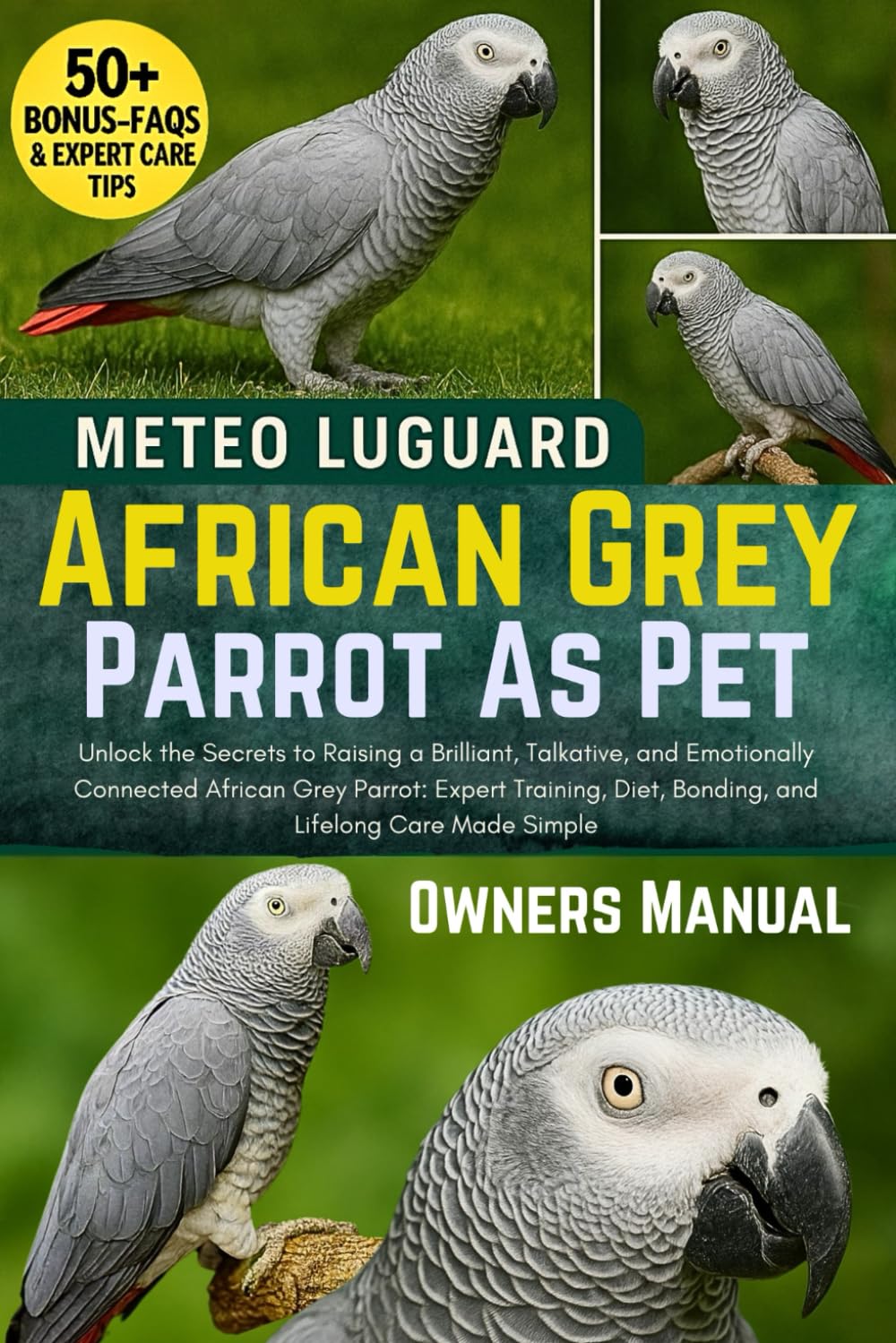
AFRICAN GREY PARROT AS PET: Unlock the Secrets to Raising a Brilliant, Talkative, and Emotionally Connected African Grey Parrot: Expert Training, Diet
$16.99
by METEO LUGUARD



Introduction to the African Grey Parrot Among the world’s most celebrated companion birds, the African Grey Parrot holds an unmatched place in the hearts of bird enthusiasts, scientists, and pet owners alike. Revered for its extraordinary intelligence, linguistic brilliance, and emotional depth, this species has been affectionately called the “Einstein of the bird world.” More than a mere pet, the African Grey represents a fascinating bridge between avian and human communication—an animal whose mind and mannerisms seem to blur the boundaries between instinct and intellect. Origins and Natural Heritage The African Grey Parrot (scientifically known as Psittacus erithacus) originates from the dense rainforests, mangrove swamps, and wooded savannas of Central and West Africa, stretching from Angola to the Ivory Coast, Cameroon, Ghana, Uganda, and the Congo Basin. In these lush regions, flocks of Greys soar gracefully above canopies, their silver feathers glinting softly in the sunlight, and their unmistakable calls echoing through the forest. These birds thrive in humid, shaded environments where food and water are abundant. They feed primarily on fruits, nuts, seeds, palm kernels, and berries, often gathering in small to medium flocks to forage. In the wild, they play an essential ecological role as seed dispersers, ensuring the growth and renewal of tropical vegetation. Their keen intelligence and social cooperation enable them to adapt remarkably well to the complex rhythms of forest life, avoiding predators while maintaining intricate communication within their groups. Subspecies: Congo and Timneh Greys The African Grey Parrot is divided into two recognized subspecies—each unique in its size, appearance, and personality. ● Congo African Grey (Psittacus erithacus erithacus): The larger and more well-known variety, Congo Greys are distinguished by their light silver plumage, bright scarlet tail feathers, and pale ivory beak. They are native mainly to equatorial regions such as the Democratic Republic of Congo and Cameroon. Known for their articulate speech and calm yet commanding presence, they are often the parrot of choice for first-time Grey owners. Timneh African Grey (Psittacus erithacus timneh): Slightly smaller in size, the Timneh has a darker charcoal-gray coloration, a maroon tail, and a horn-colored upper beak. Originating from countries like Guinea, Liberia, and Sierra Leone, the Timneh Grey tends to mature earlier and adapt faster to domestic life. Many owners describe the Timneh as more steady-tempered, less nervous, and easier to socialize than its larger cousin. Despite their subtle physical differences, both subspecies share a brilliant cognitive capacity, remarkable vocal mimicry, and an emotional depth that makes them among the most rewarding yet challenging parrots to keep. A Legacy of Intelligence Few species on Earth can rival the African Grey in problem-solving, reasoning, and communication. Decades of research—most famously the groundbreaking studies by Dr. Irene Pepperberg with her African Grey named Alex—have shown that these parrots possess not just mimicry, but true comprehension. Alex could identify colors, shapes, and numbers; he understood concepts such as “same” and “different,” and even grasped emotional cues. His legacy proved that Greys think, learn, and respond with a sophistication once thought possible only in primates. In captivity, this intelligence translates into a deep emotional sensitivity. African Greys quickly learn routines, recognize individual family members, and can mirror the emotional atmosphere of a household. They may call your name, whistle your favorite tune, or even mimic laughter at the right moments. But their brilliance is a double-edged sword—boredom, neglect, or inconsistent handling can lead to behavioral challenges such as feather plucking or excessive vocalization.