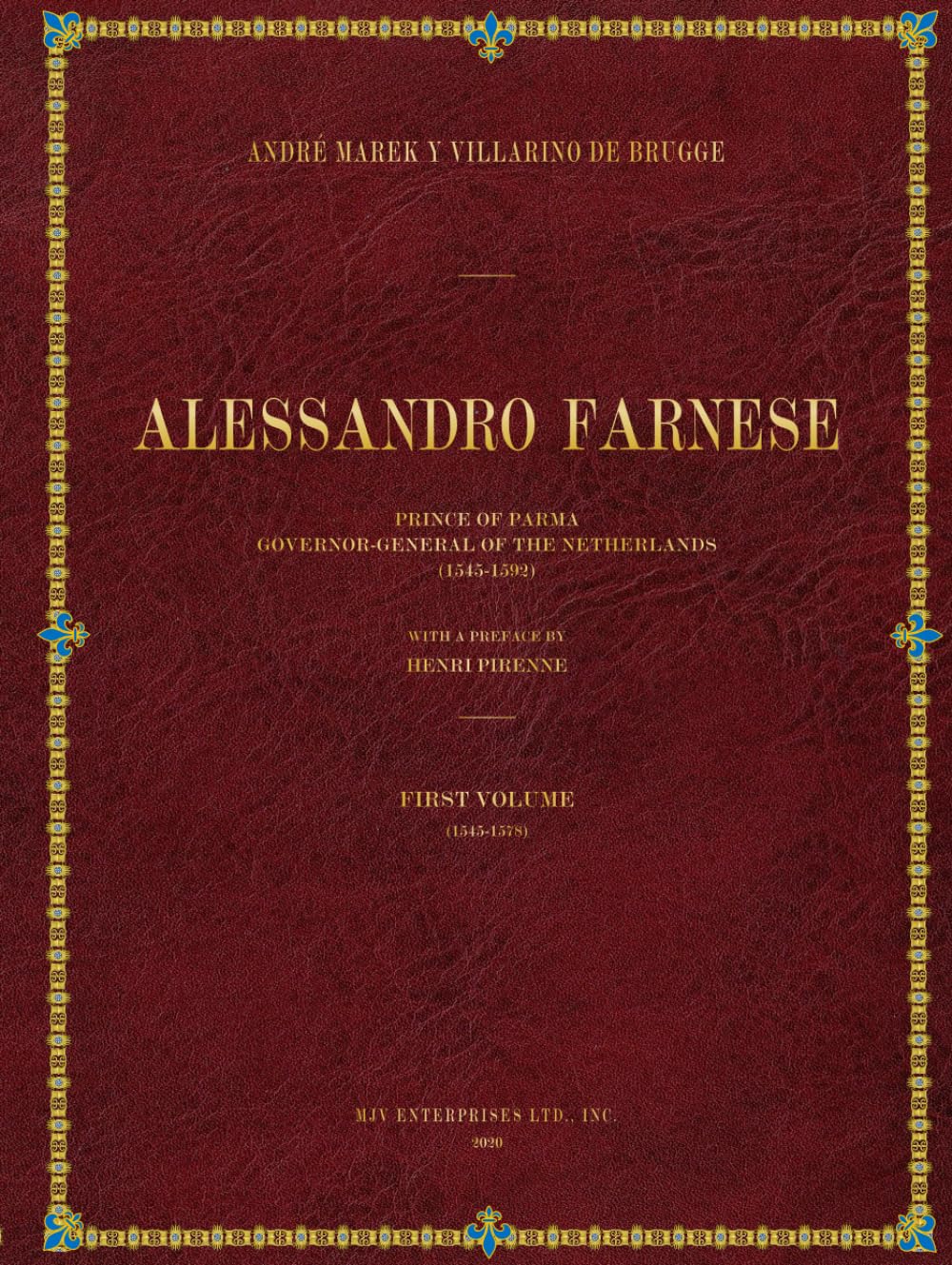
ALESSANDRO FARNESE: PRINCE OF PARMA : GOVERNOR-GENERAL OF THE NETHERLANDS (1545-1592) | FIRST VOLUME : (1545-1578) (DUKE ALEXANDER FARNESE)
$23.69
by ANDRÈ MAREK Y VILLARINO DE BRUGGE



HARDCOVER LEGACY EDITION He is called Alexander Farnese (English, Dutch, and German), Alessandro Farnese (Italian), Alejandro Farneseo or Farnesio (Spanish), Alexandre Farnèse (French), and Alexandrum Farnesium (Latin), Governor of the Netherlands (1578-1592), Prince, then 3rd Duke (1586), of Parma. Referred by some as the “forgotten Farnese”, if you are reading this, you have likely heard of him and are seeking to learn more. Adventurer and warrior extraordinaire who conspicuously distinguished himself with valor at the Battle of Lepanto and the Battle of Gembloux. Brilliant strategist who saved the Catholic army from being wiped out in France. Underappreciated diplomat, considered the founding father, or, at the very least, having laid the initial cornerstone for the foundation of what is today called the Kingdom of Belgium, through negotiations with the Wallonian provinces. Military genius who, as part of the siege of Antwerp from 1584-1585, orchestrated the blockade of the Scheldt river, touted by historians to be a remarkable feat of engineering. To date, there are six published biographies about this notable historical figure; two in French, two in Italian, and two in Spanish. Furthermore, none of these biographies have been translated into any other languages. For decades, historians, be they respected scholars or casual enthusiasts, have been clamoring for a biography written in English. The appeals from Anglophone has been answered at last. Done in the style of Léon van der Essen’s Alexandre Farnèse , this magnum opus consists of more than 1,550 pages in five volumes detailing Farnese’s life. Out of economic consideration, the 28 illustration plates contained within are in black & white, however, a sixth volume, the addendum, features all illustration plates and more from all five volumes in full-color. This volume takes you from his family’s origin, his birth, childhood, life at the Brussels Court, English Royal Court, Spanish Royal Court, marriage, first military campaigns, to the death of Don John of Austria. Vol. I, ASIN: B09KN2QKFP Vol. II, ASIN: B09KN4CG62 Vol. III, ASIN: B09KN4CZDV Vol. IV, ASIN: B09KNGDFCG Vol. V, ASIN: B09KN2QL2J Addendum, ASIN: B09KN652RK "ALEXANDER Farnese", writes Professor Van der Essen, "is one of the grandest figures in the history of the sixteenth century... It was because of him that Belgium was destined to remain Roman Catholic... He threw up a barrier between the Catholic south and the Calvinistic north... He was the most redoubtable adversary of William the Silent." And Pirenne remarks in the preface, "Within eight months after the arrival of Farnese, this 'common country' was dissolved. His clairvoyance and his political finesse split asunder the union which his Spanish predecessors had been unable to break up through brutal force of arms." It is rather remarkable that a man of such ability and of such consequence in the political history of Europe in general and of the Low Countries in particular should have received so little attention among Belgian and Dutch historians. Much has been written about William of Orange, for he was the national hero in a country that happened to become and remain for a time the foremost naval, colonial, and commercial power in the world, while the ten provinces in the south declined. Perhaps this was the reason why throughout the nineteenth century the career of Farnese, duke of Parma, seemed of so much less importance than that of the "father of the Dutch Republic". It was not until 1883 that the first [modern] biography of Farnese was published. The author was an Italian, Pietro Fea, and he entitled his work, Alessandro Farnese. Unfortunately, he was interested primarily in the military exploits and neglected the political achievements of Farnese. Furthermore, neither in France nor in Germany was the work of Farnese well understood. Pirenne was the first writer to present a proper analysis of the role played by him in the field of European politics, but his picture fills but two pages in his Histoire de Belgique . An excellent discussion appeared in The Revolt of the Netherlands by Professor P. Geyl (1932), but it is brief and does little more than arouse our curiosity. Nothing else would suffice except a detailed study ill more than one volume. Consequently, Van der Essen, the secretary of the University of Louvain, after twenty years of painstaking research in numerous archives and libraries, determined to publish such a work. The first volume ends with the year 1578, when Parma succeeded Don Juan of Austria as governor-general of the Netherlands. The second will close with the siege of Antwerp in 1585, and the third will conclude the biography. This scholarly production deserves the highest praise. It is not only well organized and well documented, but it has been well written. It portrays the hero as a product of his age and his environment. leaving nevertheless enough space for the delineation of his innate talents as