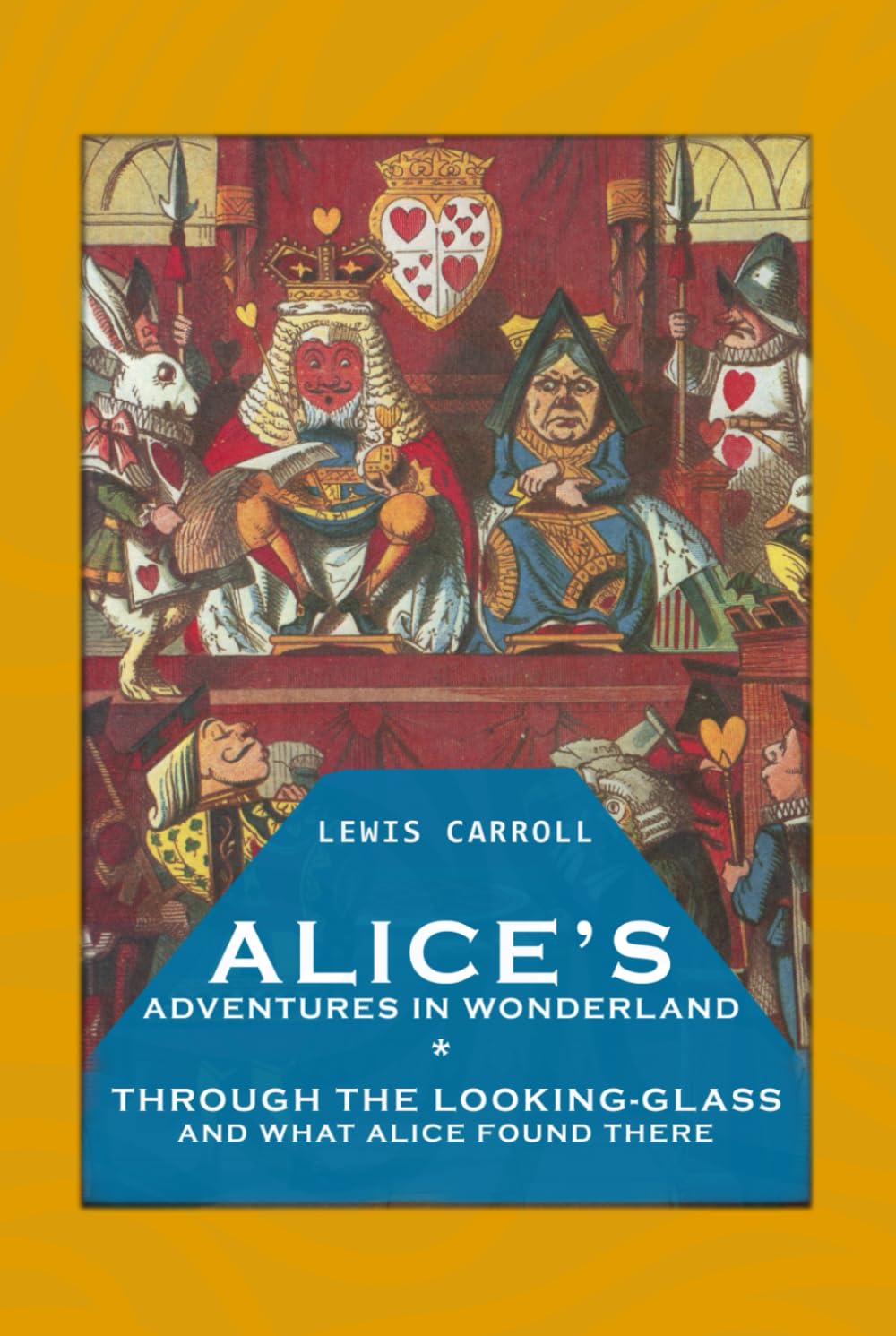
ALICE’S ADVENTURES IN WONDERLAND & THROUGH THE LOOKING-GLASS AND WHAT ALICE FOUND THERE: original edition
$17.65
by Lewis Carroll



There is a room in front of the mirror and another behind it. In the room behind the mirror, everything is reversed, reality is reversed, and Alice feels strange because she has to interpret everything for the first time. Who does not feel like Alice at least once a day? How often do we fall into an upside-down world without realizing it? Its author, Charles Ludwig Dodgson (1832-1898), better known as Lewis Carroll, was a typical Victorian clergyman, stammering and disarmingly shy, serving as don of logic and mathematics at Christ Church, Oxford: an existence so orderly and devoid of events that it justifies Virginia Woolf's claim that he "had no life. We now know that the germ of his most famous work came to him very near there, during a boat trip, accompanied by another vicar and three girls, along the Isis, the name given to the Thames as it passes through the city. On this outing, Dodgson improvised, as entertainment for his little guests, a mad story, full of nonsense and puns, in which logic and chance, nature and imagination, anticipated the framework of what was to become his masterpiece. One of the girls, Alice Liddell, served as the model for his eponymous character and was a strange attraction for him. This book brings together the two parts of the story, Alice's Adventures in Wonderland (1865) and its sequel Through the Looking-Glass (1871), with the original illustrations by John Tenniel. This work has had a lasting influence on literature (children's and otherwise) and subsequent thought. The Surrealists were fascinated by its mixture of satirical humor and nonsense, and found in the author's narrative skills a pioneering example of free association and stream of consciousness: Max Ernst and Breton were among his greatest admirers. On the other hand, Carroll's footprint on British philosophy should not be underestimated: from Russell to Wittgenstein, through Moore, Austin, and Ayer, there are few thinkers who have not paid tribute to him as a constructor of chained syllogisms, convoluted paradoxes, puns, and logical diagrams, or who have not acknowledged his ability to ironize weighty issues of philosophy through his child characters. From this perspective, some have seen, for example, in the Cheshire Cat-whose body sometimes vaporizes, leaving only its enigmatic and eternal smile-an allegory of the (im)possibility of an accident without substance; or in the discussions of the Tweedle brothers (in Through the Looking-Glass) the trace of Berkeleyan disquisitions on the reality or unreality of things in the world. This is without descending into the gentle symbolic satire of contemporary politicians (Bill the Lizard would allude to Benjamin Disraeli) or his colleagues at Christ Church. Moreover, since its publication, Alice's Adventures in Wonderland and its sequel have continued to influence the most diverse manifestations of popular culture: from songs and stories to cinema (the most recent major version, freely adapted, is by Tim Burton). Alice's imaginative journey crosses the threshold that separates reality from dream and enters a lawless territory where anything is possible. A triumph of imagination and wit, this narrative creates a world of unusual scenarios and creatures, questioning each and every logical postulate of the conventional world.