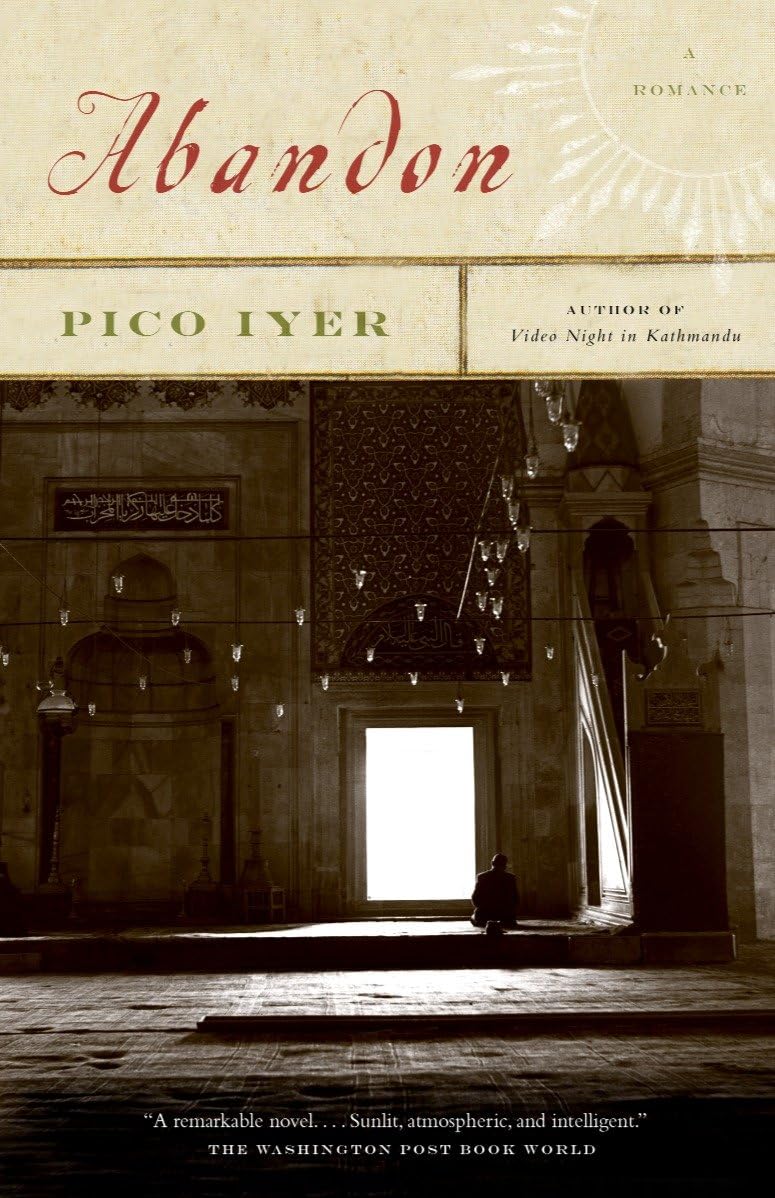



From the national bestselling author of The Half-Known Life comes an intoxicating novel that's at once a stylish intellectual mystery and a pulse-quickening love story—the love in question being at once sacred and profane. John Macmillan, a classically reticent Englishman who has moved to California to study the poems of the Sufi mystic Rumi, unexpectedly becomes involved in two equally absorbing quests. The first is for a mysterious Rumi manuscript that may have been smuggled out of Iran; the second for the elusive Camilla Jensen, who continually offers herself to him only to repeatedly slip from his grasp. Are these quests somehow related? And can Macmillan give himself over to them without losing his career and identity? Moving deftly from California academia to the mosques of Iran, filled with insights into the minds of Islam and the modern West, Abandon is a magic carpet-ride of a book. “A rapturous narrative.... A perfect gift for young scholars in any field, tied with a bow by the prolific world traveler Iyer.” — San Francisco Chronicle “A remarkable novel.... Sunlit, atmospheric, and intelligent.” — The Washington Post Book World “Iyer has a poet’s gift for the sharply-drawn, just-right descriptive ... quietly powerful.” — Los Angeles Times Book Review “Iyer treats Macmillan’s spiritual confusion and hunger with sympathy, even tenderness.... A wise and graceful novel.” — The New York Times Book Review Pico Iyer s intoxicating new novel is at once a stylish intellectual mystery and a pulse-quickening love story the love in question being at once sacred and profane. John Macmillan, a classically reticent Englishman who has moved to California to study the poems of the Sufi mystic Rumi, unexpectedly becomes involved in two equally absorbing quests. The first is for a mysterious Rumi manuscript that may have been smuggled out of Iran; the second for the elusive Camilla Jensen, who continually offers herself to him only to repeatedly slip from his grasp. Are these quests somehow related? And can Macmillan give himself over to them without losing his career and identity? Moving deftly from California academia to the mosques of Iran, filled with insights into the minds of Islam and the modern West, Abandon is a magic carpet-ride of a book. Pico Iyer's intoxicating new novel is at once a stylish intellectual mystery and a pulse-quickening love story--the love in question being at once sacred and profane. John Macmillan, a classically reticent Englishman who has moved to California to study the poems of the Sufi mystic Rumi, unexpectedly becomes involved in two equally absorbing quests. The first is for a mysterious Rumi manuscript that may have been smuggled out of Iran; the second for the elusive Camilla Jensen, who continually offers herself to him only to repeatedly slip from his grasp. Are these quests somehow related? And can Macmillan give himself over to them without losing his career and identity? Moving deftly from California academia to the mosques of Iran, filled with insights into the minds of Islam and the modern West, Abandon" is a magic carpet-ride of a book. PICO IYER is the author of several books about the romance between cultures, including Video Night in Kathmandu , The Lady and the Monk , Cuba and the Night and, most recently, The Global Soul . He lives in suburban Japan. He reached for his alarm clock in the dark, and then realized that the sound was coming from somewhere else. All across the city the long, slow, heart-torn cry of love— “La ilaha illa ’Llah” (There is no god but God)—rose up, as if from a widow in her grief alone. Pulling back the curtains, he saw the high-rises with their rickety antennae in the brownish light, pictures of Assad the size of six-story buildings, green-lit minarets standing sentinel across the town. Nearby, on the hill, a scatter of lights, and then the desert began. He went down, as was now his custom, to the lobby—two women slumped enigmatically in chairs—and saw a pair of taxis idling under the line of trees. He walked up to the first, tapped at the window, and the man, startled from his sleep, reached back a lazy arm to open the door. Then they drove through the hushed, still-darkened streets to where the suq began, inside what looked to be a Crusader castle. Even now the smell of cardamom and spices, as if, he always thought, he were walking into a curry. The store where they’d shown him a manuscript, two days before, that came, they said, from Isfahan; the other stall, where the owner, it was rumored, was a member of the secret orders. Everywhere, thin alleyways trailing off into silence, and then, five minutes later, out again into the faint light to see a few huddled figures slipping into the great mosque through its northern entrance. He followed them in, and a huge flock of pigeons took sudden flight, lit up against the blue-black sky, and settled around the minarets like guards. Inside the prayer hall, ev