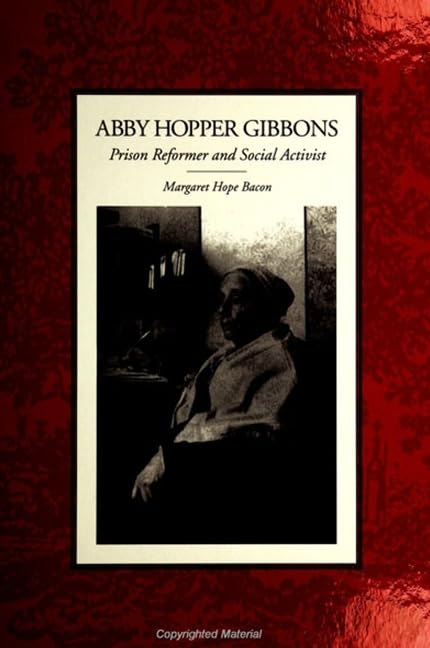
Abby Hopper Gibbons: Prison Reformer and Social Activist (Women Crime Criminology)
$34.95
by Margaret Hope Bacon



The first contemporary biography of Abby Hopper Gibbons, a nineteenth-century American social activist. Involved in a broad range of reform activities, she is particularly known for her pioneering efforts to improve the treatment of women prisoners. This first contemporary biography of nineteenth-century American social activist and prison reformer Abigail Hopper Gibbons (1801–1893) illuminates women's changing role in the various reform movements of the period. Beginning as an abolitionist/feminist, Gibbons helped to found the Women's Prison Association of New York City in 1845. This group established the Isaac T. Hopper Home for discharged women prisoners, the first such institution in the world. Gibbons later became an advocate and lobbyist for improvements in the care of women in the city prisons, for the employment of police matrons, and for the establishment of separate correctional facilities for women prisoners. Though born a pacifist Quaker, Gibbons became a Civil War nurse who protected escaping slaves. During the 1863 Draft Riots, her house in New York City was sacked. Following the war, she was involved in establishing several New York charities. In the 1870s she became a leader and lobbyist for the Moral Reform Movement, both locally and nationally. Her story is intrinsically interesting, and illustrates the political action employed by women of her period. Although not so well known as reformers like Lucretia Mott and Elizabeth Cady Stanton, Abby Hopper Gibbons was an important advocate for women's causes in the 19th century. Born into a socially conscious Quaker family, Gibbons was an abolitionist and then a nurse in the Civil War. Later, as times and issues changed, she decided not to work with the growing suffragist movement but to focus on the less prominent cause of improving the lives of women prisoners. Gibbons founded the Women's Prison Association of New York City and lobbied for many innovations that are still in effect today, including improvements in the care of women in the city's prisons, the employment of police matrons, and the establishment of separate correctional facilities for women. She did all of this as a wife and a mother of five children. Beacon (Lamb's Warrior) offers a simple, direct style in this volume, the only biography of Gibbons outside of one by her daughter, Sarah Emerson, in 1896. It should prove useful for classes in women's studies and criminal justice and for biography collections in public libraries. -Frances O. Sandiford, Green Haven Correctional Facility Lib., Stormville, NY Copyright 2000 Reed Business Information, Inc. "What I like most is that the book brings to light an unknown champion of a political movement, adding important insight and perspective to our sense of the political awareness and independence of thought of nineteenth-century women. Gibbons' story gives greater texture to the variety of women's lives, experiences, beliefs, and political behavior." ― Emma Jones Lapsansky, Professor of History and Curator of Quaker Collection, Haverford College Margaret Hope Bacon, author and lecturer, has written many books including most recently Wilt Thou Go on My Errand? The Journals of Three Eighteenth Century Quaker Women; One Woman's Passion for Peace and Freedom: The Life of Mildred Olmsted ; and Let This Life Speak: The Legacy of Henry Joel Cadbury . She is a Swarthmore College Honorary Doctor of Humane Letters. The city of Philadelphia has honored her with both a Human Rights Award in 1976 and a Citation for Contributions to Women's History in 1987. Used Book in Good Condition