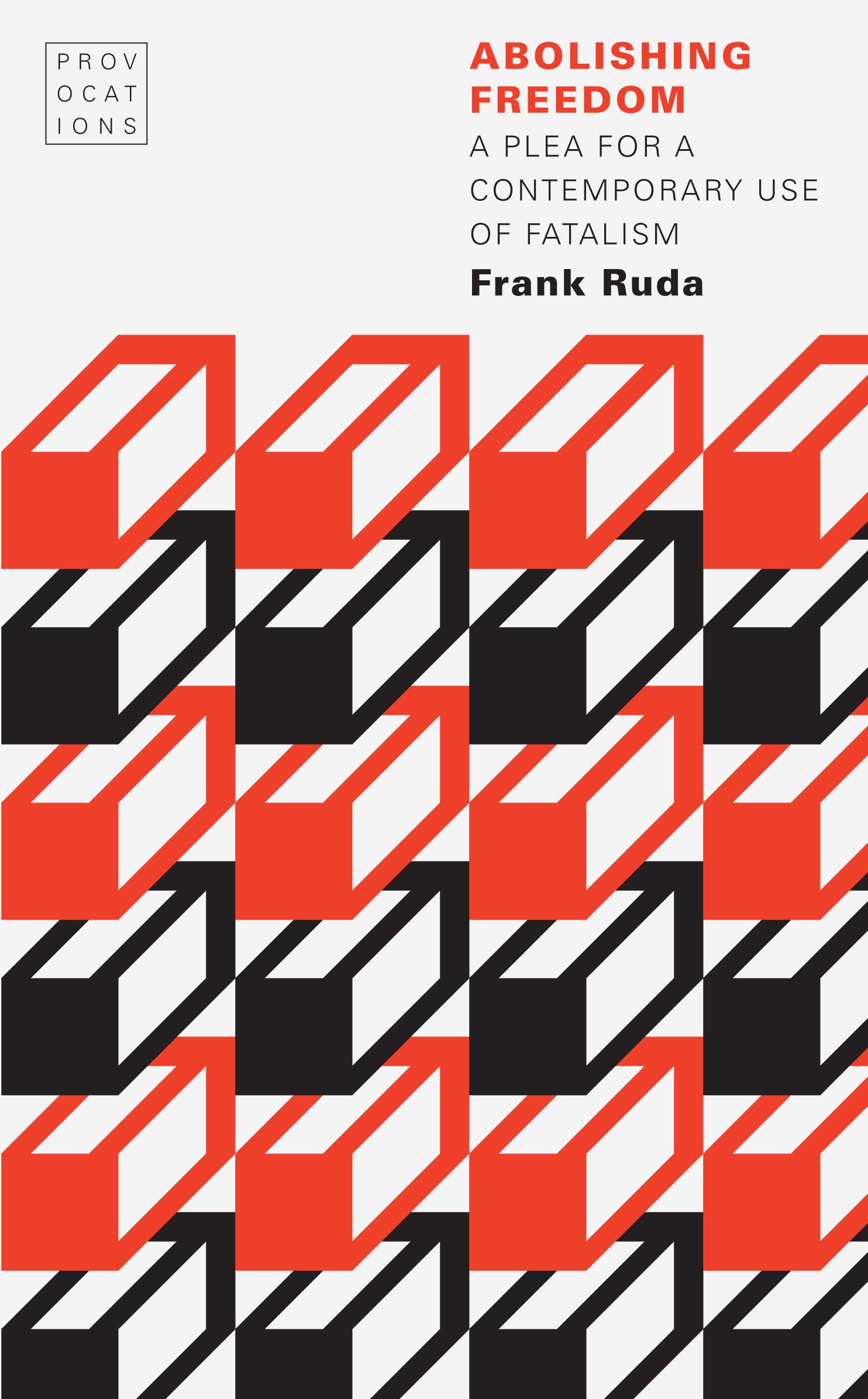
Abolishing Freedom: A Plea for a Contemporary Use of Fatalism (Provocations)
$13.67
by Frank Ruda



Pushing back against the contemporary myth that freedom from oppression is freedom of choice, Frank Ruda resuscitates a fundamental lesson from the history of philosophical rationalism: a proper concept of freedom can arise only from a defense of absolute necessity, utter determinism, and predestination. Abolishing Freedom demonstrates how the greatest philosophers of the rationalist tradition and even their theological predecessors—Luther, Descartes, Kant, Hegel, Freud—defended not only freedom but also predestination and divine providence. By systematically investigating this mostly overlooked and seemingly paradoxical fact, Ruda demonstrates how real freedom conceptually presupposes the assumption that the worst has always already happened; in short, fatalism. In this brisk and witty interrogation of freedom, Ruda argues that only rationalist fatalism can cure the contemporary sickness whose paradoxical name today is freedom. “ Abolishing Freedom is both philosophically and stylistically daring.”—Michael Principe, Marx and Philosophy “ Abolishing Freedom is not only the very acme of today’s philosophy, but much more—it is a book for everyone who is tired of all the ideological babble about freedom of choice.”—Slavoj Žižek, author of Absolute Recoil: Towards a New Foundation of Dialectical Materialism Published On: 2015-09-15 “Appropriating it as a natural right, a possession that can be taken away, the sign of the subject’s sovereignty, liberalism has given freedom a bad name. Yet how to think without acknowledging the fact of freedom? In his delightful book, Ruda shows us the way. Reducing the liberal edifice to rubble, he rescues a freedom that is in no way ad libitum. ”—Joan Copjec, author of Imagine There’s No Woman: Ethics and Sublimation Published On: 2015-09-15 “This is an utterly captivating, smart, provocative book—compelling in its argument, fascinating in its detail, sobering in its implications. Absolutely exhilarating.”—Rebecca Comay, author of Mourning Sickness: Hegel and the French Revolution Published On: 2015-09-15 Frank Ruda is an interim professor for the philosophy of audiovisual media at the Bauhaus University in Weimar, Germany, and a visiting lecturer at Slovenian Academy of Sciences and Arts. He is the author of Hegel’s Rabble: An Investigation into Hegel’s Philosophy of Right and For Badiou: Idealism without Idealism . Abolishing Freedom A Plea for a Contemporary Use of Fatalism By Frank Ruda UNIVERSITY OF NEBRASKA PRESS Copyright © 2016 Board of Regents of the University of Nebraska All rights reserved. ISBN: 978-0-8032-8437-1 Contents Acknowledgments, Provocations, Introduction: Fatalism in Times of Universalized Assthetization, 1. Protestant Fatalism: Predestination as Emancipation, 2. René the Fatalist: Abolishing (Aristotelian) Freedom, 3. From Kant to Schmid (and Back): The End of All Things, 4. Ending with the Worst: Hegel and Absolute Fatalism, 5. After the End: Freud against the Illusion of Psychical Freedom, Last Words, Notes, CHAPTER 1 Protestant Fatalism Predestination as Emancipation Well, if I frighten you, we can always go our own ways. — Denis Diderot, Jacques the Fatalist Predestined, why not? — Jean-Paul Sartre, The Words I got so much soul in me that I am barely alive. — Every Time I Die, "Decayin' with the Boys" Is There a Choice? In 1525 Luther retaliated. His reply to Erasmus of Rotterdam was so drastic that the latter retorted, "You plunge the whole world into fatal discord." Their dispute concerned the question of free choice. Erasmus was for it, Luther against it. Luther thereby opposed any form of Aristotelianism, since for him Aristotelians derive their concept of justice from a human (ontic) context, where it normatively describes the appropriate way of acting, and transpose it onto the (ontological) doctrine of God. In so doing Aristotelians forget the ontic-ontological difference. They believe that human beings can contribute to their salvation by means of good works because God shares our normative standards (of justice and reason): there is thus continuity between man and God. Luther countered such Aristotelianism by pointing out that it conflates man and God: it derives an image of God from the image of the human as a free being. For Luther, however, things are precisely the other way around: God works in us even against our will, which is why true faith never begins with free choice but with a forced reorientation of one's life. To believe is not to actualize a human capacity. Rather the origin of belief, as well as its direction, is God. The advent of faith constitutes a fundamental break in one's life and implies that one quits relying on good reasons and normative or objective capacities. Faith begins "only where the illusion of a remote 'inner world' is disturbed." Luther here follows St. Paul. Belief emerges from a conversion experience similar to Paul's on t