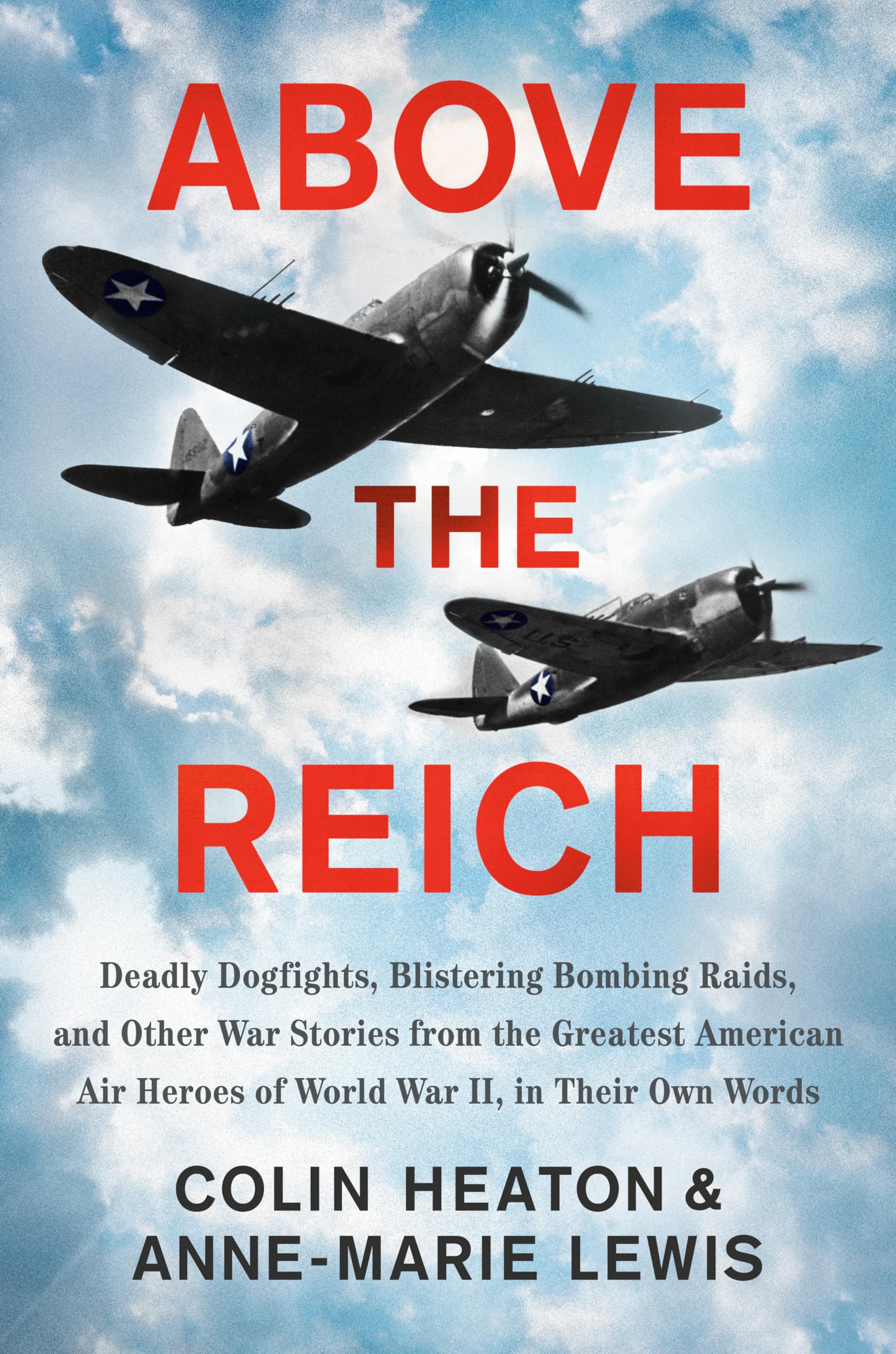
Above the Reich: Deadly Dogfights, Blistering Bombing Raids, and Other War Stories from the Greatest American Air Heroes of World War II, in Their Own
$17.89
by Colin Heaton



Sensational eyewitness accounts from the most heroic and legendary American aviators of World War II, never before published as a book They are voices lost to time. Beginning in the late 1970s, five veteran airmen sat for private interviews. Decades after the guns fell silent, they recounted in vivid detail the most dangerous missions that made the difference in the war. Ed Haydon dueled with the deadliest of German aces—and forced him to the ground. Robert Johnson racked up twenty-seven kills in his P-47 Thunderbolt, but nearly lost his life when his plane was shot to ribbons and his guns jammed. Cigar-chomping Curtis LeMay was the Air Corps general who devised the bomber tactics that pummeled Germany's war machine. Robin Olds was a West Point football hero who became one of the most dogged, aggressive fighter pilots in the European theater, relentlessly pursuing Germans in his P-38 Lightning. And Jimmy Doolittle became the most celebrated American airman of the war—maybe even of all time—after he led the audacious raid to bomb Tokyo. Today these heroes are long gone, but now, in this incredible volume, they tell their stories in their own words. "Readers with military background in general, and interest in and knowledge of the war in particular, will welcome and applaud this revealing history. Readers encountering information about the war for the first time may have their eyeballs pop out on springs. . . . The text pulls you along like an action/adventure novel, owing to the vivid voices of these five men and the obstacles they had to overcome. At the same time, it feels like you’re sitting in the same room with them hearing the stories firsthand." — New York Journal of Books "Colin Heaton has once again produced a series of first-person accounts from the men who made aviation history. . . . An invaluable addition to military history." — Adam Makos, New York Times bestselling author of A Higher Call and Spearhead "Among the top tier of World War II histories." — Jay A. Stout, author of Hell's Angels Colin Heaton is a military historian, former soldier and Marine sniper, professor, and specialist in interviewing military veterans. Anne-Marie Lewis holds a BA from American Military University (Hon) in International Relations Conflict Resolution and Peacekeeping and an MA in International Relations National Security Issues and Counterterrorism. She has worked as a photographer with the Doolittle Raiders, Black Sheep, and Tuskegee Airmen and has been featured in both publications and advertising. She has also co-authored several military histories and biographies. A South Carolina native, she currently works in Cybersecurity in Atlanta, Georgia. A Man Too Hard to Kill Robert Samuel Johnson Robert S. Johnson grew up during the Great Depression in Lawton, Oklahoma, during the dust bowl era. High unemployment and a long drought destroyed farming, increasing the misery. His life of poverty did not prevent him from deciding to become an aviator. He eventually became a fighter pilot, serving with the Fifty-Sixth Fighter Group, known on both sides of the English Channel as "Zemke's Wolfpack," so-named for its colorful, blunt leader, Colonel Hubert A. "Hub" Zemke. The Fifty-Sixth Fighter Group produced some of the highest-scoring ace fighter pilots in the US Army Air Forces in the European theater of operations (ETO). Including Johnson's own twenty-seven victories, his fellow fighter pilots were credited with destroying 985.5 enemy aircraft: 674.5 shot down and 311 destroyed on the ground, the most victories of any fighter group in the Eighth Air Force. Johnson scored his victories in eight-nine combat missions (a ratio of 3.17 sorties, per victory) and was the first American pilot in the ETO to break America's top World War I fighter ace Captain Edward Rickenbacker's score of twenty-six, achieved in World War I. When I first spoke to Bob Johnson by telephone in 1986, he seemed quite keen on doing an interview. We spent many hours talking about his life as I took copious notes. Nine years later, on the way to Lake Wylie, South Carolina, where he had invited me to his home to finally meet face-to-face, I stopped to get a bite to eat at a local restaurant before checking into a hotel. As I walked in, there sat Robert Johnson, eating his dinner. "Damn," he said as soon as he saw me. "You must be anxious. I thought I was going to see you tomorrow." The situation was more than a little uncomfortable. I did not want to intrude on his meal, but he asked me to sit down, and I did. We spoke about arbitrary things, but nothing related to the interview; I would save that until the next day. He did say that he wished his wife, Barbara, were still alive to meet me, because she had enjoyed hearing my southern accent on the other end of the line. She had seemed to be a very nice lady, one I wished I could have met, too. Johnson was looking good for a man of his years: short but still solid and strong. I sp