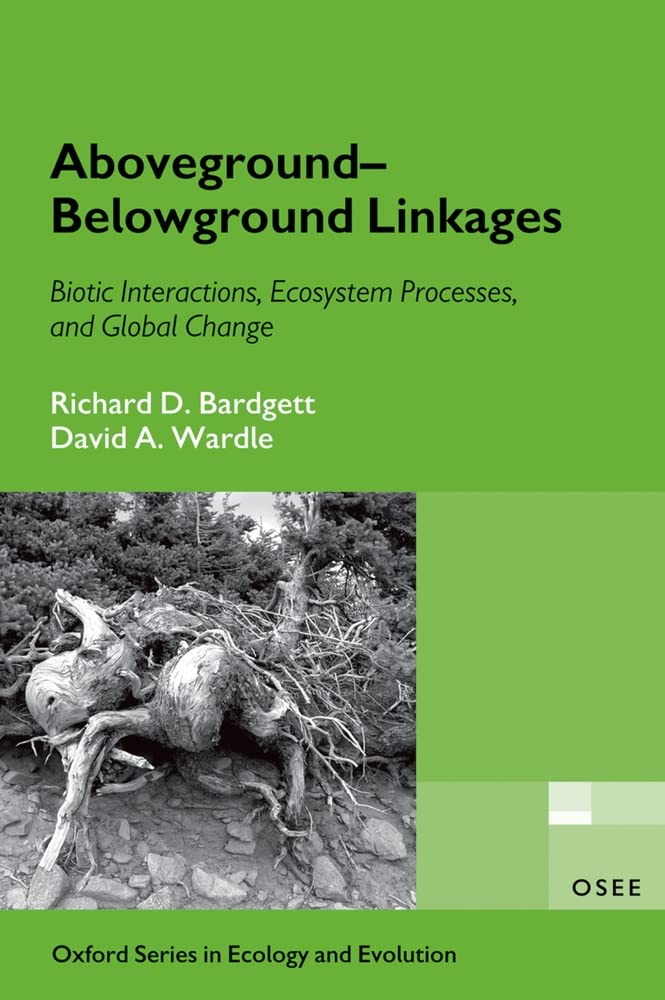
Aboveground-Belowground Linkages: Biotic Interactions, Ecosystem Processes, and Global Change (Oxford Series in Ecology and Evolution)
$49.99
by Richard D. Bardgett



Aboveground-Belowground Linkages provides the most up-to-date and comprehensive synthesis of recent advances in our understanding of the roles that interactions between aboveground and belowground communities play in regulating the structure and function of terrestrial ecosystems, and their responses to global change. It charts the historical development of this field of ecology and evaluates what can be learned from the recent proliferation of studies on the ecological and biogeochemical significance of aboveground-belowground linkages. The book is structured around four key topics: biotic interactions in the soil; plant community effects; the role of aboveground consumers; and the influence of species gains and losses. A concluding chapter draws together this information and identifies a number of cross-cutting themes, including consideration of aboveground-belowground feedbacks that occur at different spatial and temporal scales, the consequences of these feedbacks for ecosystem processes, and how aboveground-belowground interactions link to human-induced global change. "This is the most interesting book I read in 2010...It should appeal to a wide range of researchers, is an excellent source of reference and a potentially useful teaching resource." -- Bulletin of the British Ecological Society "Is Aboveground-Belowground Linkages just another synthesis? Certainly not...An excellent and up-to-date overview of the field of plant and soil community interactions and ecosystem functioning...In my opinion, a book that all plant and soil ecologists should read...It will undoubtedly have a strong influence on the direction of the future research of many scientists in this field." -- Trends in Ecology and Evolution "Well-organized, up-to-date, and insightful text that synthesized what we know (and just as importantly, don't know) about aboveground-belowground linkages...Given that the authors are pioneering leaders in this field and have had a long and productive collaboration, it is no surprise that their new book is excellent." -- Ecological Society of America "This book will be a valuable reference for plant ecologists, ecosystem ecologists, and global change ecologists. The references alone are a treasure trove and include both older literature that may not be familiar to newer readers as well as a comprehensive list of more recent examples. The most important contribution of this volume, however, is the large number of synthetic examples that link individuals (traits) to populations to communities to ecosystems and exemplify the interdependence that defines much of ecology." -- The Quarterly Review of Biology The most up-to-date and comprehensive synthesis of recent advances in our understanding of the roles that interactions between aboveground and belowground communities play in regulating the structure and function of terrestrial ecosystems, and their responses to global change. Richard D. Bardgett is Editor of Journal of Ecology and is recognised as an ISI Highly Cited Researcher. He was elected an Honorary Fellow of the Royal Society of New Zealand in 2006. He serves on the Editorial Boards of Ecology Letters and Ecosystems and is a member of Rothamsted's Board of Directors. David A. Wardle received the NZ Association of Scientists Medal in 1999, the NZ Ecological Society Research Award in 2001, and has been a Fellow of the Royal Society of NZ since 2003 and an ISI Highly Cited Researcher since 2006. He also serves or has served on a range of Editorial Boards including Science , Ecology and Ecology Letters . Orders are despatched from our UK warehouse next working day.