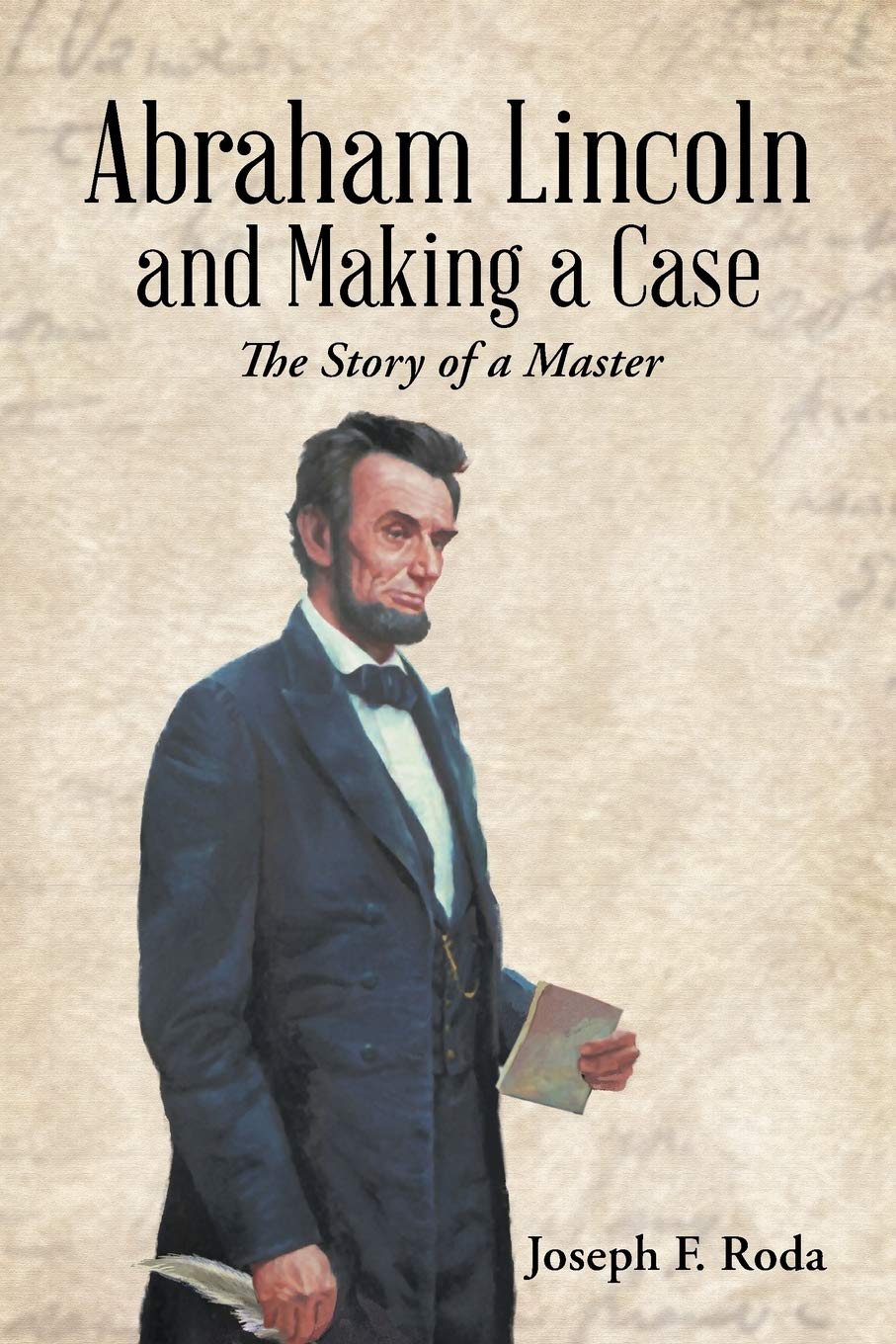



We remember Abraham Lincoln for many things, but without his ability at persuasion, we would remember him for nothing. It was that ability that brought him first to national prominence and the White House, and then through the most difficult four years that any president has ever faced. This book focuses exclusively on that ability, looking first at Lincoln’s history of persuasive efforts, from the poverty-stricken boy who stood on tree stumps to repeat sermons, through the young state legislator and congressman, courtroom lawyer, rising national politician, and ultimately president,and then at what made him so effective: his personality and intellect, his credibility and clarity, and his masterful use of fact, logic, and emotion. It is a remarkable story. Mr. Roda graduated from Harvard College and the University of Pennsylvania Law School, and was then a trial and appellate lawyer for 42 years, now retired. He is a member of The International Academy of Trial Lawyers, which limits its United States membership to 500 attorneys, and the American College of Trial Lawyers, which limits its membership to one percent of practicing attorneys in each state. He has given presentations on Abraham Lincoln's ability at persuasion for the past nine years, to other attorneys and laypersons, and builds in this book on those presentations. He lives with his wife, Elizabeth, in Lancaster, Pennsylvania Abraham Lincoln and Making a Case The Story of a Master By Joseph F. Roda AuthorHouse Copyright © 2018 Joseph F. Roda All rights reserved. ISBN: 978-1-5462-6394-4 Contents Preface, ix, Prologue, xiii, Part I, Chapter 1: Born to Speak, 3, Chapter 2: Best in the State, 9, Chapter 3: The Road to the White House, 15, Chapter 4: Mr. President, 37, Part II, Chapter 5: Personality and Intellect, 87, Chapter 6: Knowledge of People, 94, Chapter 7: Preparation and Timing, 101, Chapter 8: Credibility, 110, Chapter 9: Clarity, 121, Chapter 10: Facts, 135, Chapter 11: Logic, 140, Chapter 12: Emotion, 147, Chapter 13: Conclusion, 161, Index, 203, CHAPTER 1 Born to Speak ABRAHAM LINCOLN WAS drawn to public speaking from his earliest days. His stepmother, Sarah Bush Johnston Lincoln, said that, even as a boy, Lincoln "would hear sermons preached — come home — take the children out — get on a stump or log and almost repeat it word for word." His older cousin Dennis Hanks likewise said that the young Lincoln, even at work, "sometimes would mount a stump — chair or box and make speeches — Speech with stories — anecdotes & such like thing[s]." Thus would begin one of the great legacies of public persuasion, through both speech and pen. Perhaps his first "debate" for which there is a "record" came in 1830, when the twenty-one-year-old Lincoln, while "driving a team of oxen, breaking prairie," encountered Peter Cartwright, a well-known "circuit-riding preacher and politician." William Butler witnessed the encounter and later recalled it: Cartwright laid down his doctrines in a way which undoubtedly seemed to Lincoln a little too dogmatical. A discussion soon arose between him [Lincoln] and Cartwright, and my first special attention was attracted to Lincoln by the way in which he met the great preacher in his arguments, and the extensive acquaintance he showed with the politics of the State — in fact he quite beat him in the argument. In the summer of the same year, the young Lincoln similarly impressed observers with a speech at a political gathering, which another of Lincoln's older cousins, John Hanks, later recalled: A man by the name of Posey Came into our neighborhood and made a Speech: it was a bad one and I Said Abe could beat it. ... Abe made his Speech [and] ... beat him to death — his subject being the navigation of the Sangamon River. The man after the Speech was through took Abe aside and asked him where he had learned So much and what he did so well. Abe Explained, Stating his manner & method of reading and what he had read: the man Encouraged Lincoln to persevere. Not long after this, the twenty-two year old Lincoln struck out on his own, leaving home and moving to New Salem, Illinois, where he soon began attending meetings of the town's Literary and Debating Society. He stood to speak for the first time after just a few months, and impressed the group's leader, James Rutledge, who reportedly told his wife that Lincoln "was already a fine speaker; that all he lacked was culture to enable him to reach the high destiny which he Knew was in store for him." Rutledge's son, who was also present when Lincoln first spoke, echoed that sentiment, saying that Lincoln "pursued the question [to which he spoke] with reason and argument so pithy and forcible that all were amazed." The next year (1832), at the age of just twenty-three, Lincoln made his first try at elective office, running as a Whig against twelve other candidates for four available seats in the Illinois House. He finished eigh