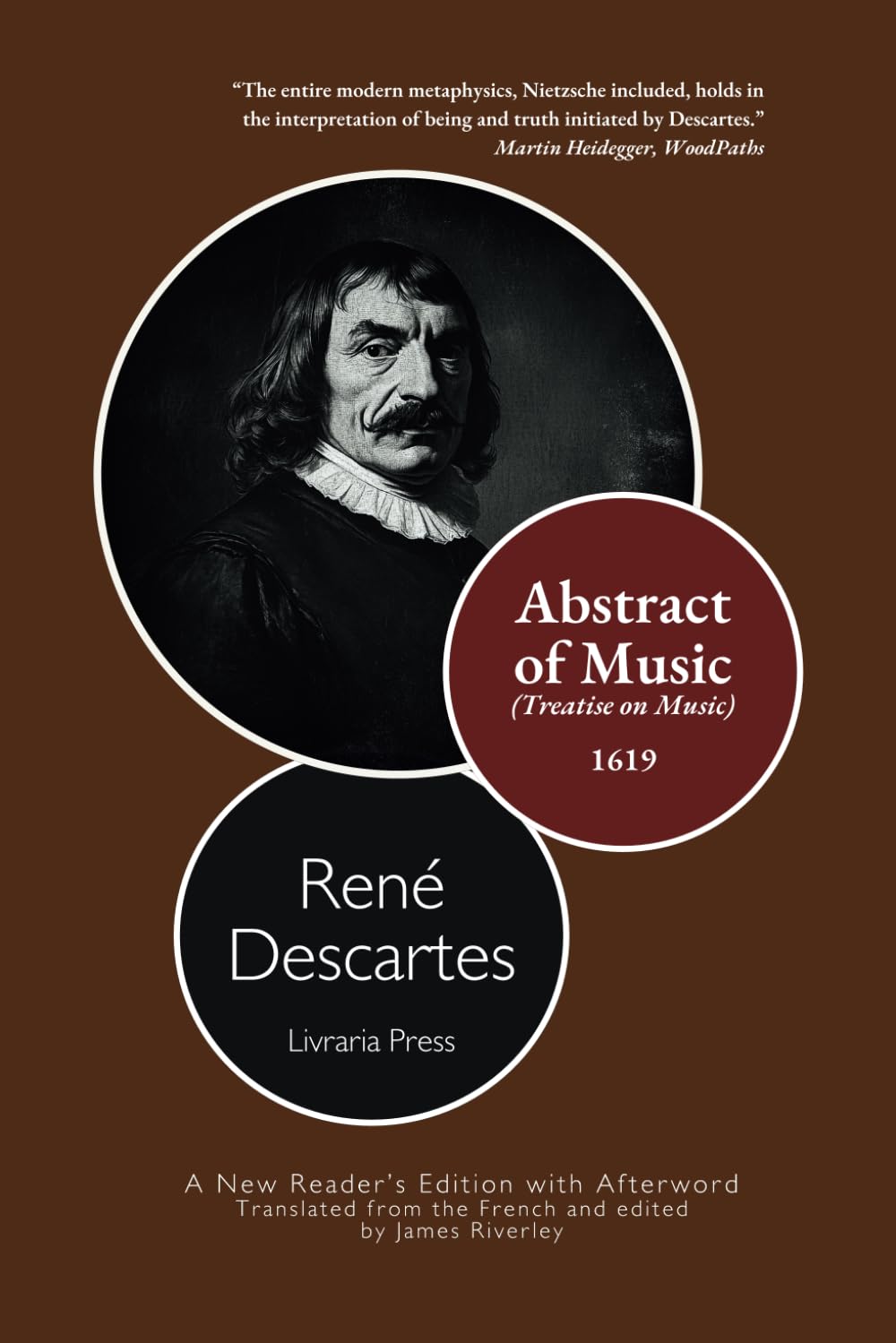



"Descartes was the first to bring to light the idea of a transcendental science, which is to contain a system of knowledge of the conditions of possibility of all knowledge." - Kant A modern translation of Descartes' famous 1619 work "Abstract of Music" or "Treatise on Music" (Compendium musicæ). This edition contains an Afterword from the translator, as well as a timeline of Descartes' life and summaries of each of his works. "Abstract of Music," completed in 1619 when Descartes was just twenty-three years old, represents his earliest significant work and establishes his lifelong interest in the mathematical foundations of natural phenomena. This pioneering text seeks to explain musical harmony through mathematical principles, arguing that the pleasure we derive from music can be understood through rational analysis of sound waves and their mathematical relationships. Though unpublished during his lifetime, the treatise demonstrates Descartes' early attempt to apply mathematical reasoning to sensory experience, laying groundwork for his later philosophical investigations. The work examines the nature of sound, consonance, and dissonance through a mathematical lens, presenting music theory as a bridge between abstract mathematics and human perception, and marking one of the first systematic attempts to analyze musical aesthetics through scientific principles. Descartes wrote this treatise during his stay in Breda, but it was only printed after his death. It discusses the relationship between music and mathematics, and how music can be understood through mathematical principles. This work influenced later discussions of the mathematical foundations of music. The text explains that music has the ability to arouse different passions by using variations in time, intensity, and the arrangement of sounds. Music can evoke feelings of sadness, joy, or fear, and these emotional effects are attributed to harmony, rhythm, and proportion in the composition of sounds. Here he breaks down the "key properties of sound", such as pitch (high or low) and duration (time), are analyzed to show how they influence the listener's emotional response. It explains the importance of proportion, symmetry, and variety in creating pleasing sounds. Descartes also explores concepts such as consonance, dissonance, and the division of sounds into intervals (octaves, fifths, and thirds), emphasizing the mathematical relationships that form the basis of harmony. Finally, the text touches on how the structure of music, particularly its meter and rhythm, can lead to physical responses such as dance, illustrating the deep connection between music and the human experience of emotion- relating music back to his famous body-soul duality and a nascent Phenomenology. What makes this work particularly intriguing is how it bridges medieval music theory with emerging scientific thought - Descartes sought to explain why certain combinations of tones please the ear while others create dissonance, grounding his analysis in mathematical ratios rather than traditional Pythagorean mysticism. The manuscript itself wasn't published until 1650, but its ideas heavily influenced his later work on mathematics and sensory perception. This early exploration of music theory connects deeply to Descartes' later philosophical framework. His systematic examination of sound and harmony prefigures the methodological doubt he would develop in Meditations, showing an early commitment to finding clear, rational principles underlying human experience. The treatise demonstrates Descartes wrestling with questions about the relationship between mathematical truth and sensory experience - a tension that would become central to his mature philosophy.