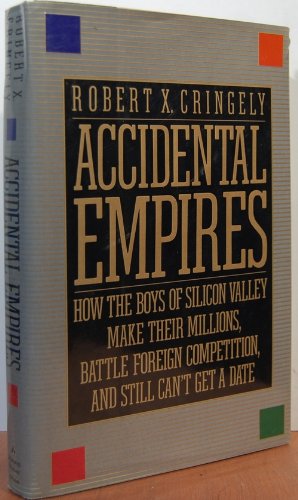
Accidental Empires: How the Boys of Silicon Valley Make Their Millions, Battle Foreign Competition, and Still Can't Get a Date
$7.80
by Robert X Cringely



Details the stories of the unlikely business barons of Silicon Valley, profiling Steve Jobs, Bill Gates, and others, and revealing how and why these mavericks have succeeded Readers of the computer industry journal Info World will recognize Cringely as the weekly columnist who openly solicits industry secrets from readers. Here, he offers an irreverent explanation (he says it's harder to be an explainer than a historian) of the computer culture together with an informative chronology of the major computer companies and the personalities that have shaped the industry. His informal insights presented in a characteristically wry manner will make this a popular book for a wide audience. - Joseph Barth, U.S. Military Acad. Lib., West Point, N.Y. Copyright 1992 Reed Business Information, Inc. A savvy observer's witty, wide-ranging audit of the personal- computer industry's ragtag roots, disorderly (albeit dramatic) growth, and competitive future. While InfoWorld columnist Cringely focuses on Silicon Valley, he covers the PC waterfront, from Armonk (home base for IBM) to the Seattle suburbs (where Microsoft is headquartered), with stops along the way in Houston (Compaq) and elsewhere. By his authoritative account, the business dates back to the early 1970's, when Intel introduced a microprocessor device and outlaw engineers used it to build a PC that could be assembled by hobbyists. Although many nerds and junk-food geniuses remained comparatively indifferent to the commercial potential of their creations, Cringely recounts, others did not. Within a few years, aggressive, visionary entrepreneurs like Steve Jobs (co-founder of Apple) and Bill Gates (Microsoft) had set up shop to cash in on a new market, which boomed in earnest with the arrival of Big Blue's initial entry, together with a host of so-called clones; at last count over 40 million PCs have been sold in the US. But, as Cringely makes clear, ``computers die young, but software lives on, nearly forever.'' Thanks to ongoing advances in the state of the circuitry art, he says, new generations of higher-performance PCs, work stations, and allied systems emerge about every 18 months. By contrast, programming has a virtually limitless life span. In addition to producing a high mortality rate among fledgling hardware suppliers, market dynamics have put IBM on a slippery down slope. In the meantime, Cringely predicts, Microsoft could, despite mediocre technology, become a genuine master of the universe because of its prowess at establishing and maintaining industry standards. Nor is Cringely concerned that Japan might dominate the PC/work-station game, with its preoccupation with mass- manufacturing hardware rather than originating perdurable and proprietary software. A lively, informed overview of a consequential enterprise that, for all its volatility, has produced earth-shaking change throughout the Global Village. -- Copyright ©1991, Kirkus Associates, LP. All rights reserved.