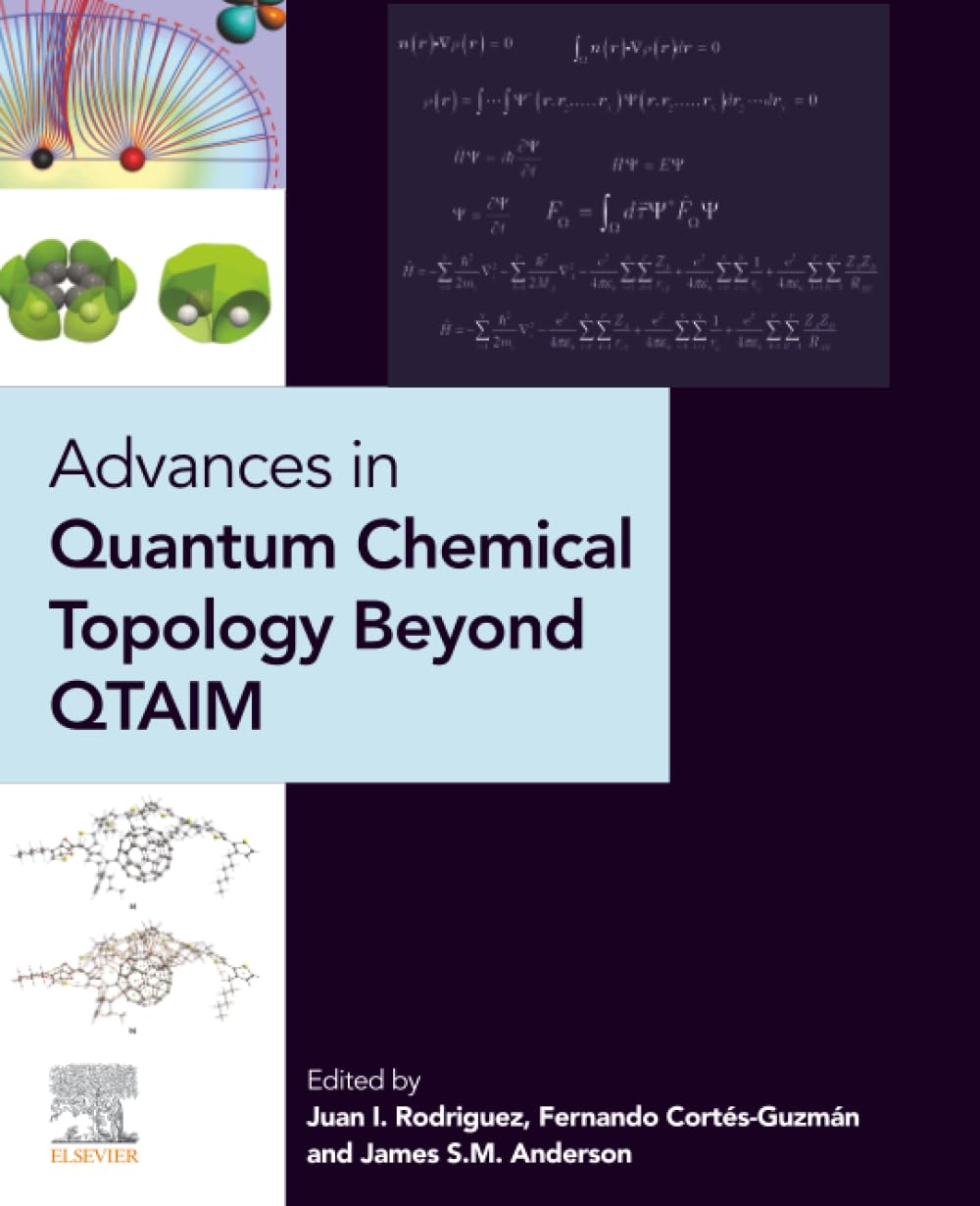



Advances in Quantum Chemical Topology Beyond QTAIM provides a complete overview of the field, starting with traditional methods and then covering key steps to the latest state-of-the-art extensions of QTAIM. The book supports researchers by compiling and reviewing key methods, comparing different algorithms, and providing computational results to show the efficacy of the approaches. Beginning with an introduction to quantum chemistry, QTAIM and key extensions, the book goes on to discuss interacting quantum atoms and related energy properties, explores partitioning methods, and compares algorithms for QTAIM. Partitioning schemes are them compared in more detail before applications are explored and future developments discussed. Drawing together the knowledge of key authorities in the area, this book provides a comprehensive, pedogeological guide to this insightful theory for all those interested in modelling, exploring and understanding molecular properties. Provides a contemporary review of the extensions and application of QTAIM methods - Compiles all extensions of QTAIM in one place for easy reference - Includes a chapter with an Introduction to Quantum Chemistry - Presents complex information at a level accessible to those engaged in theoretical/computational chemistry Authoritative review of quantum theory of atoms and molecules (QTAIM), ranging from traditional principles to the latest state-of-the-art extensions The Quantum Theory of Atoms in Molecules (QTAIM) helps researcher’s model and define the properties of molecules based on electron densities. Since Bader’s classic QTAIM was first developed, there have been numerous important extensions and developments in the field. Advances in Quantum Chemical Topology provides a complete overview of the field, starting with the traditional methods and covering all of the key steps up to the latest state-of-the-art extensions of QTAIM. It supports researchers by compiling and reviewing key methods, comparing different algorithms, and providing computational results to show the efficacy of the approaches. Beginning with an introduction to quantum chemistry, QTAIM and key extensions, the book goes on to discuss interacting quantum atoms and related energy properties, explores partitioning methods, and compares algorithms for QTAIM. Partitioning schemes are them compared in more details, before applications are explored and potential future developments discussed. Drawing together the knowledge of key authorities in the area, Advances in Quantum Chemical Topology provides a comprehensive, pedogeological guide to this insightful theory for all those interested in modelling, exploring and understanding molecular properties. Juan I. Rodríguez is a full professor at Instituto Politécnico Nacional-México since 2014. He obtained his PhD in quantum chemistry under the supervision of Prof. Paul Ayers developing efficient Density Functional Theory (DFT) numerical methodologies. He also worked with Prof. Richard Bader as a postdoctoral research assistant focusing on developing high performance algorithms for computing Bader’s QTAIM properties of “big CPU-time-prohibiting systems. These methods were implemented in the “Amsterdam Density Functional package (ADF). Currently prof. Rodríguez and his research group uses DFT-QTAIM based calculations to study materials for technological applications in organic solar cells, hydrogen evolution catalyst, virus biosensors, water pollution, etc. Fernando Cortés-Guzmán is a full professor at the Instituto de Química, Universidad Nacional Autónoma de México since 2008. He received his Ph.D. under Dr. Gabriel E. Cuevas González Bravo at UNAM. He also worked with Prof. Richard Bader as a postdoctoral research assistant focusing Metal-Ligand interactions. He focuses on the study of the evolution of specific interactions throughout a chemical process, both in the basal and excited state, using the local and integrated properties of scalar fields in order to understand and predict reactivity and molecular recognition. James S. M. Anderson is an associate professor at Instituto de Química, Universidad Nacional Autónoma de México since 2019. He received his Ph.D. under Prof. Paul W. Ayers at McMaster University where he developed algorithms for finding exact solutions for the equations appropriate for quantum chemistry. He completed a postdoctoral stays with Prof. Takaharu Otsuka at the University of Tokyo, Prof. Wenjian Liu at Peking University, Dr. Seiji Yunoki at RIKEN, and Prof. Koichi Yamashita at the University of Tokyo. Currently Prof. Anderson and coworkers carry out research in: 1) Developing methods that accurately approximate the electronic structure of atoms, molecules, clusters, and chemical systems. 2) Developing computational facile models that provide intuition into a molecules or chemical system, with a strong preference for models that are derived directly from formal mathematics. 3) Using mathematical theorems and