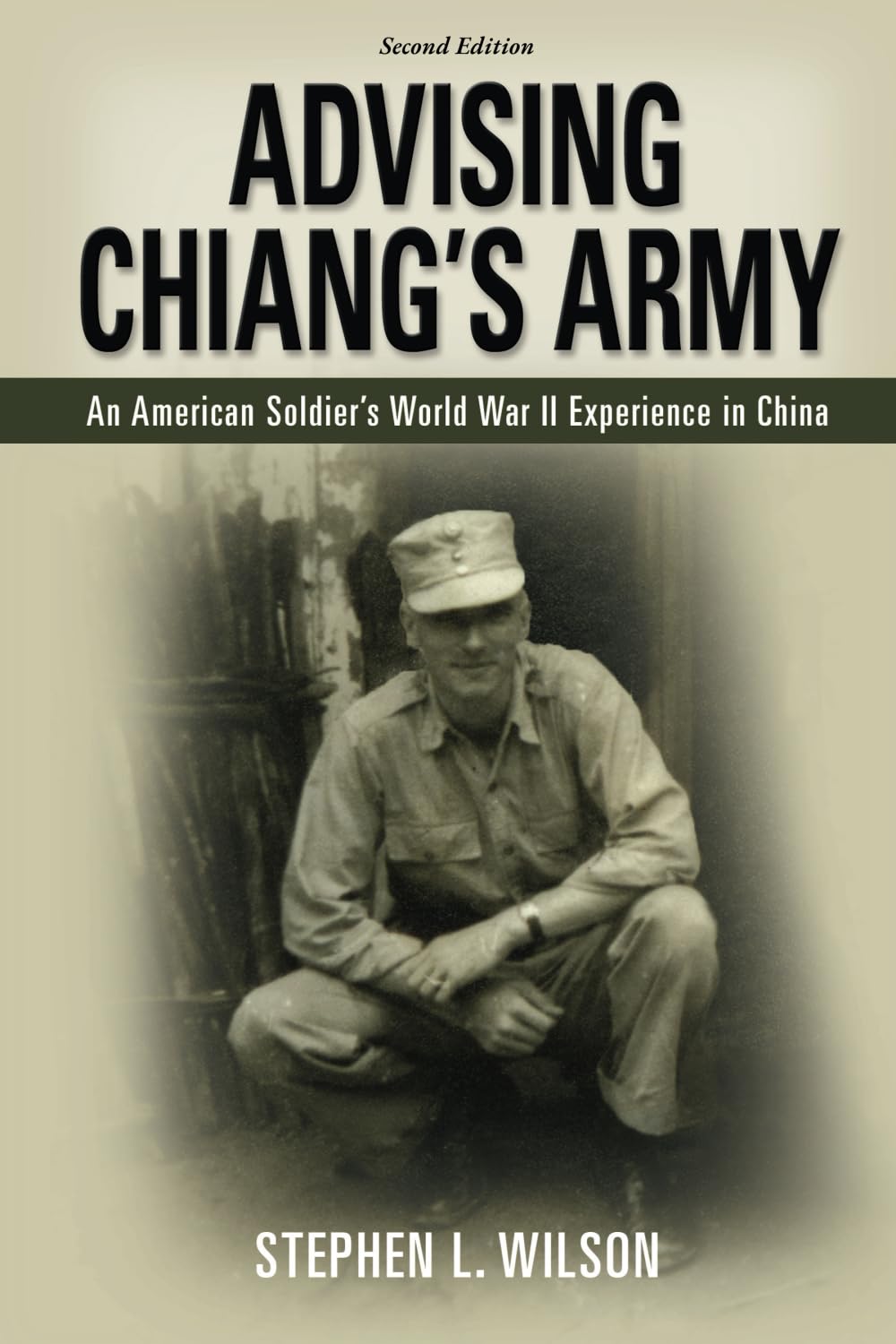
Advising Chiang’s Army: An American Soldier’s World War II Experience in China (South Dakota Patriots)
$16.00
by Stephen L. Wilson



Phil Saunders was commissioned as a second lieutenant in the U. S. Army in 1942. After receiving further training at Fort Benning and serving as a training officer at Camp Wheeler, he was assigned as a combat liaison officer with Chiang Kai-shek's nationalist army in China. He arrived in the China-Burma-India theater in the fall of 1943 and soon discovered the Chinese soldiers were underfed, underpaid, unprepared for combat, and reluctant to engage the Japanese. Advising Chiang's Army details Phil's two years spent in China and describes how the troops he worked with gradually became an effective fighting force, shifted from defensive to offensive combat, and ultimately defeated the enemy. The book also recounts his post-war career in state politics and with the National Labor Relations Board. Advising Chiang's Army won a CIPA EVVY Merit Book Award in the Military/Military History category. And it is featured in a newsletter for University of Oxford Alumni in North America. George Fry for Military magazine; reprinted by Midwest Book Review in Reviewer's Bookwatch On Christmas 1941, under the tree I found a boy's U.S. Army uniform (complete with Browning belt) from Santa (courtesy of Sears & Roebuck, Chicago). I put it on, headed for the door, and told my Mom I was off to China to save Madame Chiang Kai-shek from the Japanese. This 5-year-old got no further than the front porch. An older (and wiser) Midwest lad, Phil Saunders, was to be very successful in his mission to China. This delightful book tells his tale. In October 1943, when Phil Saunders arrived, the Nationalist forces were "underfed, unfit and under-equipped." Having fought Imperial Japan since 1931 (and the Mukden incident in Manchuria), they had reached the point where "they handed out medals for retreats." All of that was about to change. Of course, given the priorities of Europe and the Pacific, China was the "forgotten theater." Generalissimo Chiang Kai-shek was hard-pressed to stave off both the Communists (under Mao Tse-tung) and the Japanese. An infusion of American know-how and willpower was urgently needed. Isolated, China was reached by "Flying the Hump" over the Himalayas. American determination was to prevail. Phil Saunders was one of 96 Americans in China when he arrived in Yunnan (southeast quadrant of the Republic). When he came home in September 1945, over 20,000 Yanks were there. Some were famous, as Claire Chennault (the Flying Tigers), Joseph W. (Vinegar Joe) Stilwell and Albert E. Wedemeyer. Most were nearly anonymous. Together with their Asian allies, these Americans led Chiang to victory. Often we focus only on the "big names" in military history, but this is a narrative of "GI Joe." A ROTC graduate from the University of South Dakota, given more training at Fort Benning and Camp Wheeler, Georgia, Saunders was a versitile and gifted asset to his Chinese friends. Of course, there were the daily frustrations of climate, food fatigue, travel (by foot over rugged terrain) and language (just which Chinese dialect ought he learn?), let alone loneliness and poor accommodations (one hut was shared with pigs). Through it all Saunders prevailed. Against impossible odds, China won! This book has it all. There is a love story, a successful academic career, 18 years of military service and distinguished achievement in local and national politics (as a Republican), including a stint as Attorney General of South Dakota. This exciting life receives full justice from an adept author, Stephen L. Wilson, a retired attorney and an Adjunct Professor of History and Political Science at Concordia University, St. Paul, Minnesota. The volume is well researched, carefully documented and richly illustrated with 54 pages of photos and maps. This book is a vast treasure trove for anyone interested in World War II, Asian history, and in the career of an extra-ordinary American. It's a joy to recommend it to readers of Military . Rabina Tanveer for Reader's Favorite (5-star review) Advising Chiang's Army: An American Soldier's World War II Experience in China by Stephen L. Wilson gives us a different view of World War II and China at that time. We all know what happened to China and the innocent people living there, but we don't get to see the soldiers' perspective that often. This book gives us a glimpse behind the curtain and tells us what happened to the Chinses soldiers in WW II. Phil Saunders was a second lieutenant in the U.S. Army in 1942; he was assigned the duty of combat liaison with Chiang Kai-shek's nationalist army in China. Soon after he arrived, he discovered that the Chinese soldiers were not prepared for the war. Half starved, ill prepared and underpaid, these soldiers were not equipped to fight in any war. He trained them to be an army to be reckoned with. He made them stronger, sharper, and gave them the boost they needed to protect their country and their people. I don't have to tell you much about what he did f