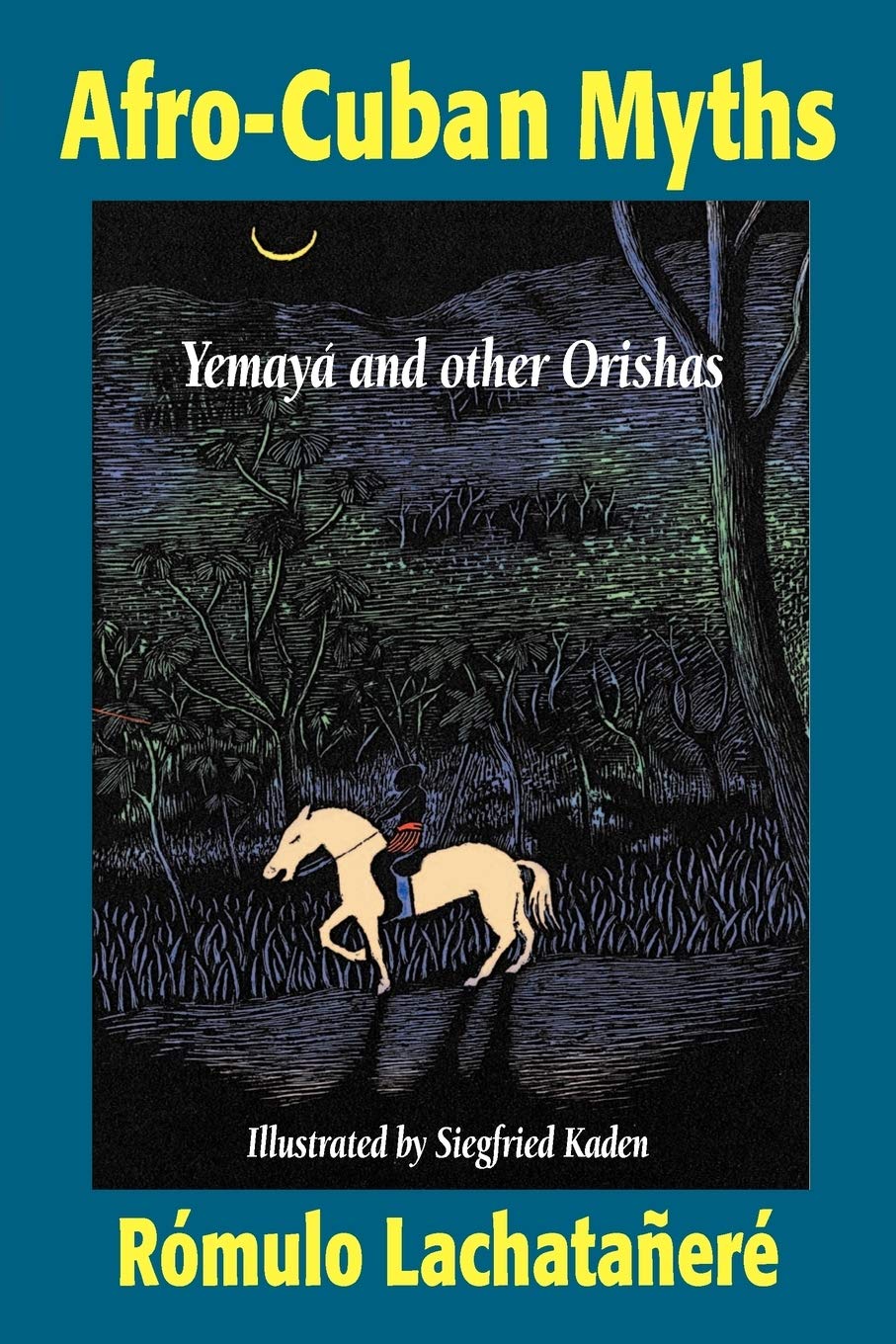



"The essay "The Afro-Cuban Festival 'Day of the Kings'" by Fernando Ortiz, founder of Afro-Cuban studies, describes how, as in Brazil, Catholic priests and the colonial government as early as 1573 allowed and encouraged the African slaves to celebrate Epiphany, the Festival of the Three Kings...Free people joined in and the dances, music and costumes paraded by the various eyewitnesses demonstrate how early and how immense were the African contributions to what was to become the carnival of the African Diaspora. "A collection of myths from the Yoruba branch of Afro-Cuban religions, the Spanish original of this book (1938) was a pioneer publication in the field. Lachatanere interviewed a practitioner of the most widespread Afro-Cuban religion; taking special care to maintain the oral style in the development of the stories, he reveals the freshness of the narrator's perspective as he outlines the cosmological fabric created by the encounter of the African people with the Catholic religion. The book includes stories of important deities, that will help the reader understand the conceptual world of the believers. Those interested in learning about Afro-Cuban music, art, and poetry will find in this translation an introductory manual to the language, certain foods used in ceremonies, and the role of divination and figures such as the trickster. Jorge Castellanos, a scholar who has published widely on the influence of African culture on Cuban society, provides an introduction that places the author's work in its social and cultural context. The volume includes a short glossary and a selection of songs and prayers dedicated to the deities. Summing up: Recommended. General readers." â O.B. Gonzalez, Loyola University for Choice Magazine "Carnival in Santiago...here, with her (Bettelheim's) own two essays, the anthology really comes to life." -- African Arts "Thirty-six illustrations from the original Spanish Ortiz edition and twenty-six field photographs by Judith Bettelheim...help immeasurably to bring these little-known secular rituals to life." -- New West Indian Guide This invaluable anthology...is required reading for those interested in Cuba's history, religious forms, and popular culture. -- Cuba Update About Judith Bettelheim: Judith Bettelheim, San Francisco State University, is the co-author of Cuban Festival Arts and numerous scholarly articles. The River :The hordes of men advanced deep into the impenetrable forest, savagely tearing down the dense trees, trampling the green grass that grew on the paths and pulling up by the roots the slender bushes that blocked their destructive impulse. They built roads. Narrow paths carpeted with fallen leaves appeared that gave way to wide roads skirting the high and inaccessible mountains that rose to meet their natural ceiling: the sky. In this way man created his communication routes and extended the boundaries of the villages, establishing new links and taking possession of more and more of the forest's jealously guarded secrets. In the wildest and densest part of the forest where the harshness of the terrain curbed man's audacity, the river flowed, majestic and menacing. From the highest plateaus it could be seen meandering through the mountains like a silvery monster that moves forward sluggishly. But when the distance was covered in a determined effort, the river, seen from nearby, revealed all its fury, its choppy water, its raging eddies rising, writhing like a wounded serpent rippling its back in the throes of death. The river roared lugubriously, a thunderous and menacing sound. Even the bravest hearts were filled with awe, and no one dared risk the dangerous undertaking of conquering the current. When all the others had left, convinced that any attempt to conquer the river would be fruitless, Agayú Solá, a farmer who was elderly but as strong and vigorous as a young warrior and irascible and hardworking, stood beside it looking at it defiantly. After thinking for a moment, he took his sharp axe and began to cut down a huge tree. Its trunk was so wide that it could not comfortably be encircled by the arms of five people. When he had finally felled it, he stripped away the branches with his battle machete. He made a bonfire whose sputtering flames rose, illuminating the sky with its bright sparks. Then he let a slow fire bore through the resinous trunk of the felled tree while he shaped the wood until he had fashioned a crude boat. He made two powerful oars out of the same wood. When he considered his work done, he put some provisions in his boat and set out on his adventure. He rowed, cutting through the current, beating it tirelessly with his oars. The river put up a resistance equal to that of a thousand animals pulling in the same direction. But Agayú Solá cut through the river in his small boat. All his muscles flexed, and the veins on his neck stood out, his chest expanding and contracting like an accordion. The oars hit the water, thwack, thw