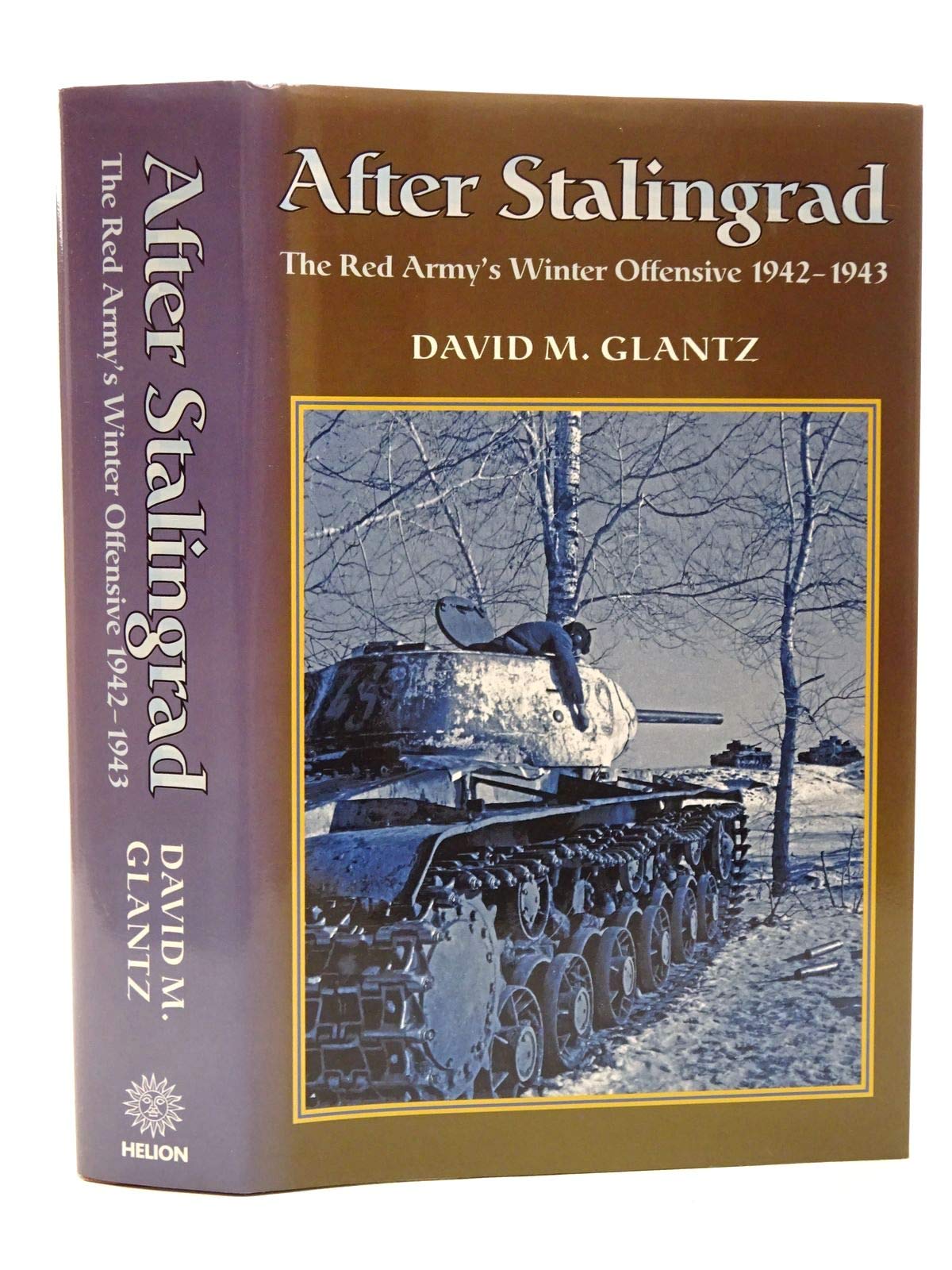



In the wake of the Red Army's signal victory at Stalingrad, which began when its surprise counteroffensive encircled German Sixth Army in Stalingrad region in mid-November 1942 and ended when its forces liquidated beleaguered Sixth Army in early February 1943, the Soviet High Command (Stavka) expanded its counteroffensive into a full-fledged winter offensive which nearly collapsed German defenses in southern Russia. Exploiting newly released Russian archival materials, After Stalingrad reveals the unbounded ambitions that shaped the Stavka's winter offensive and the full scope and scale of the Red Army's many offensive operations. For example, it reflects on recently rediscovered Operation Mars, Marshal Zhukov's companion-piece to the more famous Operation Uranus at Stalingrad. It then reexamines the Red Army's dramatic offensive into the Donbas and Khar'kov region during February, clearly demonstrating that this offensive was indeed conducted by three rather than two Red Army fronts. Likewise, it describes how the Stavka expanded the scale of its offensive in mid-February 1943 by ordering major strategic efforts, hitherto ignored, by multiple Red Army fronts along the Western (Orel-Smolensk) axis and, in Zhukov's forgotten operation Polar Star, along the Northwestern (Demiansk-Leningrad) axis as well. Finally, by restoring the full scope of these failed or partially failed Red Army offensives to history, this volume also reassesses the impact of Manstein's dramatic counterstrokes in the Donbas and Khar'kov regions, concluding that their impact was equivalent to that of a full-fledged strategic counteroffensive. This new study includes over 100 operational maps to highlight key aspects of the offensives. “…sheds new light on not only events in Southern Russia during the winter of 1942-43, but also the fierce combat that took place across the German Eastern Front during the same period. Glantz has mined newly revealed primary source material from the Russian archives to produce a fresh look at this important time in the war. Most importantly, Glantz helps clear up past myths by showing the reader the incredibly ambitious strategic intent behind Stavka's 1942-1943 winter campaign… prepare to have your pre-existing vision of the Second World War's Eastern Front challenged and be ready to reappraise what you thought you knew about the war. “ Globe at War David M. Glantz is an American military historian and the editor of The Journal of Slavic Military Studies. Glantz holds degrees in history from the Virginia Military Institute and the University of North Carolina at Chapel Hill and is a graduate of the U.S. Army Command and General Staff College, Defense Language Institute, Institute for Russian and Eastern European Studies, and U.S. Army War College. He began his military career in 1963 as a field artillery officer from 1965 to 1969 and served in various assignments in the United States and Vietnam during the Vietnam War with the II Field Force Fire Support Coordination Element (FSCE) at the Plantation in Long Binh. After teaching history at the United States Military Academy from 1969 through 1973, he completed the army’s Soviet foreign area specialist program and became chief of Estimates in US Army Europe’s Office of the Deputy Chief of Staff for Intelligence. Upon his return to the United States in 1979, he became chief of research at the Army’s newly formed Combat Studies Institute at Fort Leavenworth, Kansas, and then Director of Soviet Army Operations at the Center for Land Warfare, U.S. Army War College in Carlisle, Pennsylvania. While at the College, Col. Glantz was instrumental in conducting the annual "Art of War" symposia which produced the best analysis of the conduct of operations on the Eastern Front during the Second World War in English to date. The symposia included attendance of several former German participants in the operations and resulted in publication of the seminal transcripts of proceedings. Returning to Fort Leavenworth in 1986, he helped found and later directed the U.S. Army’s Soviet (later Foreign) Military Studies Office (FMSO), where he remained until his retirement in 1993 with the rank of Colonel. In 1993 he established The Journal of Slavic Military Studies, a scholarly journal for which he still serves as chief editor, that covers military affairs in the states of Central and Eastern Europe as well as the former Soviet Union. In recognition of his work, he has received several awards, including the Society of Military History’s prestigious Samuel Eliot Morrison Prize for his contributions to the study of military history. Glantz is regarded by many as one of the best western military historians of the Soviet role in World War II. He lives with his wife Mary Ann Glantz in Carlisle, Pennsylvania. Used Book in Good Condition