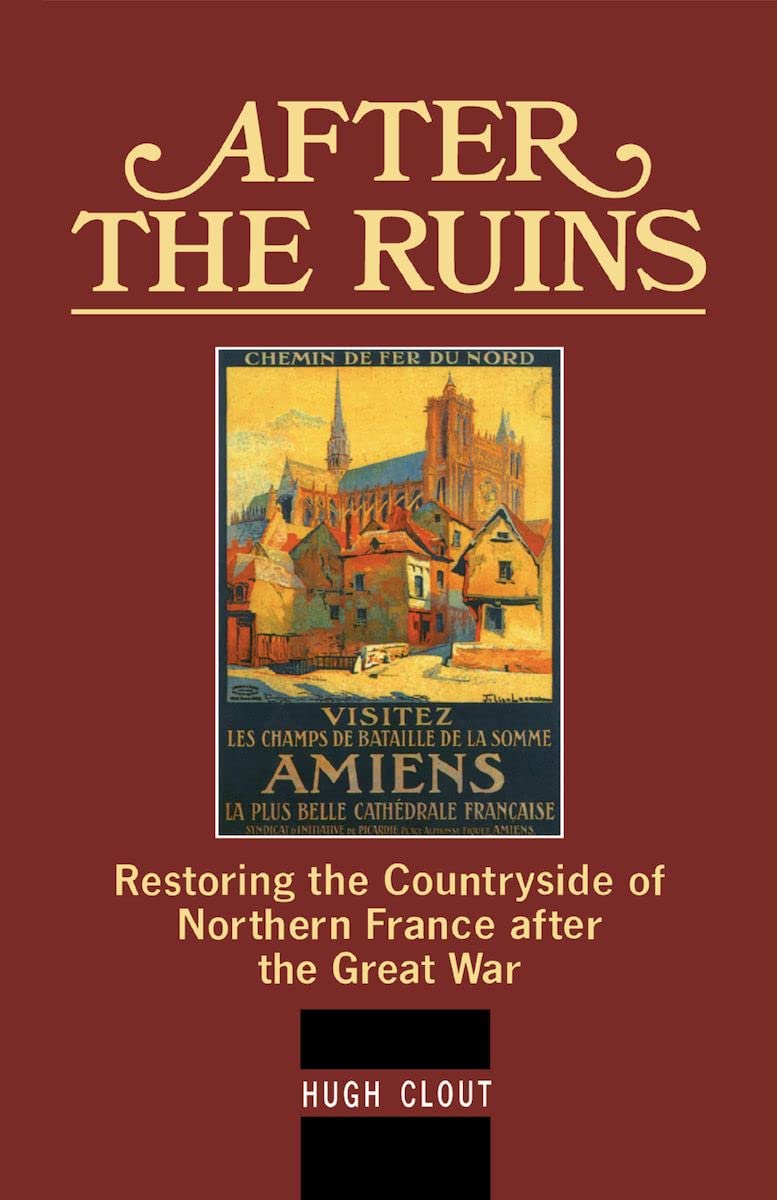
After the Ruins: Restoring the Countryside of Northern France after the Great War
$69.62
by Hugh Clout



After the Ruins uses both official and unofficial records to explore a relatively ignored aspect of recent rural history: how the fields, farms, villages and market towns of Northern France were restored during the 1920s in the aftermath of the Great War. The book contains illustrations and many detailed maps and makes use of both official reports and unofficial critical commentaries. “Hugh Clout has written a scholarly, dense text on an engrossing topic that will be of interest to all concerned with reconstruction after the First World War, and indeed interested in the still neglected interwar period of European historical geography.” – Journal of Economic and Social Geography ― Journal of Economic and Social Geography "The story told by Clout is full of detail, yet never loses sight of the main themes. It is the product of considerable research in national and departemental archives, and fills a notable hole in the history of rural France. It should be added that the quality of both print and illustrations is excellent, and the University of Exeter Press are to be congratulated on producing a high-quality book at a reasonable price." – The Agricultural History Review, Vol 46.1, June 1998 ― The Agricultural History Review “Clout provides a wealth of fascinating detail on conflicts and tensions between the various local interest groups and political organizations that emerged to coordinate reconstruction; between the local, national and even international initiatives that were involved, and between the different secular and religious agencies. The book has been very nicely produced by the publishers and has more than 40 superb maps and around a dozen photographs which convey both the nature of the devastation and the energy of those who rebuilt. This is, in short, an extremely important work which deserves to be widely read by geographers and historians alike. It will stand as a fitting memorial to the efforts (successful or otherwise) of all those who strove to overcome the terrible damage of modern war.” – Geographical Journal, 163 (3), 1997 ― Geographical Journal “...a fascinating story of bureaucracy and its well-meaning inefficiency, of the indomitable power of the human spirit to survive, of the passion of the peasantry to return to their own piece of France and to live and work again on their own holdings, of attempts to modernise as well as restore which took little account of people's yearning to return to the familiar. It is a book which will have a wide appeal across the social sciences...” –Roger Kain, Montefiore Professor of Geography, University of Exeter -- Roger Kain “. . . a pathbreaking contribution to the literature. . . The effects of the war on land use, mechanization, dispersion of the population and their resettlement have never been as carefully treated. There are powerful and telling surveys of the negotiation between local residents and official organizations over the extent of damage, and the appropriate levels of compensation for the devastation brought about by the war. There are original interpretations of the use of Chinese labour on reclamation projects, on the presence of workers from Italy, Belgium, Poland, Spain and Portugal, as well as resistance to the notion that German workers might rebuild where previously their brethren had destroyed. There is interesting detail on these fields as the repository of huge necropoli, and the commemorative efforts which organized the cemeteries which are still sprinkled liberally across this diagonal linking Belgium and Switzerland.” – Journal of Historical Geography , 1997 ― Journal of Historical Geography This is not another book about World War I. Instead, it explores a relatively ignored aspect of recent rural history: how the ordinary environments of fields, farms, villages and market towns of northern France were reconstituted once peace was restored. Using both official reports compiled by prefets and much more critical commentaries by those whose homes and land had been devastated, Hugh Clout charts the geography of destruction and then analyses the work of the state-directed services, the creation of reconstruction cooperatives, the controversial reclamation of the profoundly devastated 'red zone', and ultimately the reconstruction of the countryside across the ten northernmost departements of northern France. Hugh Clout is Professor of Geography, University College London where he has taught since 1967. He was Dean of the Faculty of Social and Historical Sciences from 1995 to 2004. He is one of the foremost geographical authorities on modern France and on the European Union in general.