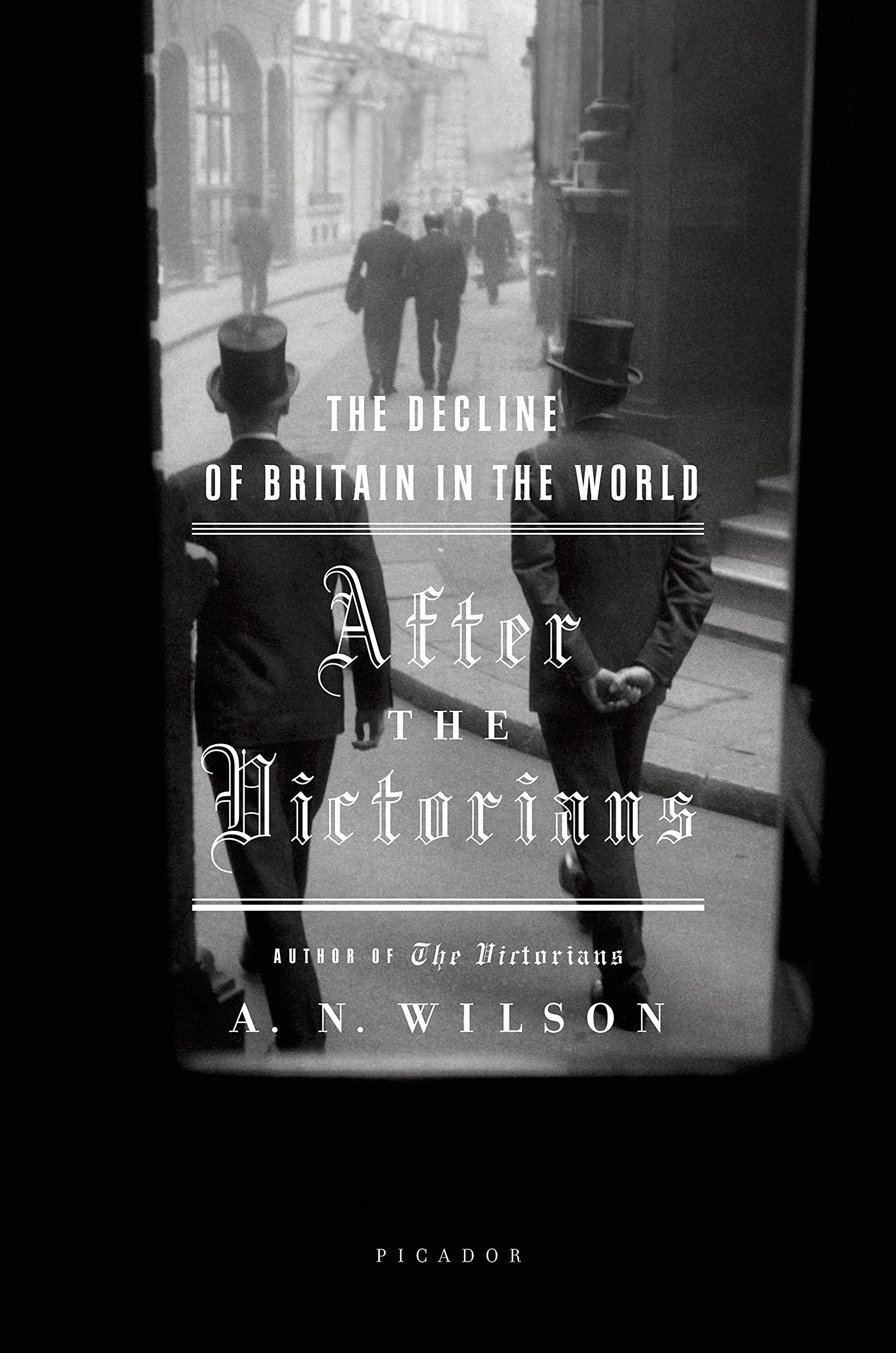



The distinguished historian A.N. Wilson has charted, in vivid detail, Britain's rise to world dominance, a tale of how one small island nation came to be the mightiest, richest country on earth, reigning over much of the globe. Now in his much anticipated sequel to the classic The Victorians, he describes how in little more than a generation Britain's power and influence in the world would virtually dissolve. In After the Victorians , Wilson presents a panoramic view of an era, stretching from the death of Queen Victoria in 1901 to the dawn of the cold war in the early 1950s. He offers riveting accounts of the savagery of World War I and the world-altering upheaval of the Communist Revolution. He explains Britain's role in shaping the destiny of the Middle East. And he casts a bright new light on the World War II years: Britain played a central role in defeating Germany but at a severe cost. The nation would emerge from the war bankrupt and fatally weakened, sidelined from world politics, while America would assume the mantle of dominant world power, facing off against the Soviet Union in the cold war. Wilson's perspective is not confined to the trenches of the battlefield and the halls of parliament: he also examines the parallel story of the beginnings of Modernism-he visits the novelists, philosophers, poets, and painters to see what they reveal about the activities of the politicians, scientists, and generals. Blending military, political, social, and cultural history of the most dramatic kind, A.N. Wilson offers an absorbing portrait of the decline of one of the world's great powers. The result is a fresh account of the birth pangs of the modern world, as well as a timely analysis of imperialism and its discontents. “[A] fast-moving, vivid, sharp-tongued portrait of Britain in the first half of the twentieth century . . . A book readers will devour with relish.” ― The Times Literary Supplement (London) “Cleverly organized, engagingly written, and rich in content.” ― The New York Times Book Review “A magnificent achievement . . . it could hardly be bettered.” ― The New Criterion “A work of affectionate memory . . . fueled by moral passion combined with irrepressible satire.” ― The Boston Globe “[A] vigorous, lively, and winningly eccentric work of synthesis and argumentation.” ― The Spectator (London) “Wilson's narrative skills, eye for an anecdote, and entertaining style should ensure a considerable audience for this lively, provocative, and thoroughly idiosyncratic history.” ― The Wilson Quarterly A. N. Wilson is a Fellow of the Royal Society of Literature and holds a prominent position in the world of literature and journalism. He is a prolific and award-winning biographer and celebrated novelist, having written biographies of Tolstoy, C. S. Lewis, Milton, Hilaire Belloc and Goethe. In 2007, Wilson's novel, Winnie and Wolf , was longlisted for the Man Booker Prize and in 2020 The Mystery of Charles Dickens was published to great critical acclaim. He lives in North London. After the Victorians The Decline of Britain in the World By A. N. Wilson Picador USA Copyright © 2006 A. N. Wilson All right reserved. ISBN: 9780312425159 Chapter One Oedipus Rex, Oedipus Kaiser In 1900 there was published in Vienna one of the most extraordinary and revolutionary texts ever to come from a human brain. Die Traumdeutung (The Interpretation of Dreams) expounded the theory on which all subsequent psychoanalysis was based, even or especially those psychoanalytical theories which reacted most violently against it: namely, that the human mind consists of what might be described as two layers. With the outer layer, of our conscious mind, we reason and form judgements. In reasonable, well-balanced individuals, the pains and sorrows of childhood have been worked through, put behind them. With the unhealthy, however, neurotic or hysterical individuals, there is beneath the surface of life a swirling cauldron of suppressed memories in which lurk the traumas (the Greek word for wounds) of early experiences. Under hypnosis, or in dreams, we re-enter the world of the subconscious and with the care of a helpful analyst we can sometimes revisit the scenes of our early miseries and locate the origins of our psychological difficulties. The author of this world-changing book, Dr Sigmund Freud (1856-1939), was a happily married neurologist, born in the Moravian town of Freiberg, but for most of his life resident in Vienna, hub of the Austro-Hungarian Empire, where his consulting room in Berggasse 19, Vienna IX (from 1931), and his celebrated couch, on which patients lay to recite their sorrows, became a totemic emblem of the century which was to unfold. The need to return to some forgotten, irrational, dark place of our lost past became compelling, personal and collective, as the hysteria of the twentieth century reached its crescendo-point and as Dr Freud, a Jew, though a non-believing on