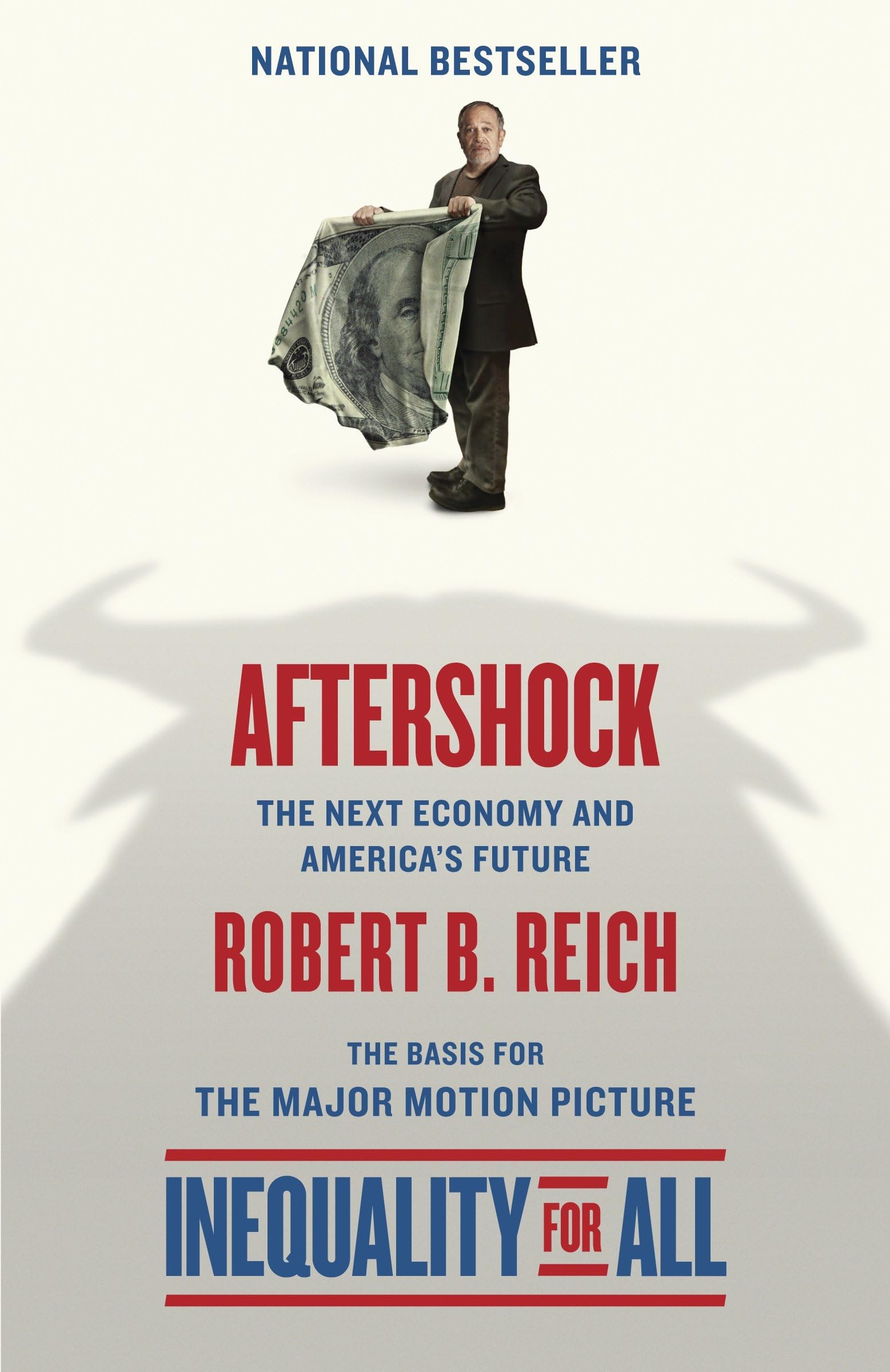
Aftershock(Inequality for All--Movie Tie-in Edition): The Next Economy and America's Future
$9.64
by Robert B. Reich



Updated and With a New Introduction When the nation’s economy foundered in 2008, blame was directed almost universally at Wall Street bankers. But Robert B. Reich, one of our most experienced and trusted voices on public policy, suggests another reason for the meltdown. Our real problem, he argues, lies in the increasing concentration of income at the top, robbing the vast middle class of the purchasing power it needs to keep the economy going. This thoughtful and detailed account of the American economy—and how we can fix it—is a practical, humane, and much-needed blueprint for rebuilding our society. Praise for Robert B. Reich's Inequality for All “Important and well executed. . . . Reich is fluent, fearless, even amusing.” — The New York Times Book Review “Reich provides a thoughtful dialogue about the structural problems that led to the recent recession. . . . His ideas are worth exploring.” — The Washington Post “[Reich] suggests a number of innovative ways to reverse the trend toward greater inequality and usher in another, more hopeful phase in American history.” — The Charlotte Observer “One of the clearest explanations to date of . . . how the United States went from . . . ‘the Great Prosperity’ of 1947 to 1975 to the Great Recession.” —Bob Herbert, The New York Times “All Americans will benefit from reading this insightful, timely book.” —Bill Bradley “Lucid and cogent.” — Kirkus Reviews “Well argued and frighteningly plausible: without a return to the 'basic bargain' (that workers are also consumers), the 'aftershock' of the Great Recession includes a long-term high unemployment and a political backlash—a crisis, he notes with a sort of grim optimism, that just might be painful enough to encourage necessary structural reforms.” — Publishers Weekly Robert B. Reich is Chancellor’s Professor of Public Policy at the Richard and Rhoda Goldman School of Public Policy at the University of California, Berkeley. He has served in three national administrations, most recently as secretary of labor under President Bill Clinton, and he served as an adviser to President-elect Barack Obama. He has written twelve books, including The Work of Nations (which has been translated into twenty-two languages), Supercapitalism, and the best sellers The Next American Frontier, The Future of Success, Locked in the Cabinet, and, most recently, Aftershock: The Next Economy and America’s Future . His articles have appeared in The New Yorker, The Atlantic, The New York Times, the Financial Times, The Washington Post, and The Wall Street Journal . He is co-founding editor of The American Prospect magazine and chairman of Common Cause. His bi-weekly commentaries on public radio’s Marketplace are heard by nearly five million people. In 2003, Reich was awarded the prestigious Václav Havel Foundation Prize for pioneering work in economic and social thought. In 2008, Time magazine named him one of the ten most successful cabinet secretaries of the twentieth century, and The Wall Street Journal named him one of the nation’s ten most influential business thought-leaders. 1 Eccles’s Insight The Federal Reserve Board, arguably the most powerful group of economic decision-makers in the world, is housed in the Eccles Building on Constitution Avenue in Washington, D.C. A long, white, mausoleum-like structure, the building is named after Marriner Eccles, who chaired the Board from November 1934 until April 1948. These were crucial years in the history of the American economy, and the world’s. While Eccles is largely forgotten today, he offered critical insight into the great pendulum of American capitalism. His analysis of the underlying economic stresses of the Great Depression is extraordinarily, even eerily, relevant to the Crash of 2008. It also offers if not a blueprint for the future, at least a suggestion of what to expect in the coming years. A small, slender man with dark eyes and a pale, sharp face, Eccles was born in Logan, Utah, in 1890. His father, David Eccles, a poor Mormon immigrant from Glasgow, Scotland, had come to Utah, married two women, became a businessman, and made a fortune. Young Marriner, one of David’s twenty-one children, trudged off to Scotland at the start of 1910 as a Mormon missionary but returned home two years later to become a bank president. By age twenty-four he was a millionaire; by forty he was a tycoon—director of railroad, hotel, and insurance companies; head of a bank holding company controlling twenty-six banks; and president of lumber, milk, sugar, and construction companies spanning the Rockies to the Sierra Nevadas. In the Crash of 1929, his businesses were sufficiently diverse and his banks adequately capitalized that he stayed afloat financially. But he was deeply shaken when his assumption that the economy would quickly return to normal was, as we know, proved incorrect. “Men I respected assured me that the economic crisis was only tem