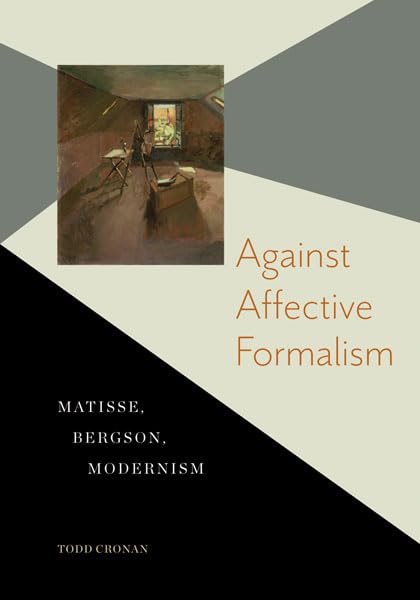



For nearly fifty years the humanities have been defined by a series of critiques: of the subject, of representation, of the visual, of modernism, of autonomy, of intention, of art itself. In their place various "materialities" have appeared: signs, identities, bodies, history, and works. Against Affective Formalism challenges these orthodoxies. "What I am after, above all, is expression," Henri Matisse declared. Matisse believed that through the careful arrangement of line and color he could transmit his feelings directly to the minds and bodies of his viewers. Yet Matisse continually struggled with the reality that his feelings were misunderstood--or simply ignored--by viewers of his art. Matisse oscillates between a desire for expressive command over the viewer and a sense of the impossibility of making himself known. Against Affective Formalism confronts modernism's dissatisfactions with representation. As Todd Cronan explains, a central tenet of modernist thought turns on the effort to overcome representation in the name of something more explicit in its capacity to generate bodily or affective experience. Henri Bergson was one of the most influential advocates of the antirepresentational impulse; his novel theories of memory and freedom gripped a generation of writers, philosophers, psychologists, and artists. Matisse and Bergson worked within and against the context of form and expression that remains in force today. Writing in opposition to prevailing theories and assumptions about the relation of intention and form--most of which accept the "death of the author" as a basic fact of interpretation--Cronan argues that the beholder's response to art, outside a framework of intentionality, is irrelevant to a work's meaning. Intentions are not a matter of method at all: no letter, biography, document, archive, or key will recover an intention. What matters is that intentions make works of art different from objects in the world. Contents Acknowledgments List of Illustrations Introduction: Modernism against Representation 1. Painting as Affect Machine 2. Freedom and Memory: Bergson's Theory of Hypnotic Agency 3. The Influence of Others: Matisse and Personnalit é 4. Matisse and Mimesis Conclusion. From Art to Object: The Case of Paul Valéry Notes Index Matisse knows that sensations belong to - or alas have been detached from - particular human occasions, ways of being, forms of life. But the exacerbation of colour in Matisse speaks, dialectically, to the lack of particularity that makes us 'modern'. This to and fro of contraries is dealt with powerfully in a new book by Todd Cronan, Against Affective Formalism: Matisse, Bergson, Modernism. Colour, for Matisse - pure sensation, the stuff of the senses--will make, will be, a form of life. And at the same time it will enact the extremity--the uncanniness--of the wish. --T. J. Clark, The London Review of Books Suffice it to say, if other works of scholarship were only half as contentious, exuberant, and full of life, academic writing would be a joy to read. Thank God for Todd Cronan. -- Art Journal Cronan is against affective formalism because it leaves interpretation and thus evaluation up to the viewer...In place of response...he offers an approach, which he insists is not a method, that combines phenomenology and psychology. This has enabled him to write a book which is delightful twice over: once in proving everyone else wrong about Matisse without that being his main point; again in his strong response to a question that has lain out there, repressed in plain view for decades. --Jeremy Gilbert-Rolfe, The Los Angeles Review of Books Cronan demonstrates his mastery [of the..] dense philosophical abstractions layered across recent thinking...about mimesis. But what this book is really 'about' is Matisse....And its analyses of individual pictures make this essential reading for Matisse specialists as well as for art-historians with wider interests...Thanks to Cronan's sensitive and subtle reading of the pictures themselves, Matisse's place in the history of modernism has been intellectually and aesthetically redefined. --Robert Lethbridge, Journal of European Studies Cronan's book is an important contribution to the enormous corpus of Matisse studies and a bold counterclaim to the dominant affective strand of aesthetic theory. -- The Burlington Magazine Cronan's postpoststructuralist advocacy of the profoundly unfashionable concept of artistic intentionality is an attempt to draw collective attention to the almost invisible theoretical privilege we now award the reader and the text: an effort to speak truth to power that strives to model a more self-conscious middle way. --Michelle Menzies, Theory & Event Cronan ist mit seiner Schrift ein bemerkenswerter Versuch zu attestieren, die künstlerische Intention von ihrem negativen Image zu befreien. --Hanni Geiger, sehepunkte ToddCronan's juggernaut is several books in one. In the first pla